
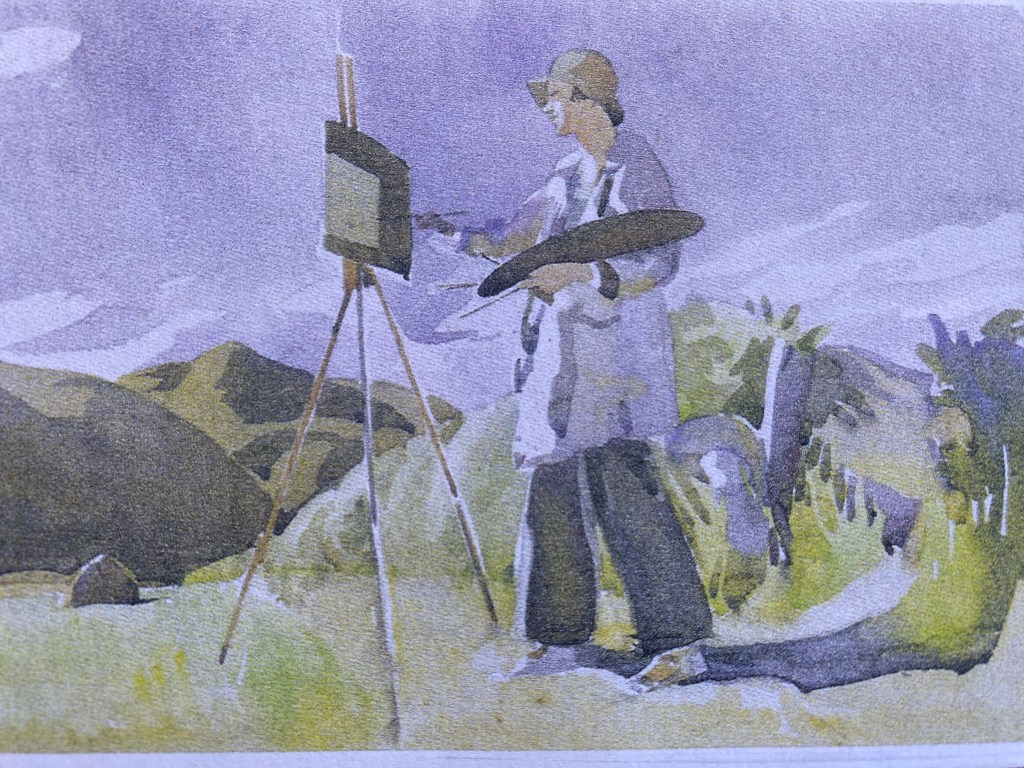
The four session course Women as Creators and Artists at the WEA finished yesterday. I expected an academic approach. The handouts had that, but mostly we had an immersive experience, visiting the Christchurch Art Gallery Te Puna o Waiwhetū across the road and talking about women’s lived experiences.

The course featured the work of New Zealand women artists over time. We were taken into one of the stores behind the scenes of the Gallery to look at the work of various artists involved in the Canterbury Group. Two curators as well as our tutor contributed knowledge and anecdotes about the artists, how they worked together and influenced each other.

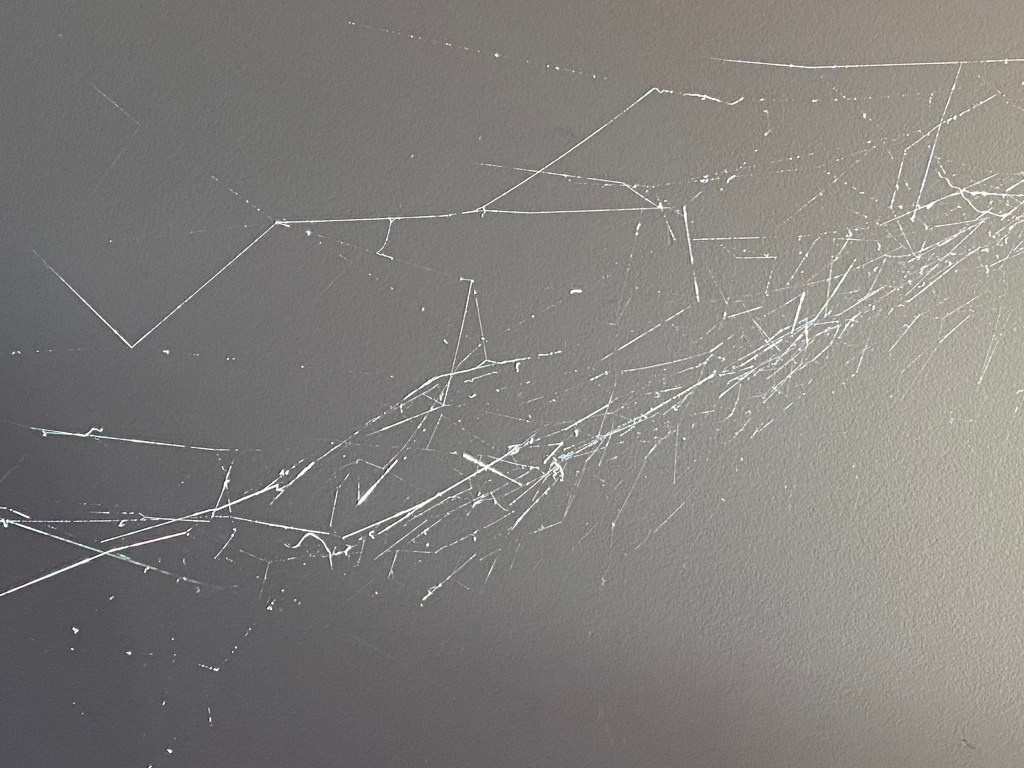
The last two sessions featured current artists. These were notable for their ethnic diversity as well as their approaches to their art. Some of these exhibitions were ones I would have passed by as ‘not my thing’ and I realise I’m a ‘grazer’ of art. The course helped me to look again. One installation featured cat’s cradle-inspired structures in luminous, almost neon, string. Subsequently, when sunlight lit up an intricate spider’s web running from my dressing table to a shelf I thought of that installation and marvelled at the spider’s skill. As soon as the sun moved, the web became invisible.
Yesterday, we looked at women’s contemporary art on the ground floor of the gallery, beginning with a large hooked carpet and seat which depict the Canterbury landscape. Spring is heart-break, a line from an Ursula Bethell (1874-1945) poem, was a theme which artists depicted in a variety of media. Often natural materials were used such as driftwood and kelp. I thought of the driftwood structures people have made on the beach and lakeside I visit.

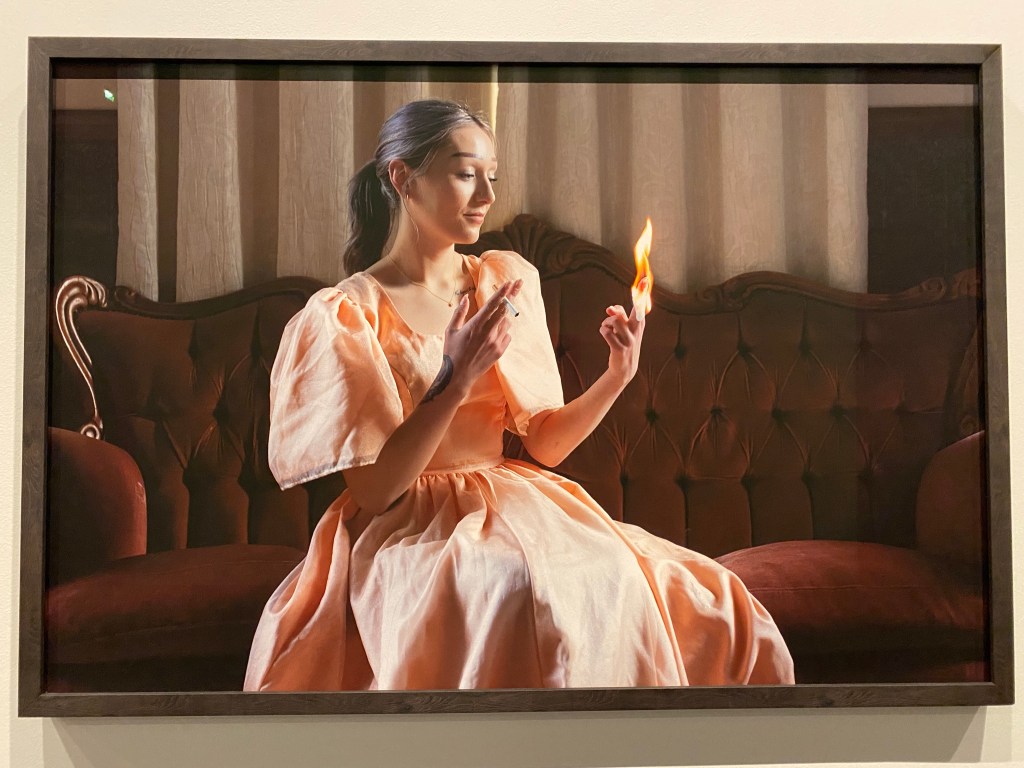
I thought of Mahuika, keeper of fire, who produces fire from her fingernails in the manipulated photograph below. Here, she seems to be about to light her cigarette. Looking more closely, I observed the mis-match (haha) of images – the stiff curtain against a plush replica couch, on which is superimposed the woman with silvered hair and painted thick eyebrows fashionable with young women now, wearing a clumsily-made formal (bridesmaid’s?) 1980s dress. She has a calculating look on her face, and is she making a rude gesture? Revenge is one of the themes of the series of photos of which this is one. Ancient power defying modern expectations of femininity could be one interpretation.
A series of large paintings showed skewed perspectives, nightmarish characters and odd combinations which “signal a desire to create a new, messier world by turning our current one inside out” according to the accompanying notes. I didn’t know how to express that in my own words!
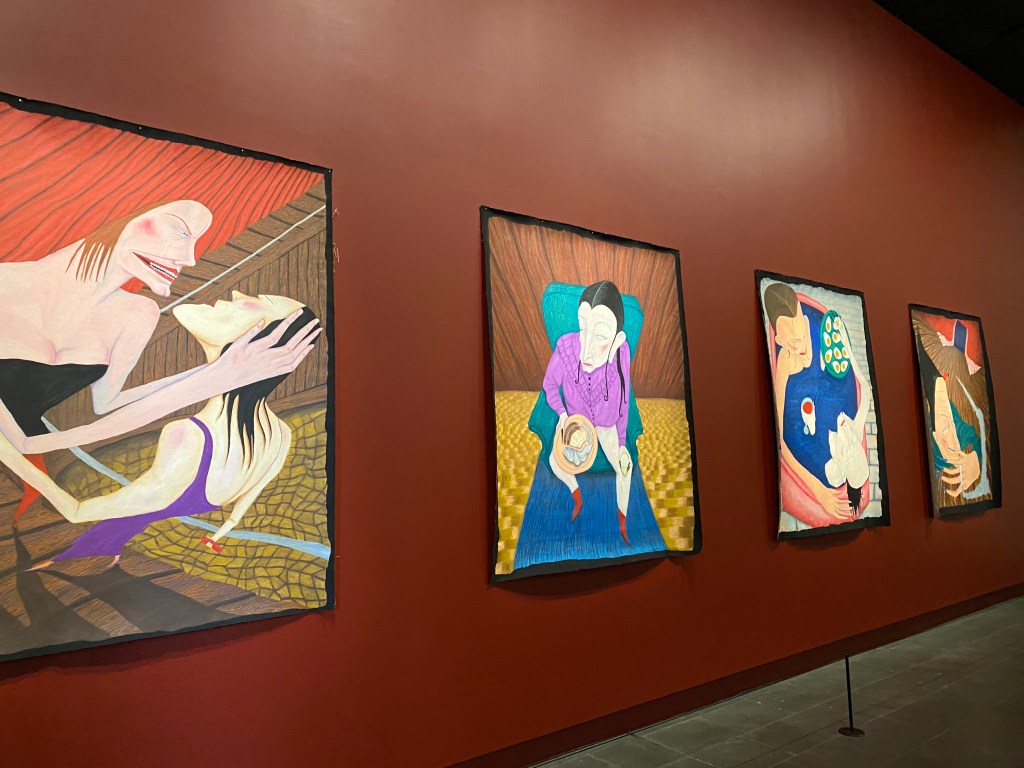
Our tutor encouraged us to volunteer as gallery guides which involves three months of training. She told us that you learn by teaching (as I know) and reminded me of the heading of our first handout: “Art, Looking at, Seeing, Understanding”. Probably, on my own, I would have passed the Priscilla Rose Howe paintings with a bit of a shudder. Now I feel braver to look, see and try to understand.
Our course finished with these statements, which our immersive experience has shown.
Art is a product of its time and place.
By the inclusion of women, art and society has changed dramatically in the last 100 years.
Art, especially for women, is useful.
Our tutor was Diane Swain












 Anne-O-tations