
An appearance by David Mitchell to promote his book on The Graham Norton Show prompted me to order it from the library. It is proving to be an excellent complement to other history books I have been reading and the courses I am attending this term about women leaders in history. I had though Joan of Arc was the first woman to wear armour and go into battle, but it seems Aethelflaed (see fragment of notes in photo below) did that too – and, we now know that Viking women operated as warriors too – not to mention the Amazons. However, this is not the subject of this book which is about the men, mainly, who became kings by various means – not usually pleasant (either the kings or the means). And, he stresses, King Arthur was not real. He was an ideal which none of the kings lived up to, but loved to use for propaganda purposes.

Unruly is a refreshing book to read. Although David Mitchell has an academic background and a life-long interest in history, he is also a comedian with a somewhat cynical and humorous take on human behaviour, getting quite worked up about some of it, as you will know if you have seen him on QI or Would I Lie to You. There are many laugh-out-loud moments in this book.
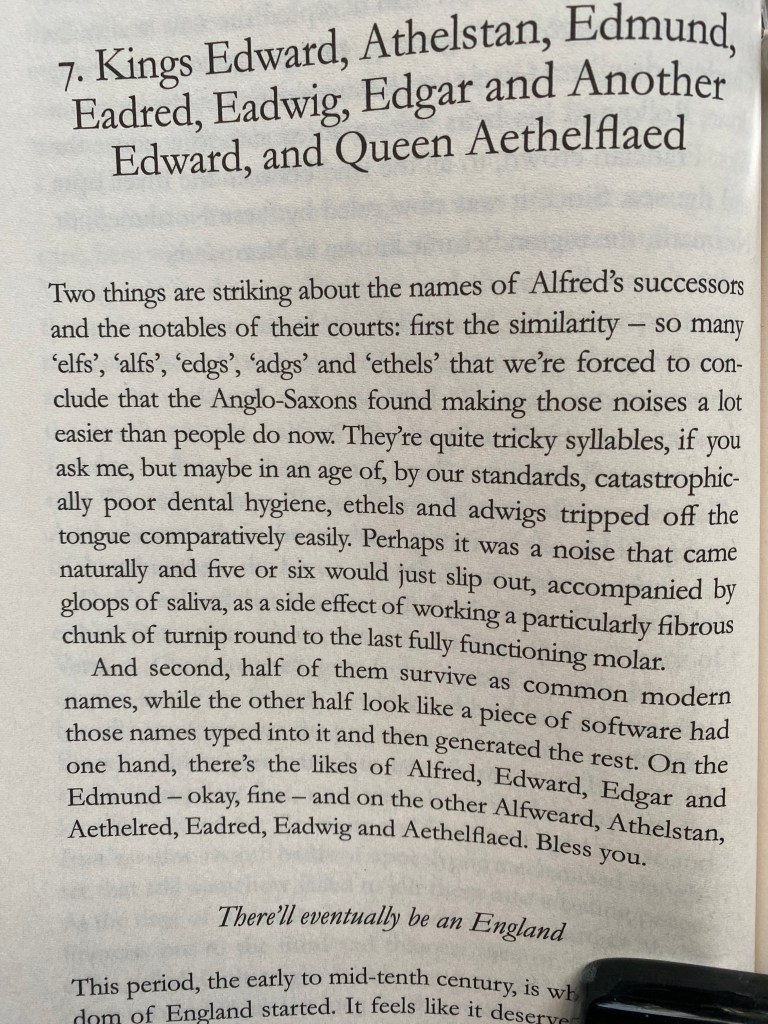
It’s nice of him, I guess, to apologise for the lack of women coming to the forefront in history. Mainly, they are married off (at around the age of 12) to cement alliances with ‘noble’ families or the rulers of other countries. Unruly gives a fuller picture to the books I have read which focussed on women in history such as Femina, Unquiet Women and The Good Wife of Bath. He is blunt and forthright about the men who fought their way to the top, as you might expect from the clever title. Basically, most were a bunch of thugs who wreaked havoc on the lives of ordinary people in their quest for power and domination. The ‘harrying of the north’ is a case in point, where William I (the Conqueror) ‘went around slaughtering people and burning villages, crops and crop stores. The hope was that the area would no longer be able to support the king’s enemies’. This sounds sickeningly similar to the headlines in the news this morning. I really do get the sense from all this that human nature has not changed one bit. It’s kind of nice, in a perverse way, to learn that William the Conqueror eventually exploded. You’ll have fun finding out how if you read the book.

As you can see, the author is happy to refer to himself and to make parallels with modern times – a refreshing change from more ‘academic’ writing. However, like these serious tomes, it has coloured plates, an index, and a list of further reading. In the Acknowledgements he says his intention is to produce ‘a history book that aims to be funny but not spoof, irreverent but not trivial’. He has achieved that.



 Anne-O-tations