
It was midday when I walked out of Groovy Glasses where I’d had a thorough eye examination and had ordered new lenses and frames. I was thinking of lunch. Directly opposite was the Belgian Waffle Haus.

The berry waffle, with added cookies and cream icecream, was huge. I prepared to take it slowly while enjoying the view out onto New Regent Street and the trams trundling past.
I considered the coincidence that my favourite glasses designer, Theo (pronounced tay-oh), is Belgian. My prescription sunglasses and everyday glasses are Theo, and the new ones are Theo.
Then I noticed the visual display on the wall opposite. Tintin featured, and surrealist art which apparently had its start in Belgium.

I made a valiant effort, but didn’t finish the waffle. I tried to work it off a bit by climbing the stairs to the fiction section on the fourth level at Tūranga but, by the second level, digestion and climbing seemed to be in conflict and I took the lift.
I managed the thirty minute walk home, however, and looked about for other Belgian connections. There is my Tintin collection. And Hercule Poirot. That he is Belgian was a deliberate choice by Agatha Christie. His off-sider, the bumbling and rather dim Hastings, is an Englishman. This was a deliberate reversal by the subversive Christie. Hercule Poirot is not your normal hero, not a Hercules at all, but rather pear-shaped (une poir), and interested in the psychological motives of his suspects. He is sniffy about being mistaken for a frenchman.
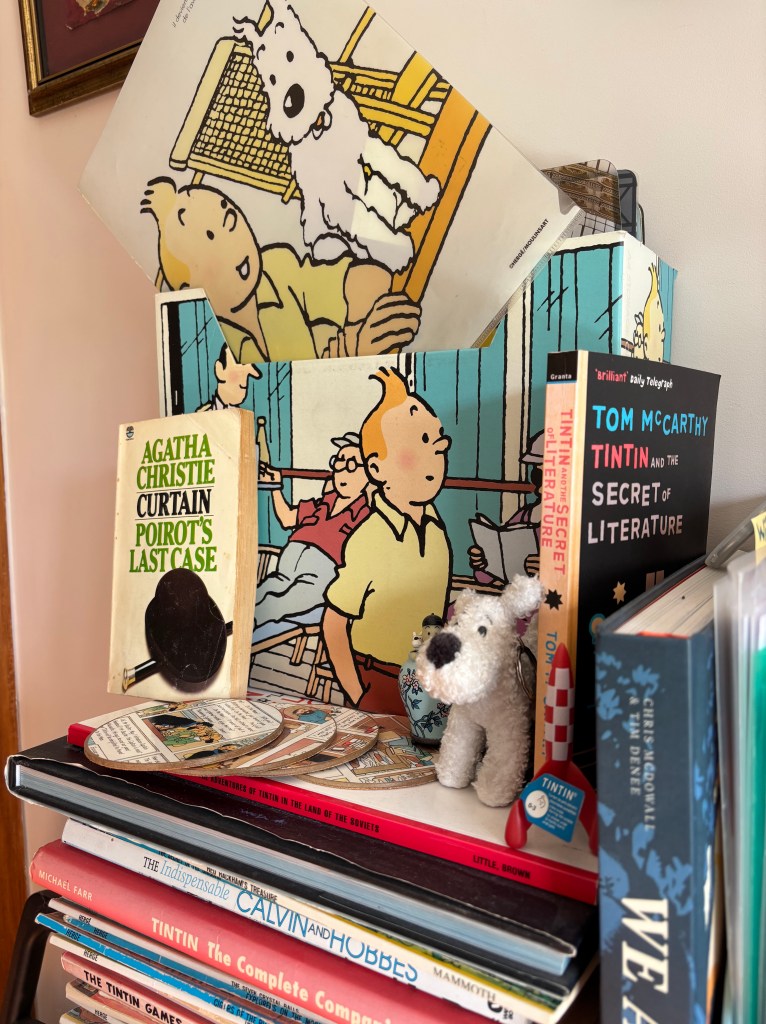
While it’s hard to put aside the gruesome colonial history of the Belgian Congo – particularly when colonial attitudes are evident in Tintin books – Belgium may have redeemed itself as headquarters of the European Union and participation in the International Criminal Court. Its national dish is Moules Frites (yum) and it’s well-known for waffles (hmm…) and chocolate. Other Belgian innovations include Art Nouveau, the Smurfs, the longest tram line in the world, and the saxophone. For me, Theo comes out on top.

Or chocolate …
 Anne-O-tations