The city after dark is a delight of lights. From the Carols by Candlelight in Victoria Square and the passing restaurant tram, to Te Pae, Cathedral Square, Ballantynes Christmas window displays and the bustling Terrace, we were charmed and uplifted by the sights and lights. Two cones placed over uplights by the Town Hall glowed luminous red-orange.
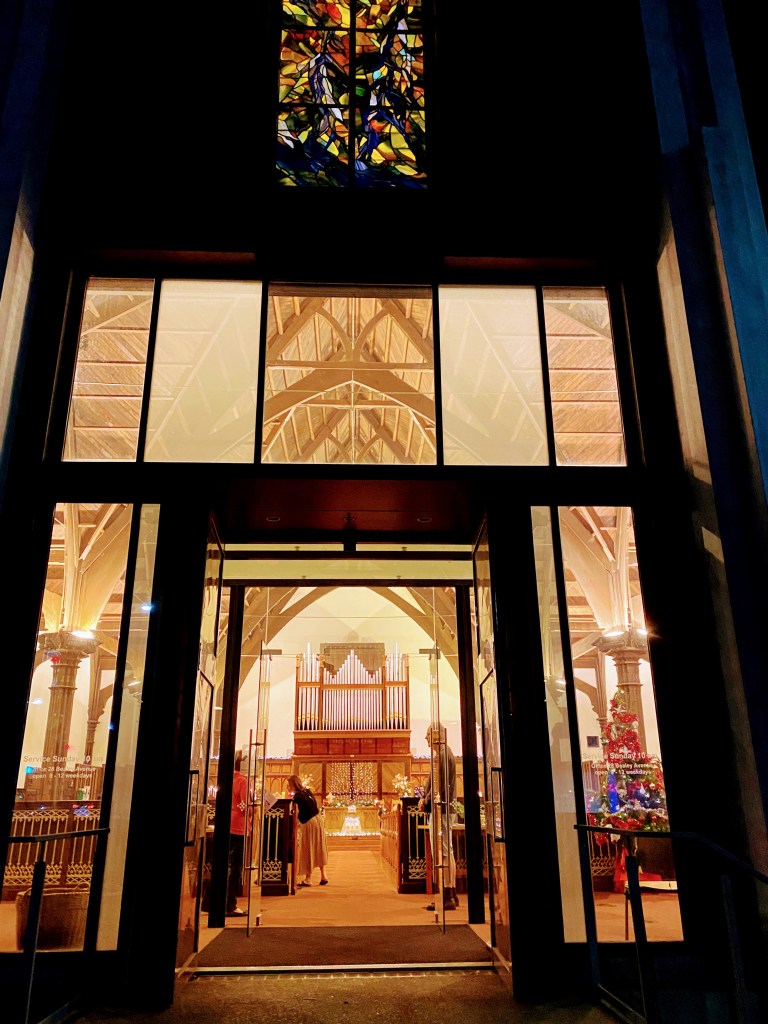
Knox Church, lit up for the Christmas Eve midnight service, looked wonderful.
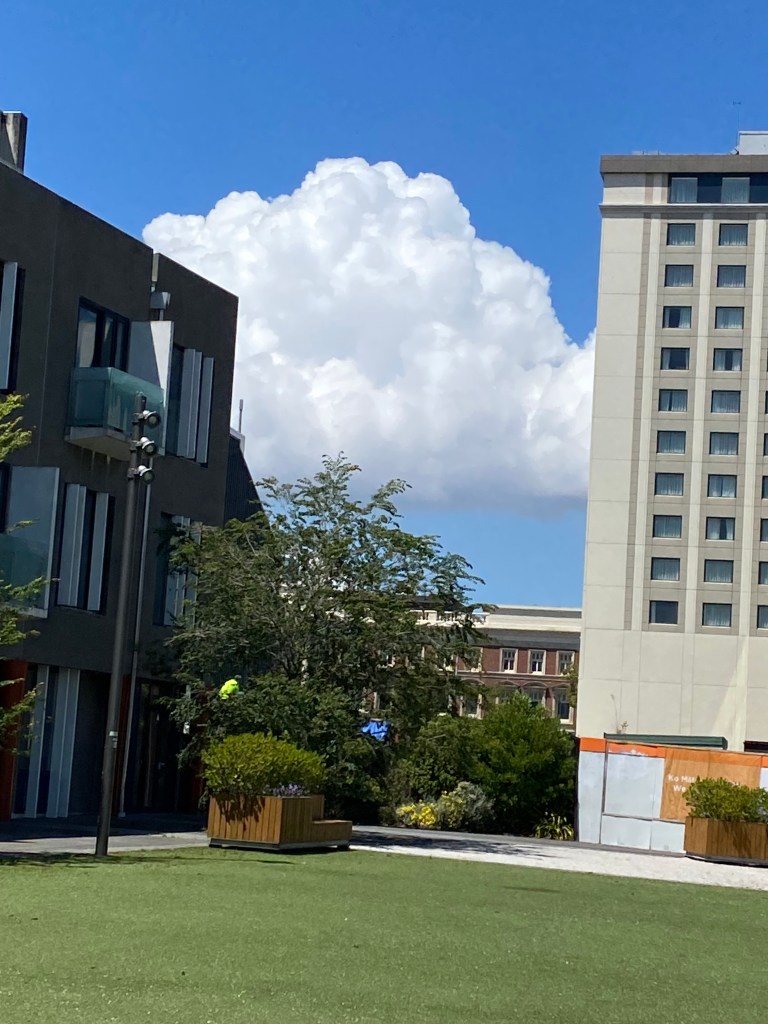
Contrasting with the hard surfaces of metal, concrete and glass, this beautiful fluffy cloud against cerulean sky stopped me in my tracks today.
At the end of New Regent Street looking toward the Port Hills
From where my bike was parked, a street over, I could see the flat base of the cloud – as you might draw a fluffy cloud – but you would have to be expert to capture its shapes and shadows.
From Armagh Street
Cumulus – known as fair-weather clouds because they usually indicate fair, dry conditions. If there is precipitation, it is light. The clouds have a flattish base with rounded stacks or puffs on top. When the puffs look like cauliflower heads they’re called cumulus congestus or towering cumulus. They can get very high.
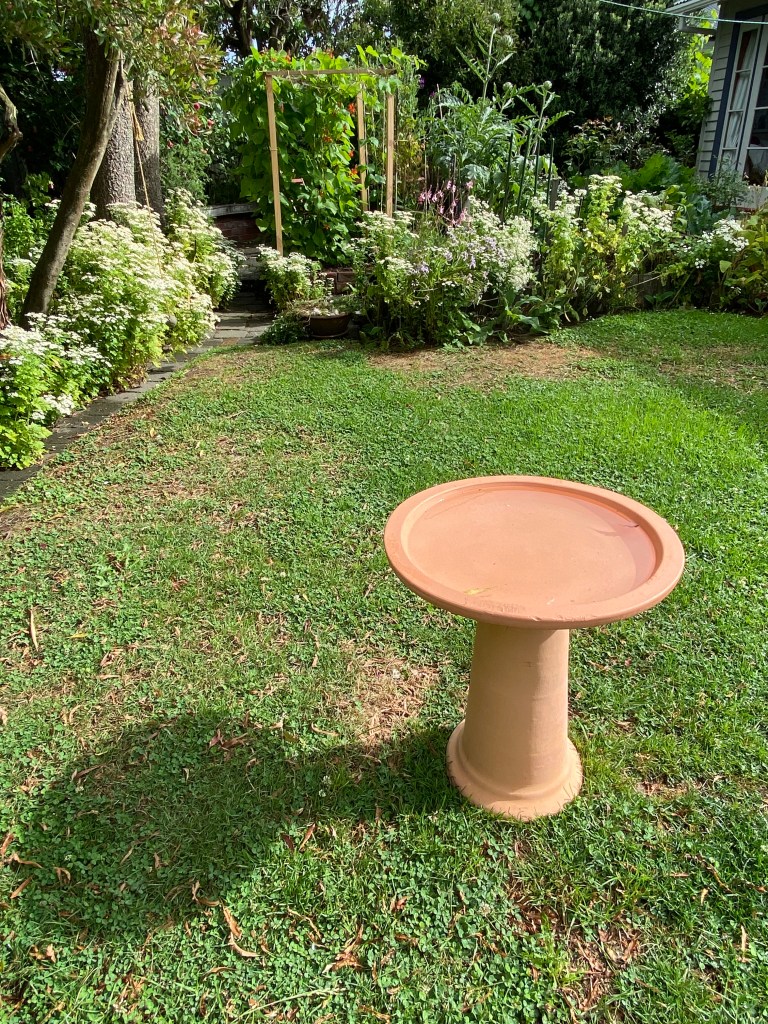
Birds should be able to see any danger (aka Felix) approaching from this fine birdbath. It is an inspired Christmas present to Mum from a loving grandchild.
Mum’s always been the maestro pavlova maker in the family. This year, she struggled to find the recipe and to remember how she made it. She eventually tracked down the old recipe book with the recipe written in careful capitals. There was no complete method however, but I remembered my sister saying that our brother, who makes an excellent pavlova, adds the sugar at one minute intervals. And so it fell to a rather nervous me to make the pavlova for a family early Christmas dinner today.
Plenty of time for a selfie during the one-minute intervalsFresh out of the oven
The secret of a good pavlova is to beat it for so long it has no choice but to stand up. It collapses a bit as it cools, but that is easily covered with whipped cream and strawberries. I forgot to take a photo of the end result, but it passed the test at the dinner, thankfully.
The Sunday sky beyond is about to turn pink with a dramatic sunset and, to the east, a rainbow appeared.
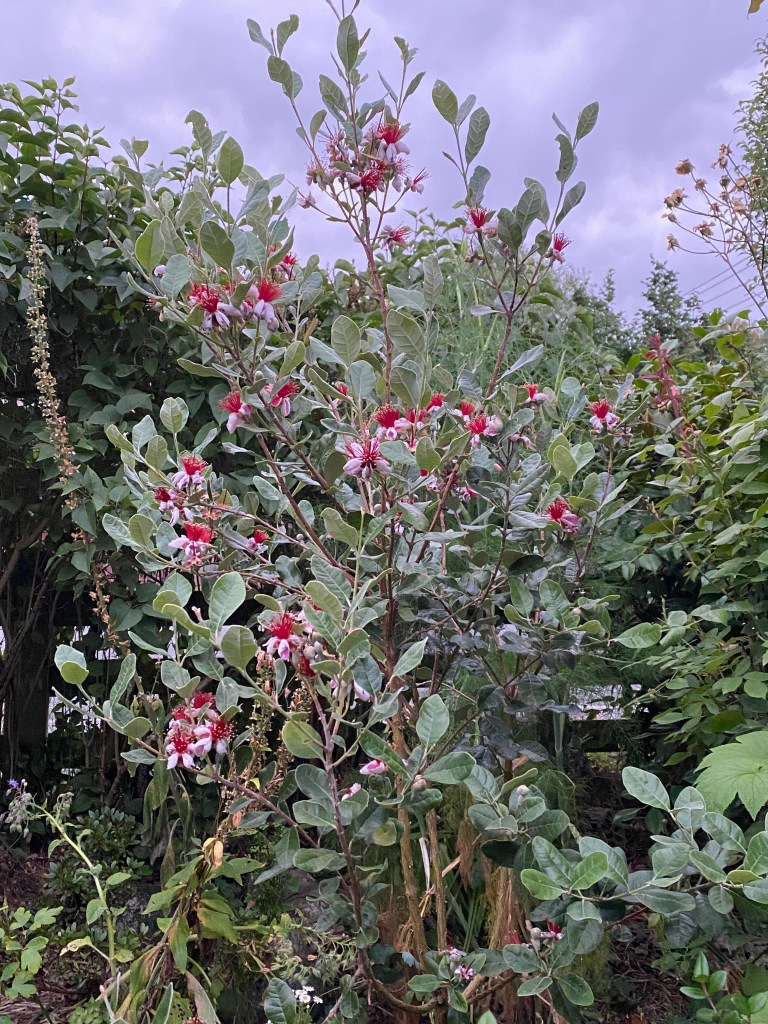
The feijoa tree is covered in flowers this year. As we put the Christmas tree (exotic pine) inside the house on Sunday, we looked out and said, ‘There’s a real one!’* It is native to South America and is of the myrtle species, so related to the pōhutukawa aka the Aotearoa/New Zealand Christmas tree (beautiful pictures and the full story on this link).
I have a New Zealand myrtle in the garden. It is covered with fluffy white flowers at Christmas time, which prompted me to post about it last year (Christmas Trees, 8 Dec 2023 – also A White Christmas 14 Dec 2021). The Southern rata, another myrtle, was in flower when I was in the Botanic Gardens the Sunday before last.
Feijoas are very popular in New Zealand, and Kate Evans has written a book about them.
Here’s a close up of the pretty flowers which make the feijoa a self-decorating Xmas tree.
Myrtle rust is a problem for myrtles, so let’s hope it doesn’t become the grinch for future Christmases.
*My sister and brother-in-law, who gave us the inside Christmas tree also gave us the feijoa tree.
My sister and brother-in-law kindly delivered a Christmas tree for us this afternoon. ‘Just a wee one,’ was my request, which turned out well as it seems to suit our tiny decorations. The tough little tree is able to hold heavier ones too, such as the angel on top.
Mum gets the decorations out of the bag
There are dangling decorations at the bottom to interest Felix, and plenty at eye level for little folk to see.
We’ll enjoy it even more as it gets dark. And it smells wonderful.
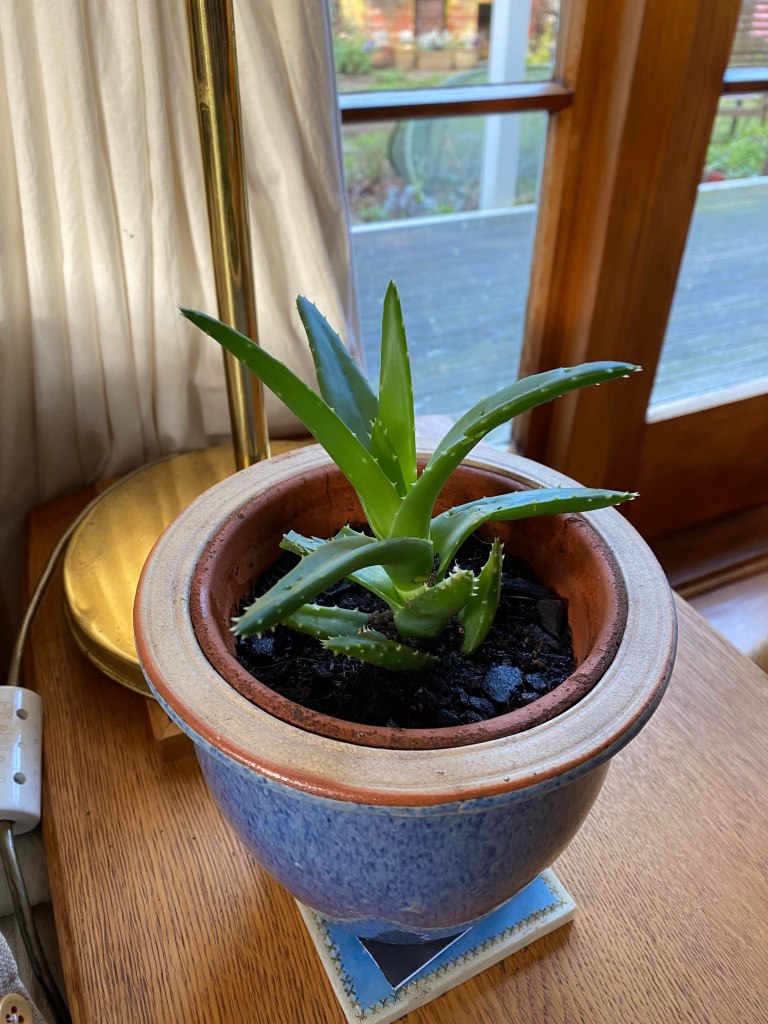
Some people talk to their plants. Greeting my aloe vera has become a habit.
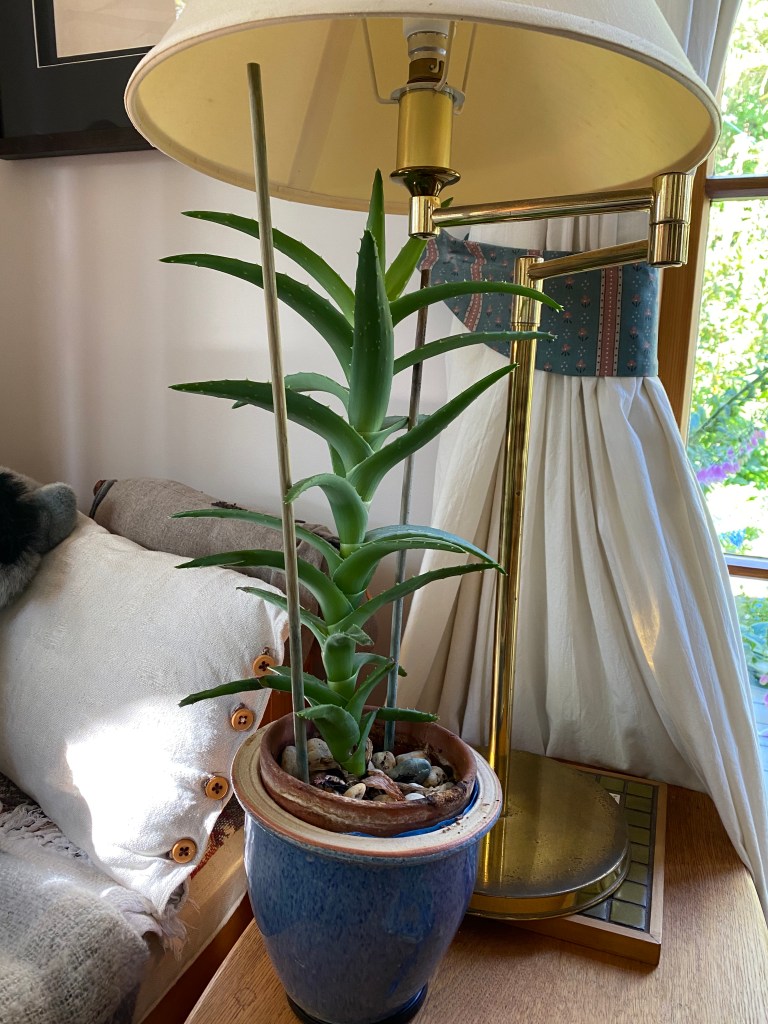
I was given the plant three Christmases ago when it was very small. A visiting puppy dragged it out of its pot and chewed it, but it seemed to recover well when repotted. Since then, it has grown so tall that it was disappearing under the lamp shade beside it. It needs stakes to stop it from keeling over. I found out that aloes can grow tall searching for light (even a light bulb?!).
Post puppy attack July 2022August 2023November 2024
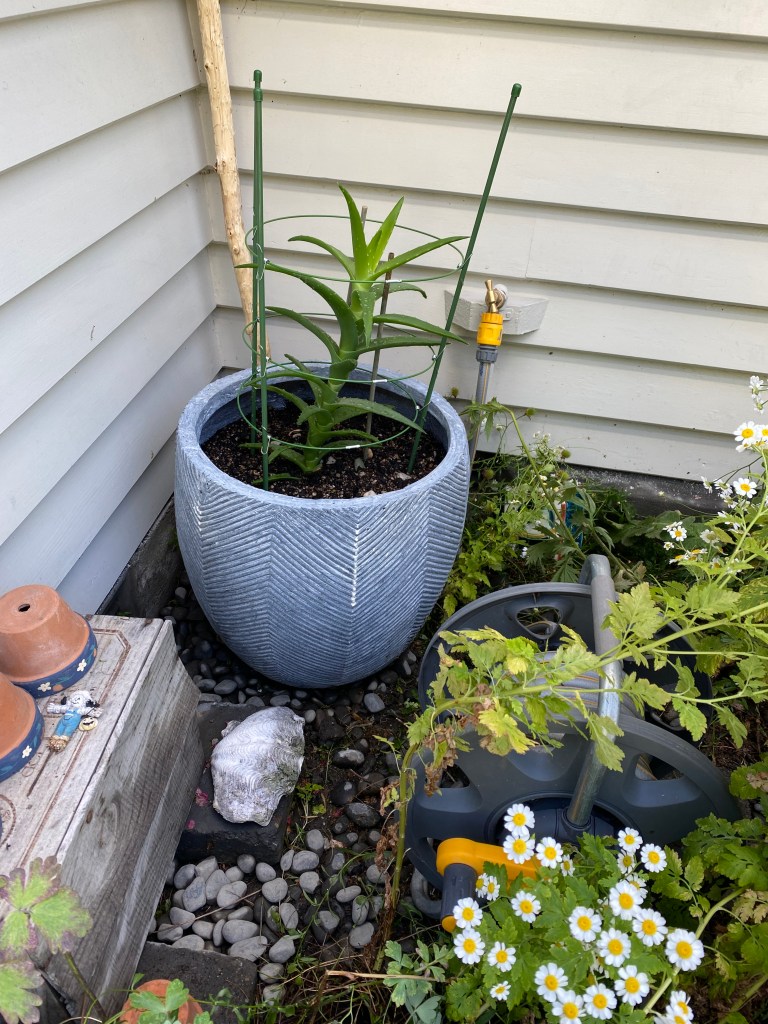
This week I found a suitable outdoor pot for it (50% off, thank you, Mitre 10). I had planned to put it beside the yucca on the driveway, but having read that aloes are frost tender, I opted to put it under the glass roof. There, it will get full sun most of the day and shelter in winter.
After planting yesterdayThis morning, in the sun.
The root ball is tiny, so this larger pot will give it room to grow, I hope*. It still needs support, but perhaps it will bulk out before long, otherwise the solution may be to cut it shorter and repot the cut piece. However, I don’t want to end up with a forest of aloe veras – then it’ll be, “‘Allo, ‘allo, ‘allo”.
The broad beans have finished and new plants are in the garden. I’m using the four stage rotation system and planted a tomato plant and a green zucchini where the beans were, and dwarf beans where the silver beet was. Beyond them, you can see how much the runner beans have grown since I posted about the bean frame recently (Old school tools, 9 Nov). The artichoke (on the left in the photo) takes up a lot of room in the garden but it is sculptural and interesting, even if I have found the artichokes pretty much inedible (Artichoke, anyone? 29 Dec 2020) or, at least, not worth the effort.
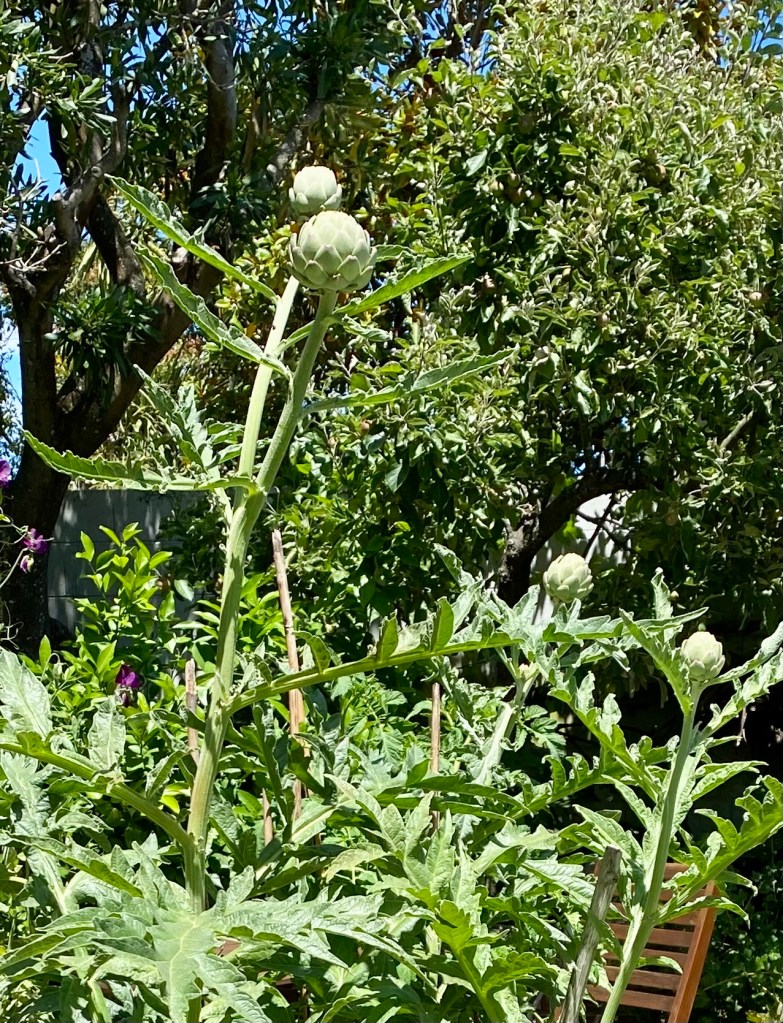
Artichokes are forming on the plants now and give the impression of bobble-headed stick figures throwing their arms upward as they ‘dance’ in the breeze. I’ve posted about their antics before (Wind-ravaged 21 Dec, 2021).
Having this anthropomorphic view in my subconscious, I was interested to see the artichoke had leaned across with one of its leaves as if to shade the zucchini plant from the sun. When the sun moved off that part of the garden, the leaf lifted up again.
A photo in a magazine shows sweet peas growing on a greenhouse frame. This gave me inspiration. The greenhouse I put together in September 2020 had lost most of its plastic sheeting which I’d replaced with shade cloth. The lettuces I tried to grow in it this year were ravaged by white fly.
After seeing the photo, I ripped out the last of the plastic (now washed and ready for soft plastic recycling) and removed the shade cloth. I’ve planted dwarf sweet peas in the relined, replenished hanging basket, tall sweet peas in the black bucket and alyssum – to ward off white fly – in the other planter. A bit of old trellis softens the harshness of the iron fence a little. I doubt if I’ll achieve the lushness of the magazine photo with this dry, hot weather, but here’s hoping for some flowers.
................... for lovers of ice cream. Your free on line magazine for sweet frozen treats. Recipes, inspiration, artisanal ideas for your delectation.













 Anne-O-tations