Such a beautiful dog could hardly be scary, you’d think. Felix didn’t agree when he encountered Mia in our house yesterday. They looked at each other for a split second before, with impressive acceleration from a standing start, Felix took off with Mia in pursuit – and us in pursuit of Mia.
Felix did a lap of the inside of the house at high velocity, executed an impressive wall-of-death arc across the bay window curtains, took a straight line through the kitchen and shot through his cat door barely touching the sides.
Mia was banished to my brother’s car.
Felix remained outside on a cold frosty night, the half-moon bright against the dark sky. Four hours later he crept cautiously through his cat door for cuddles, food (with treats) and a warm fireside armchair.
Felix’s food supply was getting low. He is 9 months old – does he still need kitten food? The vet nurse suggests that it is time to move up to ‘big boy biscuits’. The idea is to mix the two foods to help the transition. If he doesn’t like the new food, I can take the bag back.
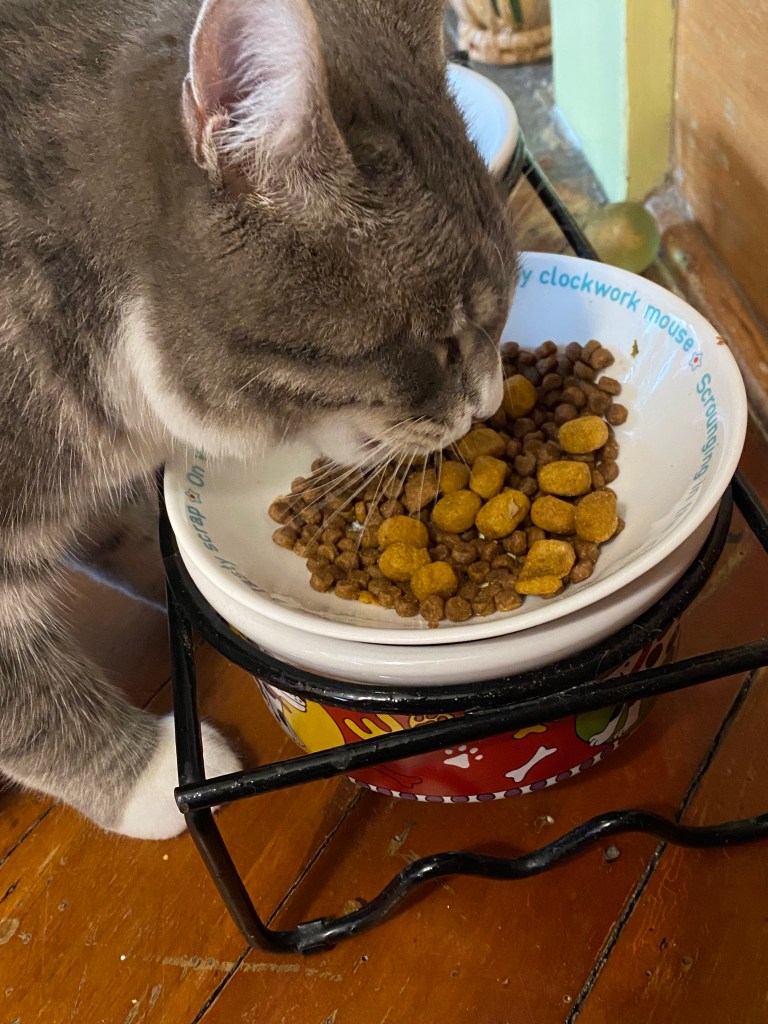
The big boy biscuits are large and are good for his teeth, apparently. Will his little teeth manage these big biscuits? Well, he likes his new food so much nothing else will do. The kitten biscuits remain while he picks out the new food.
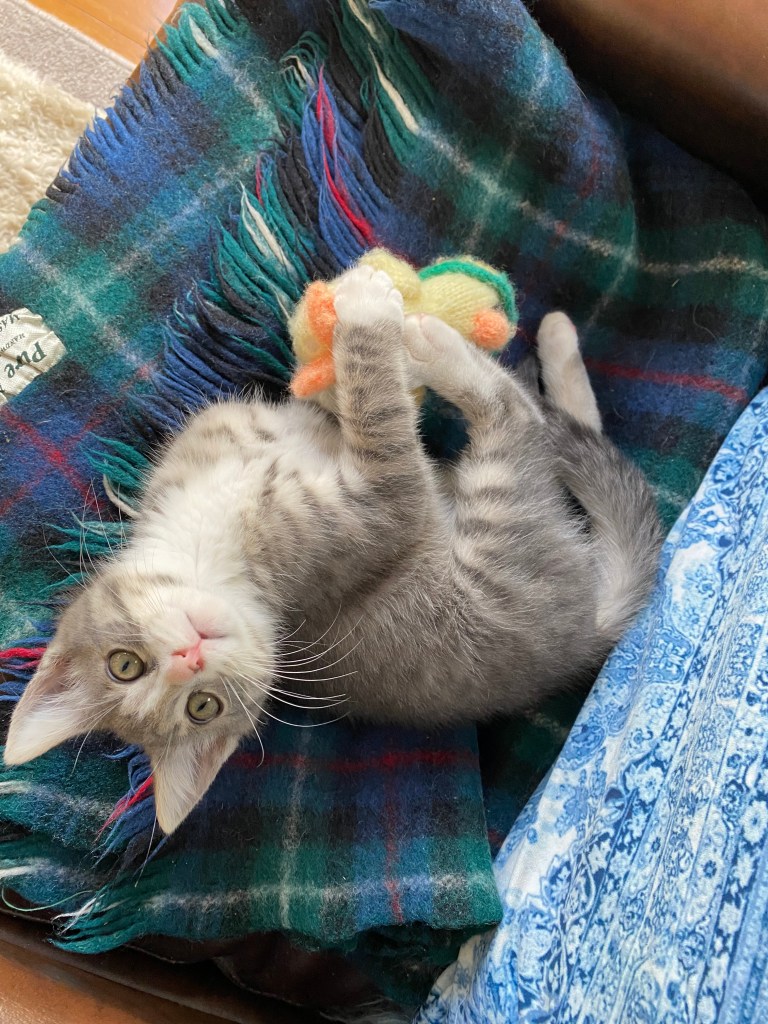
Being a big boy could explain the mysterious disappearance of his knitted duck. It’s time to put aside kittenish things. He’ll be getting more attention as an ‘only child’. Already, I can see that he is indeed a big boy. He overflows Mum’s lap.
Felix in JanuaryFelix in JulyFelix sleeping like an Egyptian – and taking up all of the chair.
With a mix of sadness and relief, I can announce that the last of my flock has died. Poor old Vera was clearly ailing in the last few days. The chicken run is now empty of life; just an empty nesting box and empty henhouse (except, perhaps, for Felix) and a chicken wire fence keeping nothing in.
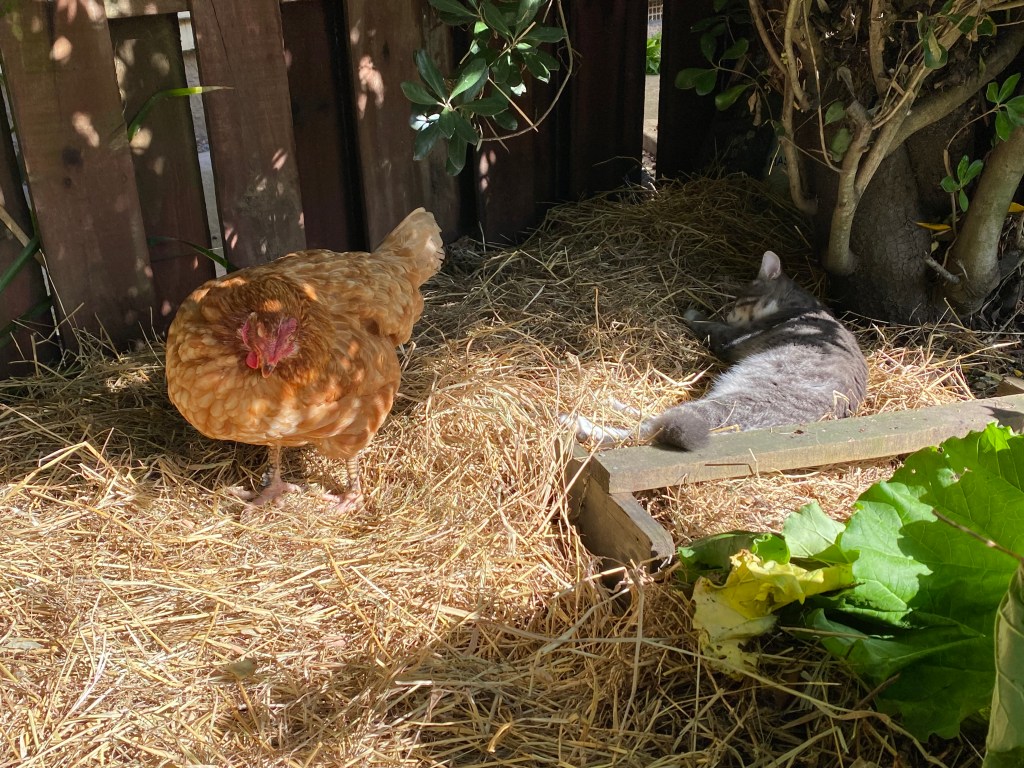
The last photo I have of Vera is the one above when, on a miserable, grey, drizzly day, she sheltered in the henhouse with her good friend, Felix, keeping her company. She stayed there all day and made no effort to go to her usual bed when it grew dark, so I let her be, knowing she had clean dry hay to lie on. The next day (Monday) she shuffled into the far corner, so I knew she wouldn’t welcome any of my ministrations, nor was she interested in the food or water nearby. This morning it was clear that she had died.
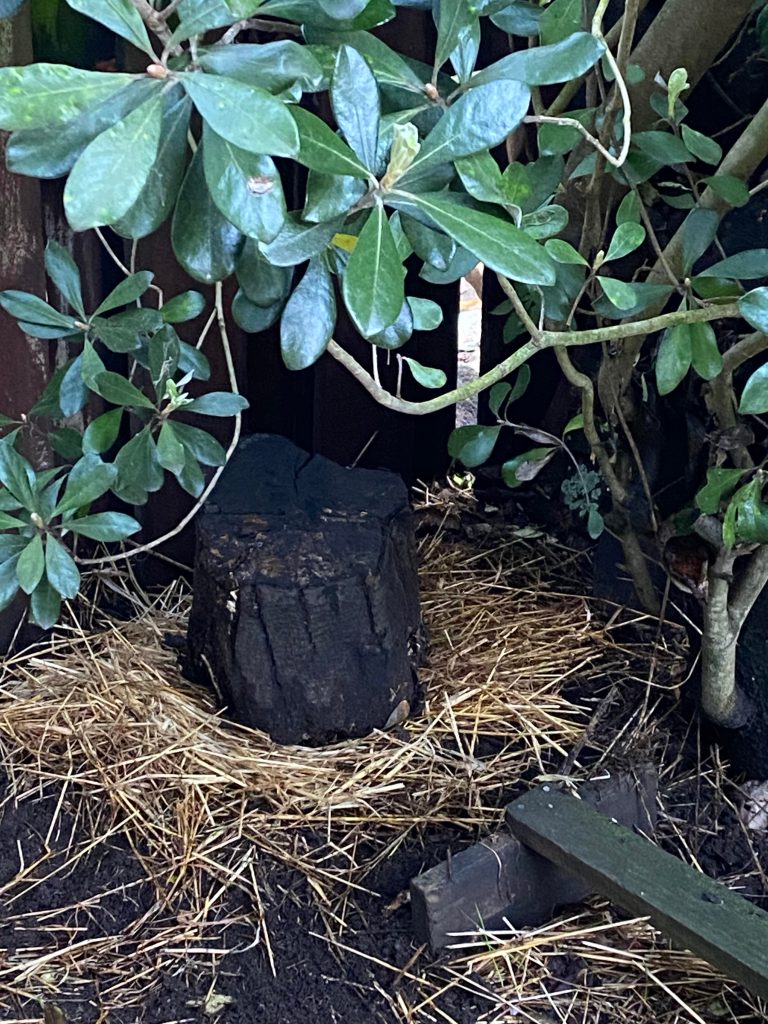
She is buried under the karo tree where she spent a lot of time in the sun or just hunkered down in what I called ‘the chicken lounge’.
Vera’s graveSunnier days under the karo tree – April 2023
The chicken poop scoop, bucket and brush have been retired. The bags of peck-and-lay and meal worms, the neem oil for her feet, the bags of straw and sawdust, are no longer needed. There are no plans to re-stock.
The chicken run is now haunted by the clucky spirits of Betty I and Betty II, Dora (the explorer), Popcorn, Mabel and Vera.
Vera in foreground – the lowest in the pecking order (hence the missing feathers), yet the longest to survive.
There’s quite a collection of books about Katherine Mansfield on the bottom shelf of one of my bookcases. S0me of them I haven’t read yet – and wonder if I will. When I read Claire Harman’s book All Sorts of Lives recently, I realised how limited my knowledge of ‘our’ famous writer is, and promptly followed it with Katherine Mansfield’s Europe by Redmer Yska. I learnt that Mansfield smoked constantly, was probably addicted to morphine, had indeed ‘gone every sort of hog’ as Virginia Woolf commented, lived beside the Seine during WWI and endured Zeppelin bombing raids, and is now a celebrated writer in France. And in other parts of the world, too, according to the back cover of the Collected Poems.
It seems people keep writing about KM whether from academic or personal or journalistic perspectives. In the last week, I’ve read two reviews of KM’s Europe in the digital newsletter ReadingRoom. The first was very thorough and academic as you’d expect from C.K. Stead. The second is a more personal response, by Miro Bilbrough, who finds KM relatable for her inability to be careful of herself. Ali Smith wrote about a woman obsessed by Mansfield in her story ‘The ex-wife’ (in Public Library and other stories). When Ashleigh Young became director of the Katherine Mansfield Birthplace people commented on her likeness to Mansfield. The volunteers and other staff were pretty much obsessed with KM and seem, in Young’s essay ‘Katherine Would Approve’ (in Can You Tolerate This?), distinctly unhinged. At the end of her time as Director, Young concludes that she probably would not much like Mansfield if she met her and is somewhat appalled to find she is going off her stories as well.
Katherine Mansfield was obsessed by her own writing, as she would have to be to have completed so much work (not to mention the letters and journals – plus reviews for literary magazines) in her short life. She needed to publish to earn a living, but she was also aware that her TB, complicated by venereal disease and a history of childhood respiratory illness, was going to finish her off before long. She seemed unaware that smoking was not helping to prolong her life.
I am neither obsessed nor indifferent to Mansfield. Redmer Yska’s earlier journalistic work, A Strange Beautiful Excitement about KM’s Wellington childhood which I finished reading this week, has added yet more depth to my understanding. I will dip into her stories now and again and continue to find them fascinating.
These cold rainy days are perfect for reading by the fire. Today I braved the cold and walked to the library to return six books which I had finished and walked home with five more. Before I begin those, however, I have started a book about Katherine Mansfield’s childhood. It’s a hard cover book with lots of illustrations and a ribbon. No map at the front but there’s a watercolour painting of Wellington Harbour 1894 on the end papers. The Matariki book in the photo beside the library books is perfect to read at this time of year because it is Matariki. Mānawatia a Matariki! (Celebrate Matariki, the Māori New Year.) Each day is getting longer. Soon I’ll be back out in the garden and probably not reading as much.
The library was full of children and was a joyous place to be. Moreover, I ran into a woman from my watercolour painting class and we sat and talked over coffee in the Foundation cafe.
What kept a grin on my face all afternoon, and even now, was something which happened before I left home. I had soup and toast by the fire which I put aside to sweep up some firewood detritus from the carpet. I put my soup on the hearth and my plate of toast on my chair and yes, you guessed it, forgot it was there and sat on it. There was a corduroy pattern in the butter. Can’t think why I find it so funny.
It’s July. Winter Solstice was last week. Matariki is next week. Now is the time we get the coldest weather. There have been cold nights and the lime trees have frost-protection covers on.
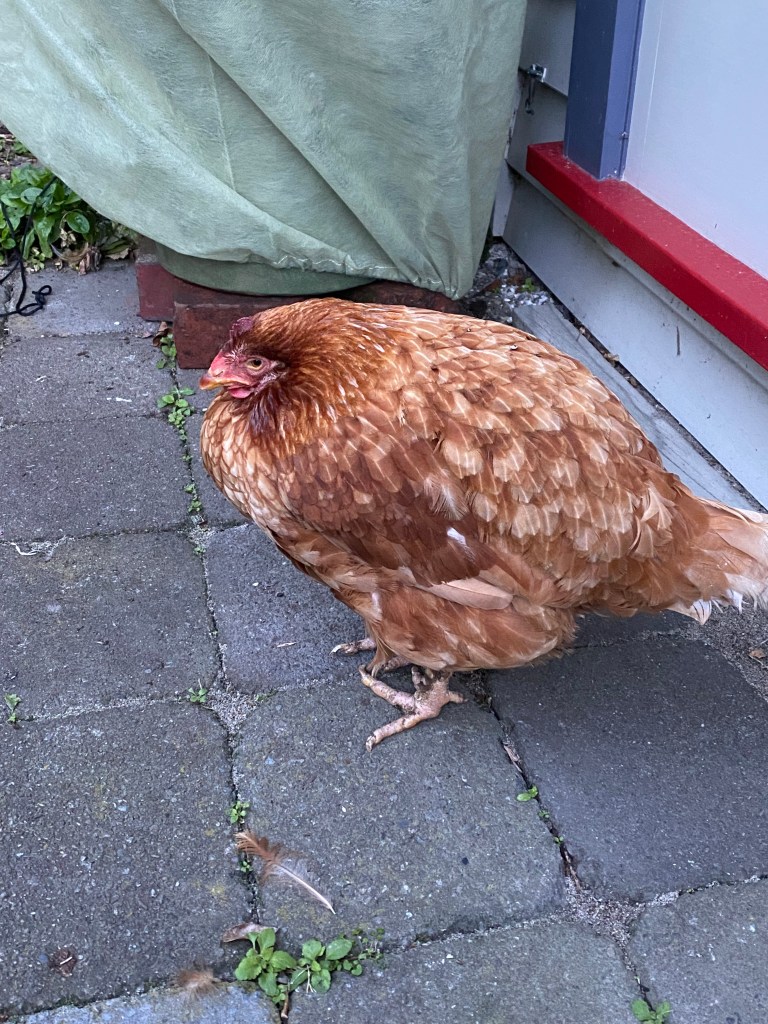
Vera wasn’t keen to get up this morning, but she found sunny spots to spend the morning and afternoon. This evening, she had her feathers fluffed up against the cold wind. There is fresh, dry straw in her house to keep her warm at night. She’s old. Her comb has all but disappeared.
Felix doesn’t seem bothered by the cold. He’s been out keeping Vera company, scaring the sparrows away from her food and doing some exploring of his own.
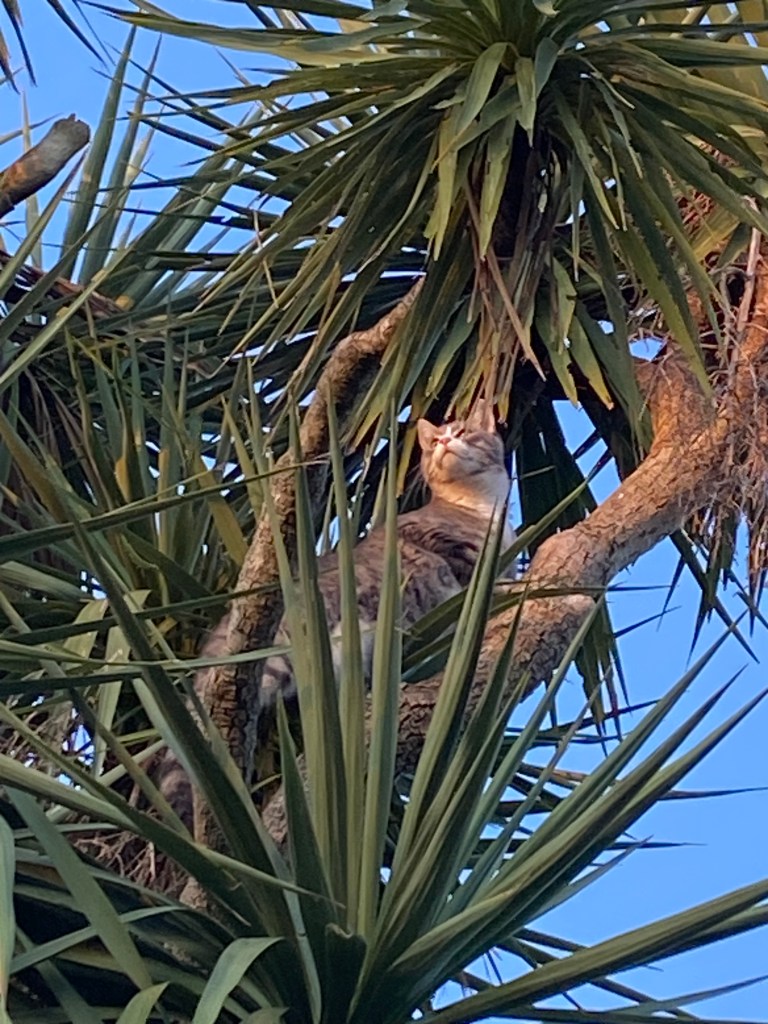
As the light began to fade, he had a burst of energy which took him to the top of a tī kōuka where he looked into the distance with the sunset lighting his face.
Now it is dark. Vera is in her bed, the fire is on and the curtains are drawn. Felix just popped inside for some food and promptly went out again. The light of the full moon is shining through his cat door and across the floor.
Having a fruitful lemon tree is sublime and the thought of having a fruitful lime tree even more so. It has the special taste important to a margarita and a mojito. Unfortunately, my lime tree is looking decidedly subpar. It was planted in 2019 when the vegetable garden was extended into the lawn. I carefully removed any fruit for the first year to let the roots establish. In subsequent years, it has never had more than six limes and it has remained small.
This year, there were quite a few limes but they began to drop off when quite small. Then the leaves began to turn yellow and to drop. I had fed it as usual, so gave it epsom salts as a boost, but it did not improve. The garden centre people thought it might have been over-watered. That’s possible, as I often tossed a bucket of water on it after cleaning up after the chooks and water from the garden sprinkler does tend to run down into that corner. We have also had a lot of rain.
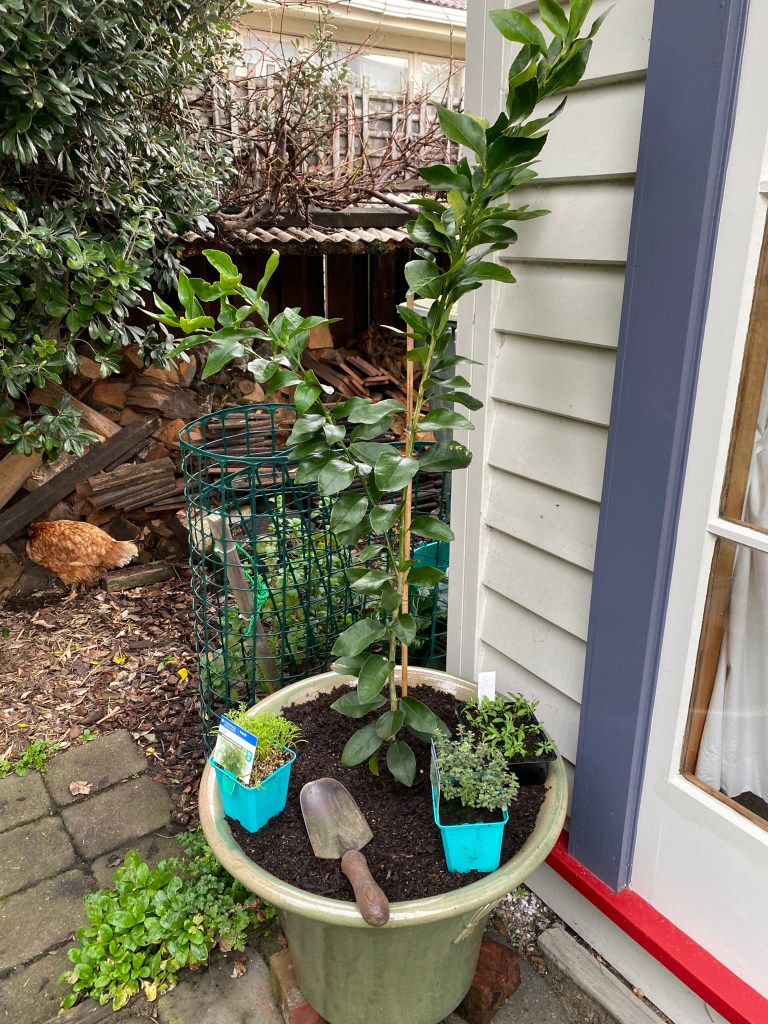
On Friday, I called in at a very nice garden centre – just to look – and came away with a new lime tree, a large pot (half price) and potting mix. I put stones and bark at the bottom of the pot to ensure good drainage. My thinking is that a pot might prove more successful. I also dug up the old lime tree, made a new hole, filled it with stones for drainage, then potting mix and replanted it just in case it might recover.
Today, I bought some companion plants and put them around the new lime tree in its pot. There’s alyssum, silver thyme and dill. It looks sublime. Fingers crossed.
It’s like being a kid again, coming home from the library with an armful of books. All of these are by authors I’ve been following. Some are the latest in a series.
Privilege in Perpetuity is perhaps the odd one out. It is one of the small texts I have been reading published by Bridget Williams Books. Fragments of a Disputed Past by Joanna Kidman et al, The Inequality Debate by Max Rushbrook, and Marilyn Waring’s Still Counting (which I read twice in the last two weeks) are some of these. All are about issues affecting New Zealand society.
Behind these choices of books is my decision to stop attending our new-format book group. Instead of an enjoyable meeting of friends to discuss literary fiction and non fiction, the hosting bookshop has turned it into a ticketed event which, after attending three times, I find has lost its spark.
Now it’s time to read for sheer enjoyment. Which isn’t to say you don’t learn something worthwhile from ‘lighter’ fiction, such as the Richard Osman Thursday Murder Club series. The author seems to have found his stride in the third book which I have just finished reading. The characters are sympathetically drawn and given a voice through the alternating points of view. Various levels of criminal offending and moral choices are ‘played with’ but never heavy-handed and there’s plenty of humour to entertain the reader.
Some books just let you be a passive reader and I don’t enjoy those very much – but, for sure, they have their place – balm for the troubled soul as Stephen Fry described the books of P.G. Wodehouse. On the other hand, books from which you learn about a culture or a time in history or consider a different experience or philosophy, invite you to be an active reader.
Janet Evanovich’s Stephanie Plum series plunges you into suburban New Jersey and reminds me of my social anthropology studies at university. Yes, I know she’s a popular fiction machine, but there’s a good reason for her popularity. It’s fun. The ancient Roman settings of the books of classics scholar Lindsey Davis are better than a time machine – everything is translated for one thing! Vaseem Khan’s Malabar House historic fiction series also takes you to a different place and time and, like Sujata Massey’s Indian books, into the lives of Zoroastrian Parsi, who first migrated from Persia around the 8th century. Graham Norton’s intense interest in people is clear on his television show and is very much present and enjoyable in his fiction. I’ve written about Denise Mina’s book Conviction in a recent post and I’m looking forward to another edge-of-the-seat adventure in Confidence. Deanna Raybourn’s Victorian series featuring detective Veronica Speedwell has entertained me from time to time, but Killers of a Certain Age is a one-off about four retired hit-women who get together to save their own lives when the tables are turned.
So, which book to read first? I can’t wait to get started!
Somehow, I felt compelled to buy this pillow case yesterday. Why was that?
I heard someone explain once that the ‘dominion’ given to humans over animals after we were expelled from the garden of Eden was mistranslated. It should be ‘guardianship’. Well, we know that now to our cost.
Guardianship is how I see my part in Felix’s life. I’ve not managed to keep him inside for the first 10 months, as the vet advised. I haven’t even kept him inside at night. Consequently, I had a sleepless night when I couldn’t locate him after hearing a fight-to-the-death cat fight in the distance.
I suspect he was a spectator rather than a participant, as he appeared in the morning, unscathed.
He brought a mouse into the house on Thursday night and proceeded to lose it under my bed. I opened the french doors so it could escape, but it chose to run further into the house. It sat under a side table in the living room for a while before I was able to get it to the front door – only to be greeted by Felix, and I thought we’d have to go through the whole saga again. Fortunately, not. The mouse lives to face another day, like the bird I rescued from Felix a couple of months ago. In that case, I applied a choke-hold on Felix until he let go. I had seen this technique used successfully by the owner of an American pit bull which had my border terrier in its vice-like jaws.
Animals just do what they do, as an interview on the radio this morning revealed. Human animals, with the double-edged sword of ‘superior intelligence’ tend to overthink everything. The ability to catastrophize is perhaps the worst thing, in my experience, certainly when we have animals in our care. But, as the photo shows, Felix just takes life as it comes, and it looks pretty good to him.
................... for lovers of ice cream. Your free on line magazine for sweet frozen treats. Recipes, inspiration, artisanal ideas for your delectation.










 Anne-O-tations