It’s July. Winter Solstice was last week. Matariki is next week. Now is the time we get the coldest weather. There have been cold nights and the lime trees have frost-protection covers on.
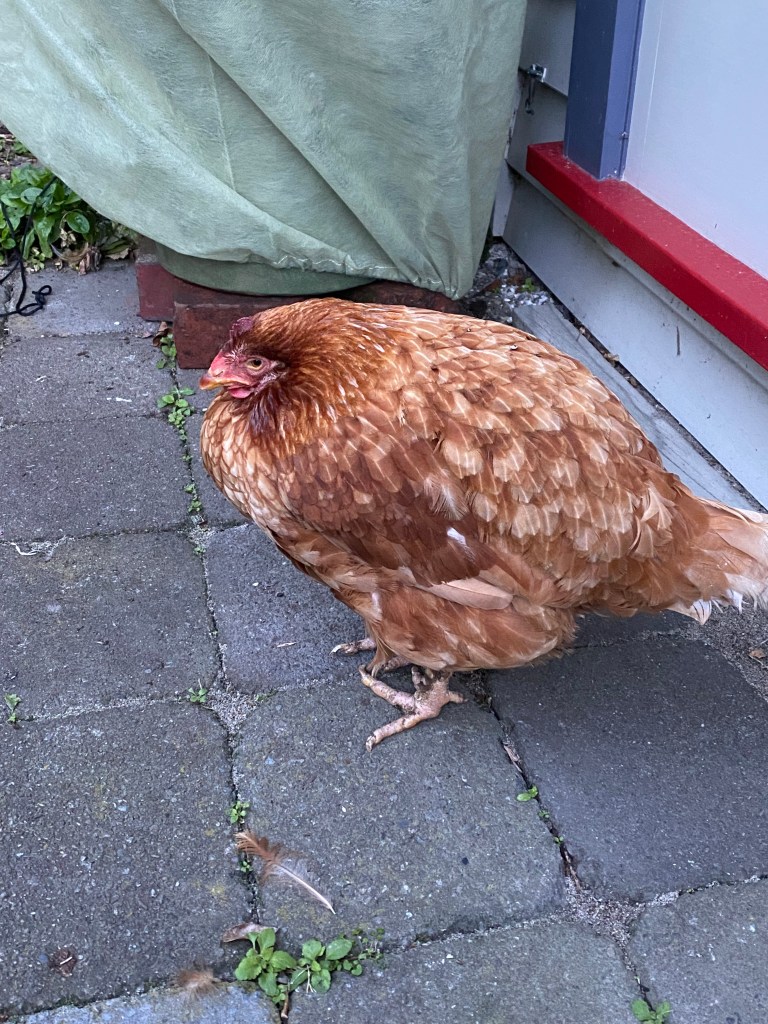
Vera wasn’t keen to get up this morning, but she found sunny spots to spend the morning and afternoon. This evening, she had her feathers fluffed up against the cold wind. There is fresh, dry straw in her house to keep her warm at night. She’s old. Her comb has all but disappeared.
Felix doesn’t seem bothered by the cold. He’s been out keeping Vera company, scaring the sparrows away from her food and doing some exploring of his own.
As the light began to fade, he had a burst of energy which took him to the top of a tī kōuka where he looked into the distance with the sunset lighting his face.
Now it is dark. Vera is in her bed, the fire is on and the curtains are drawn. Felix just popped inside for some food and promptly went out again. The light of the full moon is shining through his cat door and across the floor.
Having a fruitful lemon tree is sublime and the thought of having a fruitful lime tree even more so. It has the special taste important to a margarita and a mojito. Unfortunately, my lime tree is looking decidedly subpar. It was planted in 2019 when the vegetable garden was extended into the lawn. I carefully removed any fruit for the first year to let the roots establish. In subsequent years, it has never had more than six limes and it has remained small.
This year, there were quite a few limes but they began to drop off when quite small. Then the leaves began to turn yellow and to drop. I had fed it as usual, so gave it epsom salts as a boost, but it did not improve. The garden centre people thought it might have been over-watered. That’s possible, as I often tossed a bucket of water on it after cleaning up after the chooks and water from the garden sprinkler does tend to run down into that corner. We have also had a lot of rain.
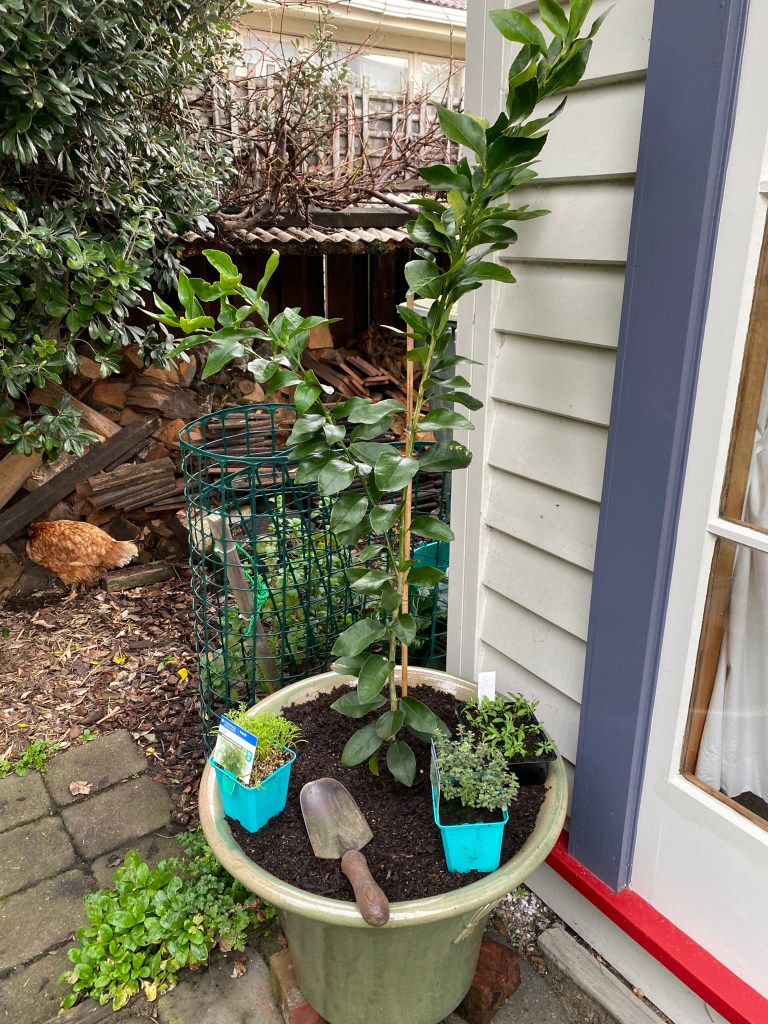
On Friday, I called in at a very nice garden centre – just to look – and came away with a new lime tree, a large pot (half price) and potting mix. I put stones and bark at the bottom of the pot to ensure good drainage. My thinking is that a pot might prove more successful. I also dug up the old lime tree, made a new hole, filled it with stones for drainage, then potting mix and replanted it just in case it might recover.
Today, I bought some companion plants and put them around the new lime tree in its pot. There’s alyssum, silver thyme and dill. It looks sublime. Fingers crossed.
It’s like being a kid again, coming home from the library with an armful of books. All of these are by authors I’ve been following. Some are the latest in a series.
Privilege in Perpetuity is perhaps the odd one out. It is one of the small texts I have been reading published by Bridget Williams Books. Fragments of a Disputed Past by Joanna Kidman et al, The Inequality Debate by Max Rushbrook, and Marilyn Waring’s Still Counting (which I read twice in the last two weeks) are some of these. All are about issues affecting New Zealand society.
Behind these choices of books is my decision to stop attending our new-format book group. Instead of an enjoyable meeting of friends to discuss literary fiction and non fiction, the hosting bookshop has turned it into a ticketed event which, after attending three times, I find has lost its spark.
Now it’s time to read for sheer enjoyment. Which isn’t to say you don’t learn something worthwhile from ‘lighter’ fiction, such as the Richard Osman Thursday Murder Club series. The author seems to have found his stride in the third book which I have just finished reading. The characters are sympathetically drawn and given a voice through the alternating points of view. Various levels of criminal offending and moral choices are ‘played with’ but never heavy-handed and there’s plenty of humour to entertain the reader.
Some books just let you be a passive reader and I don’t enjoy those very much – but, for sure, they have their place – balm for the troubled soul as Stephen Fry described the books of P.G. Wodehouse. On the other hand, books from which you learn about a culture or a time in history or consider a different experience or philosophy, invite you to be an active reader.
Janet Evanovich’s Stephanie Plum series plunges you into suburban New Jersey and reminds me of my social anthropology studies at university. Yes, I know she’s a popular fiction machine, but there’s a good reason for her popularity. It’s fun. The ancient Roman settings of the books of classics scholar Lindsey Davis are better than a time machine – everything is translated for one thing! Vaseem Khan’s Malabar House historic fiction series also takes you to a different place and time and, like Sujata Massey’s Indian books, into the lives of Zoroastrian Parsi, who first migrated from Persia around the 8th century. Graham Norton’s intense interest in people is clear on his television show and is very much present and enjoyable in his fiction. I’ve written about Denise Mina’s book Conviction in a recent post and I’m looking forward to another edge-of-the-seat adventure in Confidence. Deanna Raybourn’s Victorian series featuring detective Veronica Speedwell has entertained me from time to time, but Killers of a Certain Age is a one-off about four retired hit-women who get together to save their own lives when the tables are turned.
So, which book to read first? I can’t wait to get started!
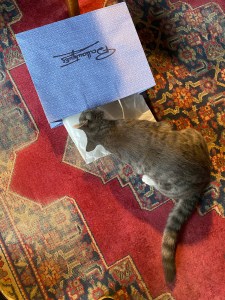
Somehow, I felt compelled to buy this pillow case yesterday. Why was that?
I heard someone explain once that the ‘dominion’ given to humans over animals after we were expelled from the garden of Eden was mistranslated. It should be ‘guardianship’. Well, we know that now to our cost.
Guardianship is how I see my part in Felix’s life. I’ve not managed to keep him inside for the first 10 months, as the vet advised. I haven’t even kept him inside at night. Consequently, I had a sleepless night when I couldn’t locate him after hearing a fight-to-the-death cat fight in the distance.
I suspect he was a spectator rather than a participant, as he appeared in the morning, unscathed.
He brought a mouse into the house on Thursday night and proceeded to lose it under my bed. I opened the french doors so it could escape, but it chose to run further into the house. It sat under a side table in the living room for a while before I was able to get it to the front door – only to be greeted by Felix, and I thought we’d have to go through the whole saga again. Fortunately, not. The mouse lives to face another day, like the bird I rescued from Felix a couple of months ago. In that case, I applied a choke-hold on Felix until he let go. I had seen this technique used successfully by the owner of an American pit bull which had my border terrier in its vice-like jaws.
Animals just do what they do, as an interview on the radio this morning revealed. Human animals, with the double-edged sword of ‘superior intelligence’ tend to overthink everything. The ability to catastrophize is perhaps the worst thing, in my experience, certainly when we have animals in our care. But, as the photo shows, Felix just takes life as it comes, and it looks pretty good to him.
What a great way to spend a winter Sunday! This book is one of those absorbing, fast-paced stories which blocks everything else out. It races about all over western Europe pretty much, revealing more and more surprising details about the characters as they encounter increasingly hair-raising situations.
I was first aware of Denise Mina as a presenter of a documentary about Coleridge and Wordsworth and, later, one about Boswell and Johnson. She and Frank Skinner visited the places travelled by the writers, Mina always distinguishable by her shock of silver hair, fingerless gloves and boofy skirts: out at the hips and in below the knees – and her Scottish accent. Researching her for this, I found she has done far more than those two docos and has written at least 15 books.
After I discovered she was a writer of crime fiction, I looked for her books in the library. It was difficult to get the first of each of her series, so I opted for this stand-alone novel (borrowed as an ebook) and am pleased I did. I’ve placed a hold on the next one: Confidence. Can’t wait.
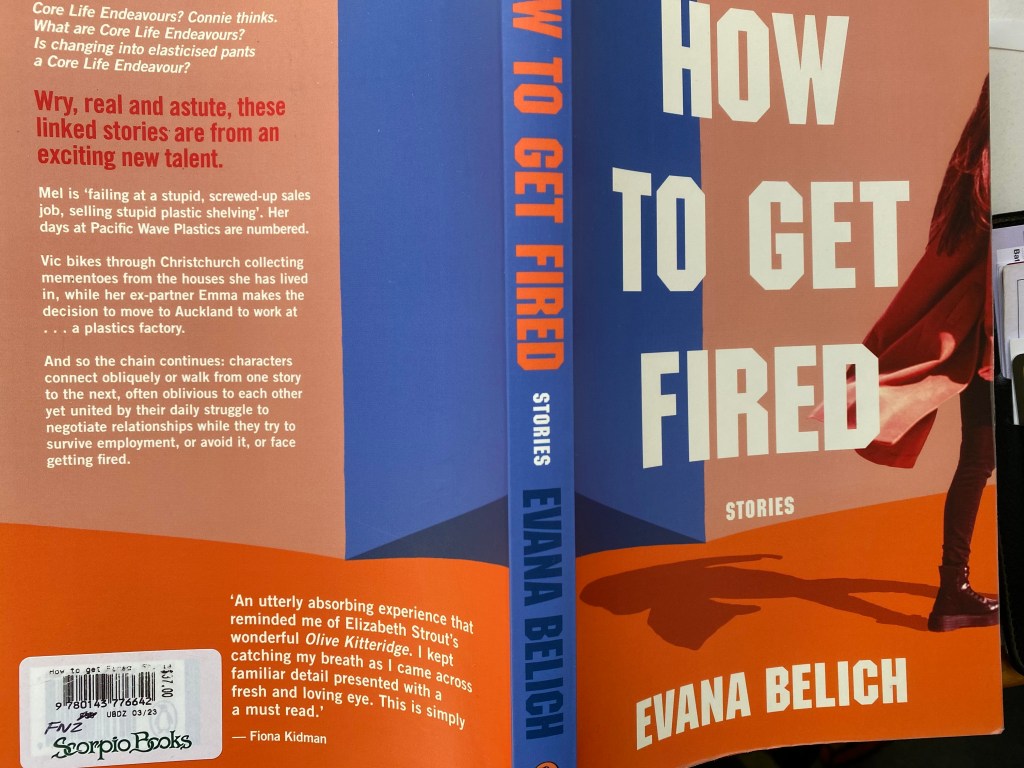
A number of the inter-connected short stories in How to get Fired depict characters with all their complications and complexities as they fit – or, mostly, don’t fit – into workplaces requiring compromises they could do without.
The author, Evana Belich, “worked as a trade union official, a mediator and an employment relations adviser. She has degrees in law, dispute resolution and a master’s in creative writing…” This helps explain the depth of her understanding of workplace issues – and her skill in crafting each story. I read an article in today’s paper about wage theft and was reminded of ‘Peach Season’ with its heat-stressed and dehydrated packing-shed workers who pass a bucket along the line so they can throw up without stopping work.
Always, in these stories, there is tension between boss and employee. I detected a fear of being mocked, undermined, humiliated, and even fired, on both sides, disguised by arrogance, bullying, subservience, resentment and defiance.
One story, ‘The Consolidation Phase’, had such resonance I felt as if I were experiencing the tension of a PD (Professional Development) session all over again. One of those excruciating sessions where everyone is so quiet you know we’re all figuring out how we’re meant to respond and wondering why it all seems so alien to how we see our role in the job. There’s a miasma of collective embarrassment and awkwardness and a fear of seeming ignorant (what do all those terms mean?).
The story begins:
National Outputs Manager Steve Stirling stops for a beat. ‘Acuity, attention and resolve.’ His gaze arcs, chin-led. ‘What do we mean by acuity, attention and resolve? What do we mean by the Consolidation Phase?’
In the audience, Seamus visualises himself ‘like the mountaineer with broken legs who dragged himself back to base camp, scrabbling from one rock to the other. Small achievable goals, rock by rock.’
At the front of the room Steve Stirling slashes an electronic pointer at three orange triangles on his PowerPoint slide. ‘Acuity, attention and resolve,’ he says. ‘Can I throw this one out to the group? Let’s hear some ideas.’
The puzzled audience is unresponsive as they figure out what’s going on – another restructuring? Zac suggests to his co-workers, then, when they are in groups (and, of course, no-one wants to be the one to report back), he mocks the language of the presenter: ‘Going forward…I’m envisioning some of these learnings cascading into high-performance work streams.’ Seamus thinks: ‘We were never meant to be this fully dominated…We were never meant to have our wills so broken, to have other people make up our words, make up our thoughts for us.’ Reading this, I realised this weirdness wasn’t just in my work place – it was happening (is still happening) everywhere. And I was in teaching, for heaven’s sake, where a major goal was to ‘remove barriers to learning‘.
I recommend this book, and not just because you are sure to recognise yourself or others you are sure you know somehow, but because of the skilful writing, humour, irony and compassion. And if, like me, you are retired, you will be even more grateful for having survived the working world more or less intact (it can only be more or less when you find how easily you relive the stress as you read, wanting to laugh but fearing you might have a heart-attack). And it’s not all about workplaces. ‘Christmas with Chess’ has true and humorous family relationships which resonated with me too. The titular story comes last, and does what it says on the lid.
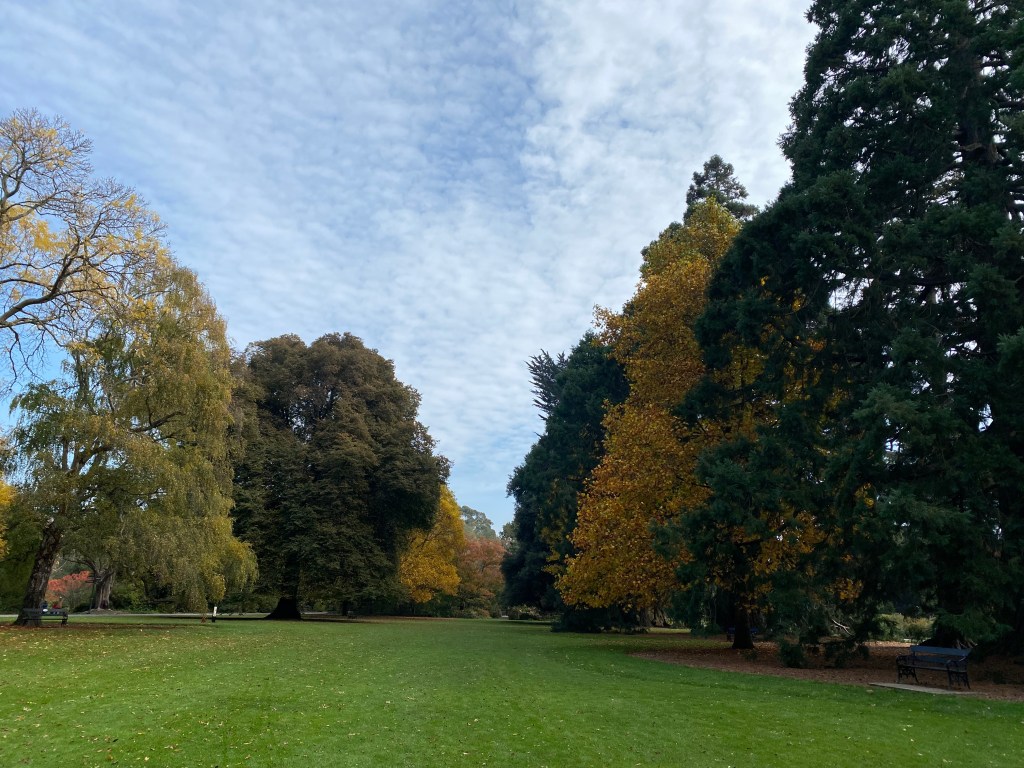
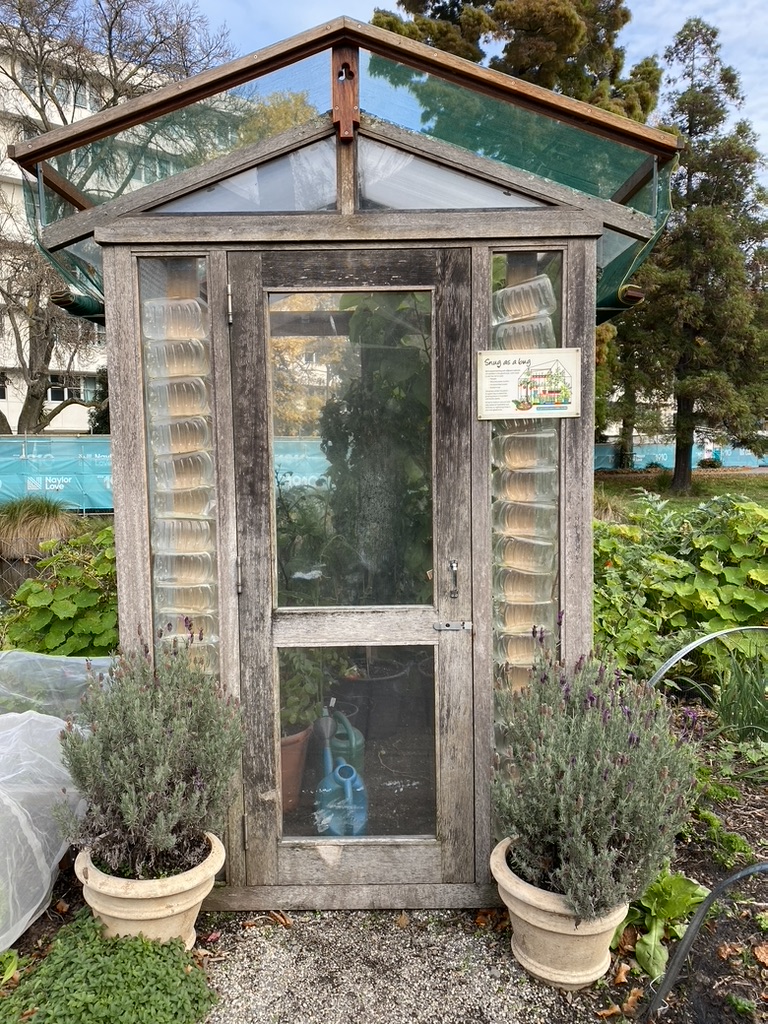
I have begun Watercolour for Beginners classes at the WEA and, on the way, I walk through the Botanic Gardens looking for shapes and colours I might try to paint. The autumn colours are glorious and some of the vistas are grand. Others parts of the Gardens are more down-to-earth, so to speak, such as the shed in the Curator’s Garden.
The Archery LawnThe Curator’s GardenGreenhouse made of recycled material
I already had watercolour paints and a how-to book. My brushes weren’t the best, however, but I found a cheap set at The Warehouse after the first class and had fun using them today.
My efforts so far are a little disappointing, but I’m not too worried because I’m enjoying myself. The class is small and our talents are on a spectrum…continuum…sliding scale… My efforts today looked like something you’d find in a petrie dish.
I’ve been hoping in vain for the inspiration which led to my purchase of watercolour paints in the first place. Never mind, the techniques are interesting to experiment with.
I did some homework after the second class today. First, I wet the paper and attempted a ‘variegated wash’ like the one in the book. Instead, it morphed into a sort of memory of my train trip from Lisbon to Ēvora in 2018 (see post ‘Corker!’ June 2018) when I was enthralled by the acres of cork trees.
A much-loved childhood book was The Story of Ferdinand by Munro Leaf, illustrated by Robert Lawson, about a little Spanish bull who did not want to fight in the bull ring. Instead, he liked to sit under his favourite tree and smell the flowers.
His favourite tree was a cork tree. Can’t you tell!
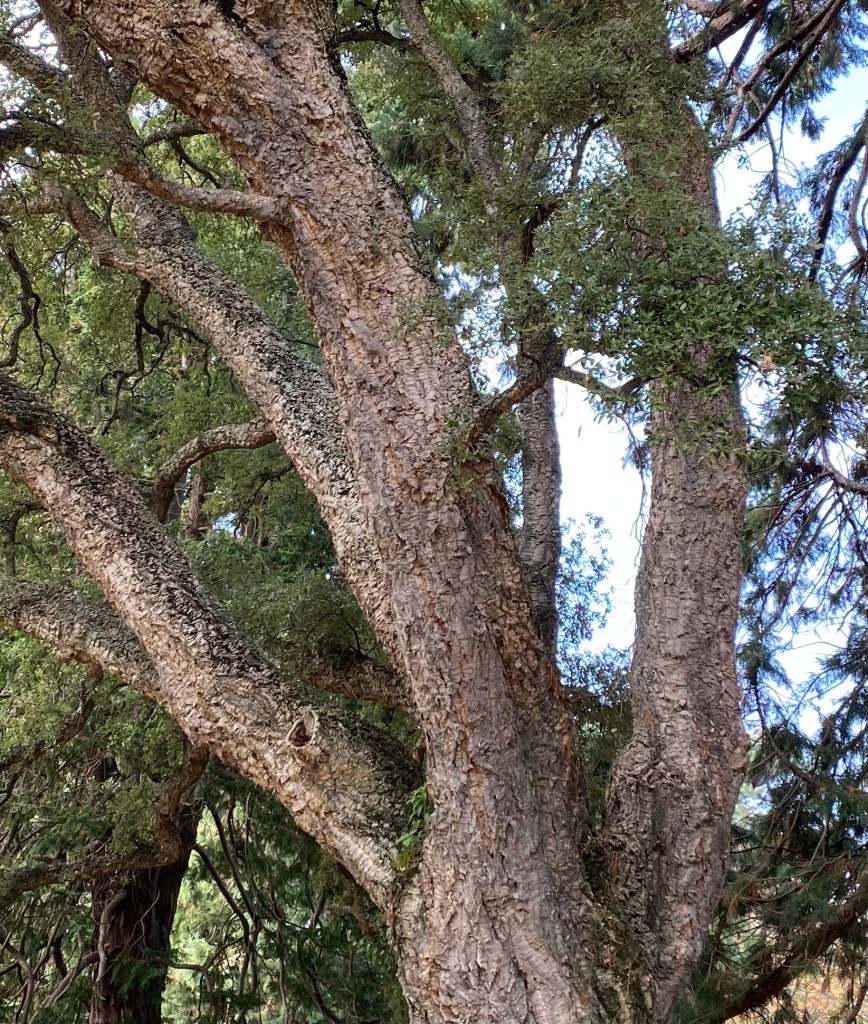
There is a cork tree in the Botanic Gardens which I make a point of visiting, giving it a pat on its warm, textured bark.
Quercus suber
Am I ready for the ‘Monochromatic tonal value scale and 3D modelling’ which is the topic for our next class? The Gardens may be my muse after all and I’ll be perfectly content within my limitations, like Ferdinand.
An interesting reversal of roles is, perhaps, inevitable when you live with your mother in later life.
Mum came to live with me after the February 2011 earthquake in which her 1920s, double storey house was damaged and its integrity compromised. In other words, it was unsafe to live in. My 1930s single storey house fared better, despite some broken bearers under the floor, since repaired. I had no hesitation in welcoming her. There was something which happened to us all in the immediate aftermath of the earthquake: shock, combined with heightened emotions which meant holding family close. We were also braced for action as aftershocks continued for several months.
If I’d known, as a teenager – or even in my 20s or 30s – that my mother would come to live with me, I might have emigrated – or at least moved cities. But, when it happened it seemed the most natural thing. I had left home as a teenager and, for a while after Mum moved in, I reverted to being like a teenager as if I was picking up where we’d left off. I had to give myself a talking to about that. We had already spent time together as adults, including travelling to Europe twice, and found we got on very well. I knew it would work, and it has.
Mum is 94 now and, as I write, she is doing the vacuuming. She does this every Saturday, regular as clockwork which is admirable to a person like me who does not operate like clockwork. Mum is very thorough with her vacuuming – another reason why this co-habitation works!
Mum makes her own breakfast (always porridge, toast with marmalade and tea) and lunch, unless I cook her an omelette or make soup, and I cook dinner. She does what’s left of the dishes after I’ve washed the pots and other cooking things. Mum enjoys baking, usually shortbread and, lately, Anzac biscuits. She does her own laundry: hand washing on Sunday after church (she still has her driver’s licence) and a full wash on Monday (more clockwork). Speaking of clocks, her cuckoo clock cuckoos the hours and, strangely, doesn’t drive me mad. It’s nice that she has her own things in the house: her comfy chairs, books, photos of grandchildren, treasures. I’m learning to read a barometer.
There’s the odd reversal of roles, where I become the mother to her teenager. Mum has a stubborn aspect to her character which, annoying as it can be, I quite enjoy because it is her. A recent example was when she came with me to Ballantynes where I hoped to find her a nice skirt (she never wears trousers). Finding a simple, A-line skirt with pockets has proved quite a mission in the past and at times I have used mail catalogues, but the results have not been great. A helpful sales assistant found us a skirt but Mum refused to try it on! “She’s such a stick-in-the-mud!” I said, frustrated, to the poor assistant. But Mum was simply tired, and it was an effort for her to walk from the car. She was overwhelmed by the visual ‘noise’ of the department store. I thought of going back later and just buying the skirt, but procrastinated.
Finally, I looked online and found a better skirt and there was only one left and it was in her size. I think I showed it to her and got her approval before going ahead with the ‘click and collect’ process! I also made a note of some plain white cotton blouses that might go with it and when I went to collect the skirt I chose one of those (and it was 50% off).
On the roof next doorSliding on the glass roofThe guttering stops him sliding
With Felix becoming increasingly adventurous, it is time to give him his freedom. He is now seven months old which some cat-years-to-human-years calculators put at 12 years of age, not quite the 21 human years required to have a key to the door.
The vet’s advice to keep him indoors for the first 10 months seems an impossible undertaking, especially in this warm weather when we have doors and windows open.
Confined to the house overnight, Felix was waking me in the wee small hours to be let out – having decided that his litter tray is beyond the pale. Then I would lie awake worrying about him getting into fights with the big cats – or the rats in the woodpile – and would watch for him asking to be let back in.
Last year – or was it the year before? – vowing never to have a cat or dog again, I had a glazier remove the old cat and dog doors. The glazier came back in the weekend and cheerfully installed a microchip cat door. The door is smart, and recognises Felix’s microchip, so no other cats can come in.
Felix learned to use it in no time.
I put a step made of books on the inside and a nail box step outside. The books include A Guide to Places of the World and James Herriot stories, both of which I thought appropriate.
I still worry about Felix being out at all hours, getting lost or stolen, running out onto the road or getting into fights, but so far so good and at least I get to sleep!
................... for lovers of ice cream. Your free on line magazine for sweet frozen treats. Recipes, inspiration, artisanal ideas for your delectation.












 Anne-O-tations