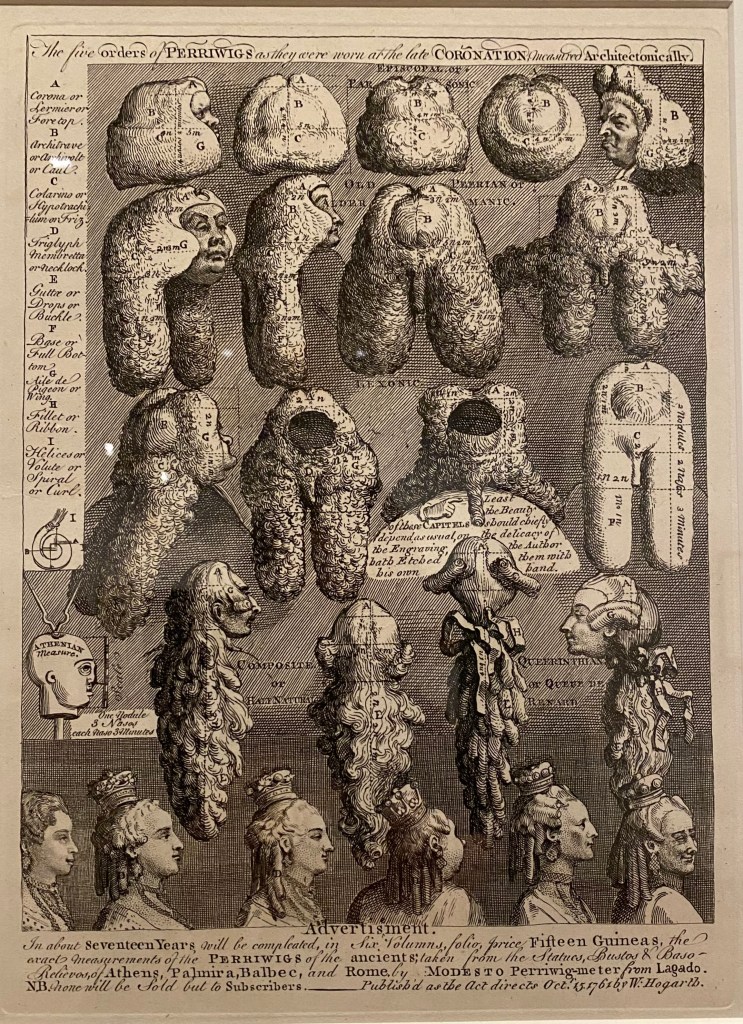
The Five Order of Perriwigs, as they were worn at the late Coronation, measured Architechtonically 1761
This etching caught my eye at the Out of Time exhibition currently on at the Art Gallery. I could imagine the artist, William Hogarth, at the coronation of George III and Queen Charlotte, astounded by the variety and complexity of the wigs worn to the event. I wonder at what point he made the connection to the concurrent fashion for classical architecture and came up with this satirical etching.
Perhaps Hogarth made surreptitious sketches and smiled indulgently at the follies of fashion – like the follies the wealthy built on their estates. His etching has led me to consider how fashion rules our lives whether we like it or not, and becomes an indicator of all manner of things, not always easy to contemplate, but often funny.
The exhibition seemed to have a soundtrack – in my head, anyway. The Rolling Stones’ Out of Time.
The Art Gallery has been mounting interesting exhibitions using themes, such as Ship Nails and Tail Feathers and Out of Time, to display works from the collection. This gives you the opportunity to see works you might not have seen before as well as familiar ones in a new context.
Now that the art galleries are closed, I’m pleased I spent so much time carefully viewing each painting in the Frances Hodgkins European Journeys exhibition on three occasions. By my third visit we knew more about Covid-19 and I was not keen to use the touch panels! There was an elderly couple carefully viewing the paintings. I felt quite sorry for them (even when one of them sneezed copiously); they looked quite frail. It would be a last treat, I expect, as before long over-70s were asked to remain at home.
I took note of who owned the paintings. The Auckland Art Gallery seems to own most of them. Other owners include the Christchurch Art Gallery, Te Papa, the British Council, Dunedin Art Gallery, and some private owners such as the Fletcher Family Trust. I was a little disappointed not to see the painting entitled Loveday and Ann. I looked it up online and found it is currently with the Tate St Ives. This seems fitting, as Frances Hodgkins lived and worked there for some time after she had to return to England from France at the beginning of World War I. The painting is dated 1915 and had two private owners (one of whom inherited it) before being purchased by the Tate London in 1944. It shows two women with a basket of flowers. The different characters of the women are quite striking, not to mention the bright colours.
The striped chair in Loveday and Ann reminds me of Hodgkins’ self-portraits which feature a favourite chair with objects belonging to her arranged haphazardly. I like this way of doing a self-portrait.
After my second viewing of the exhibition, I found the way I looked at things was enhanced. I would be struck by how a scene looked like one of her paintings. Even the pink bathroom cloth hanging over the window catch with pink flowers in the garden beyond reminded me of the rose tones she used in her later work particularly. She had a number of paintings which showed objects in the foreground and views through an open window or door.
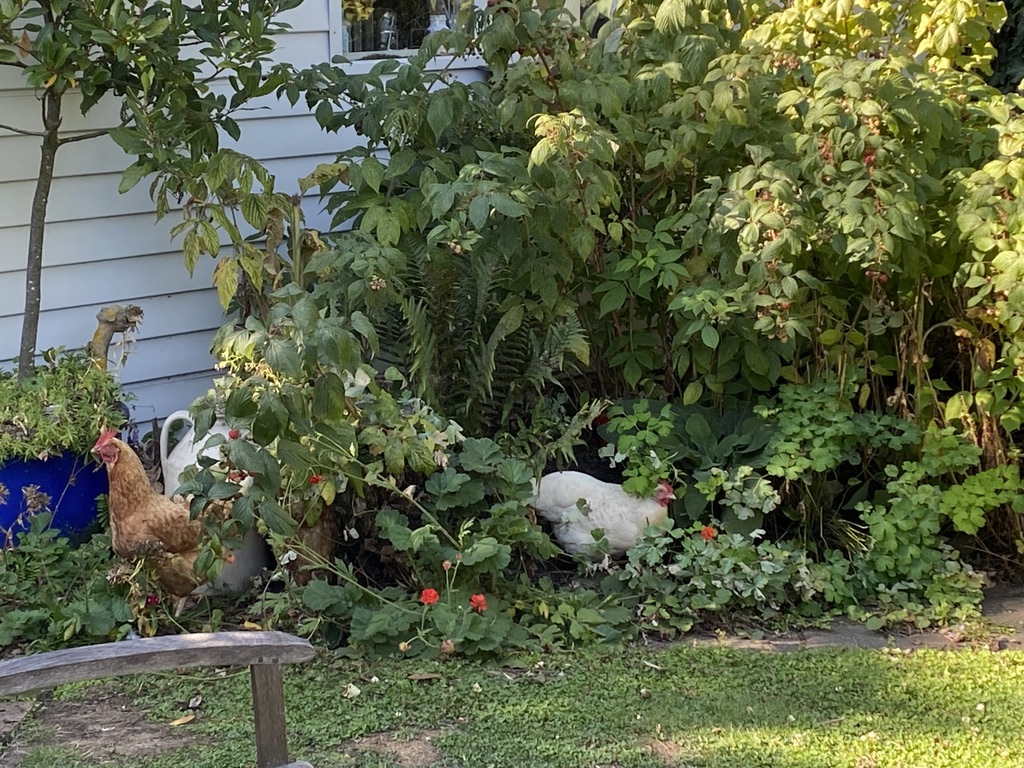
The first time I experienced this “painterly eye” effect, was on observing my hens scratching about under the raspberries.
I wasn’t sure, but I thought one of Hodgkins’ paintings featured hens. On my third visit I found it.
This is an early work, painted in 1914; watercolour and charcoal. It is entitled Barn in Picardy. (I’ve also caught the reflection of the exit sign in my photo!) This painting is owned by our art gallery, so I look forward to seeing it more often.
Many of Hodgkins’ paintings respond not just to landscape in the many places she worked, but to events at the time, particularly wartime. In World War I she tended to paint portraits or inside scenes, as she could come under suspicion for painting outside in St Ives, on the Cornwall coast. In World War II more abstract trends in painting seem evident in her work, but rendered in her distinctive style. Her portraits too, could make social comment, such as The Edwardians (1918).
I like this photograph of her, particularly her woollen socks! Worn over thick stockings, I could see, by looking closely at the bigger-than-life photo on the wall at the exit from the exhibition. Yet bare arms. Practical considerations, perhaps when painting. And does her slumped posture indicate how grateful she is to sit after painting for long hours? She was 76 in the year this was taken (1945).
The Press today lists online exhibitions we can visit while the galleries are closed. A nice way to feast on visual experiences and nurture (code cracker word today) the painterly eye.
................... for lovers of ice cream. Your free on line magazine for sweet frozen treats. Recipes, inspiration, artisanal ideas for your delectation.


 Anne-O-tations