We are more warmly dressed than usual for our beach walk this morning; it is still cool after yesterday’s thunderstorm. The air is fresh and clear, with a brisk easterly wind. From the crest of the dune pathway, we can see three ships on the horizon. The Port Hills to the south are outlined against billowing ‘cauliflower’ clouds, and the distant Kaikoura mountains are clear to the north. At the foot of the dunes, families gather around Santa Claus for photos.
The sand is firm under our feet as we head north along the beach with many others, most with happy dogs. We pass a circle of people discussing the coastal environment. Overhead, a motorised kite flies by, turns and disappears into the distance. Two light aircraft follow the line of the beach, one is white and heading south, the other is red and travelling north. ‘It’s the Red Baron,’ I say.
Later, we heave ourselves upright from the log where we stopped for morning tea, and come upon two people launching colourful kites which swoop and glow against the bright blue sky. I count two dozen birds flying in formation and intersecting a jet trail – and, in this photo, forming an angle with the kite’s string line.
The kites make undulating shadows on the sand.
As we near the pathway we can see that the swim-between-the- flags are out in front of the surf club. Families are organising themselves for photos with Santa, choosing props such as hats, a cricket set, rugby ball, surfboard, and a bent (purposely?) Christmas tree – and even the Grinch – although he seems to have retreated to a distance now, perhaps to keep in character.
It’s perfect kite-flying weather. A local, walking by with her small terrier whose ears and fur are pinned back by the wind, asks us if we have been to the annual kite day – this is just a taste of it. The next one will be at the end of January in the new year.
Should you be selective about what forages in your garden? Once you open the gate to wildlife there’s no stopping them. I have a bug house which is smothered in spider webs. Two bird feeders attract lots of waxeyes and a few sparrows. The blackbirds seem to fend for themselves, digging into the leaf litter for snails, worms and insects (and they enjoy the birdbath), and finches occasionally fly in to feed on the seeds of plants such as borage which also attracts bees when flowering. Fantails flit high up in the canopy, catching insects on the wing. Other birds pass overhead: spur-winged plovers, gliding seagulls and sometimes a pair of ducks or a skein of geese. Sometimes I hear a grey warbler and distant magpies.
On the flip side, cats cruise through (discouraged by a water gun if I’m fast enough), Felix brings in a rat now and again, and ants appear with monotonous regularity. Two days ago I was horrified to find thick masses of ants around the guttering downpipes and long lines of them along the eaves and walls of the house. I should have taken photos to freak you out, but I had turned into a rubber-gloved, masked avenger with a loaded spray gun before it occurred to me to record the event. The next day there was little sign of ants – except along the clothes line where a column of them was migrating to a nearby tree, like Mother Courage and her children toiling across the battlefield. It seems I only feel sorry for them when they are in retreat.
There are several natural sources of bird food: apples, berries, aphids, and abutilon, camelia and protea flowers.
Apple treeAbutilon flowers
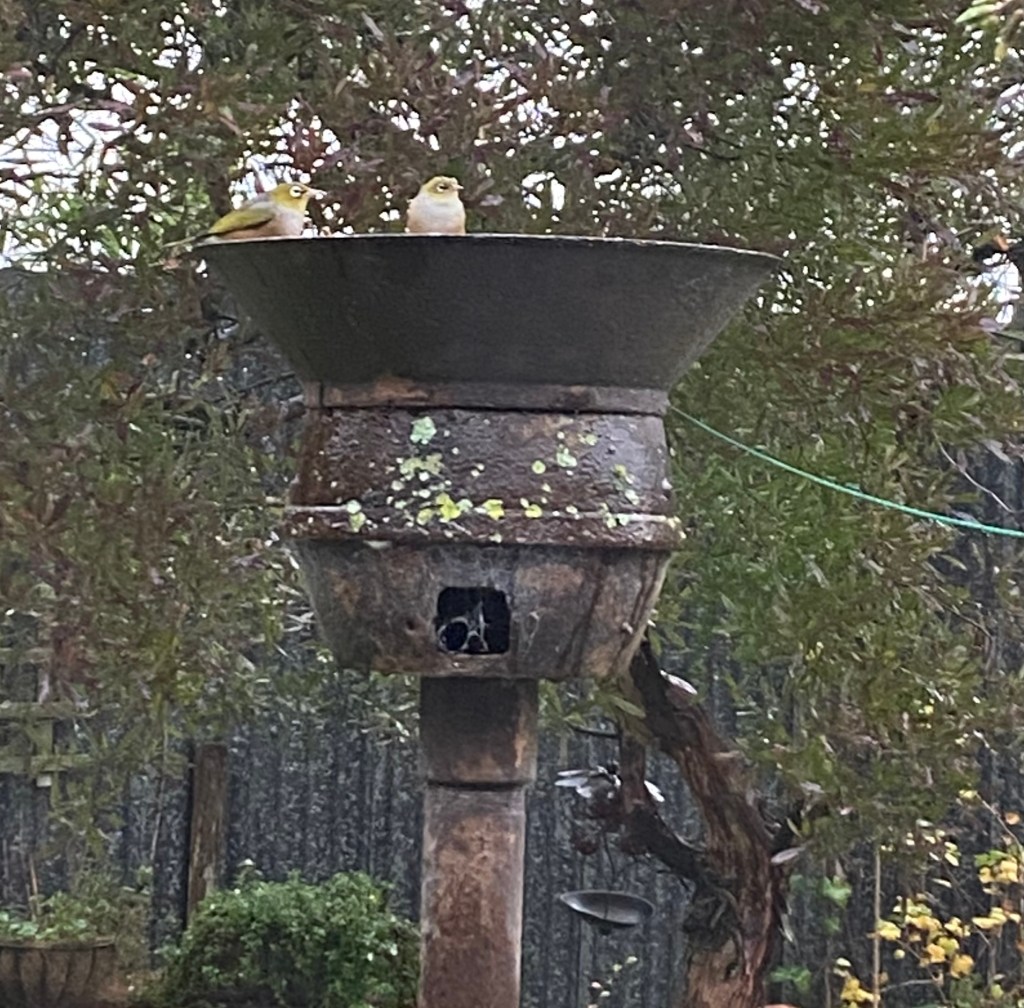
And there are two bird feeders:
The new bird feeder (on the left) requires sugar water and ‘truffles’. Lately, I’ve been replacing the truffles every day for these voracious (hungry?) waxeyes. So that nothing is wasted, I put the little bits which fall through the wire feeder into the other bird feeder, with the windfall apples. I worry that I should leave a gap before replacing the truffles (a day? half a day?) so that the birds don’t become too dependent on them.
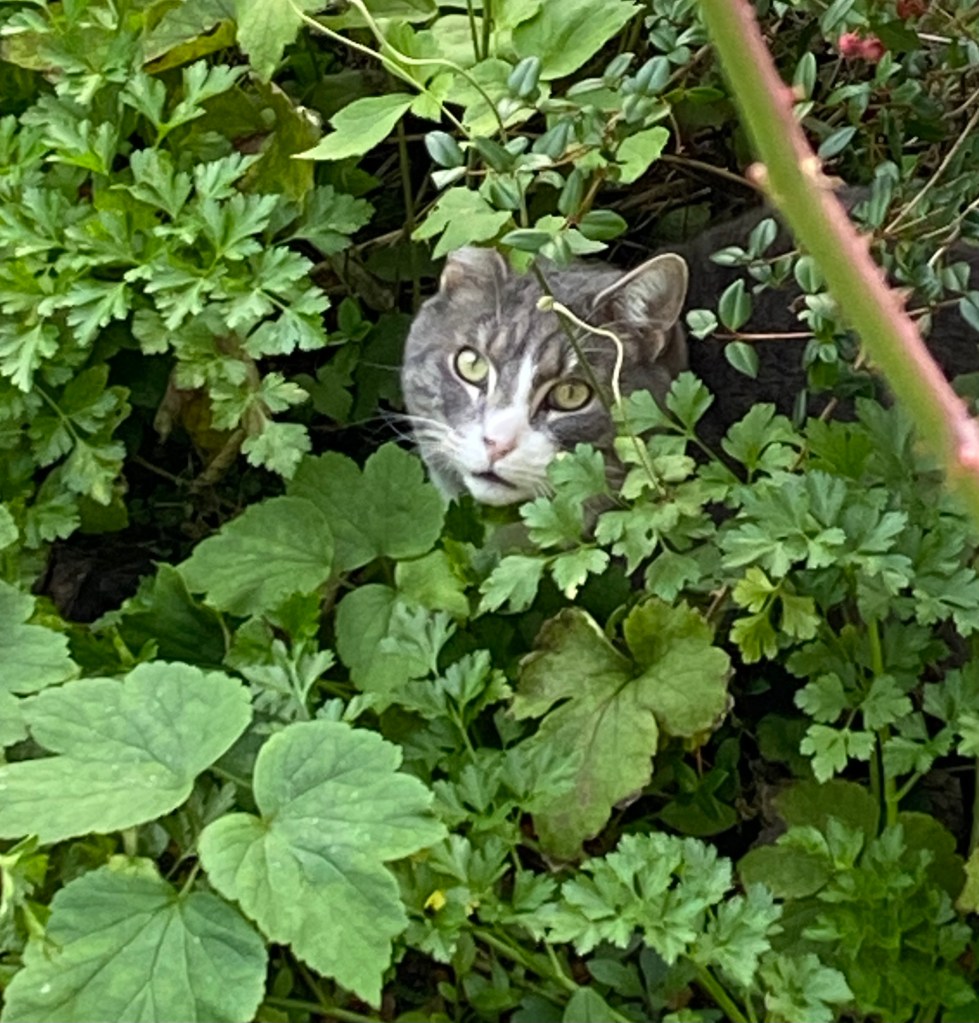
Both bird feeders are cat proof. For Felix, the new bird feeder is cat television. He sits in the parsley under the cranberry bush and watches for hours – even now, in the rain.
A photo taken several days ago. Felix briefly switched his attention to me.
Do you have an internal or external locus? A psychology article in the last (sob) Listener says: “An internal locus means you tend to see events as controllable, whereas an external locus means you see yourself awash in a sea directed by fate and outside factors.” While the writer, Marc Wilson, concedes that most of us fall somewhere between these two, it is food for thought in terms of being in lockdown. My nesting instinct means I’m quite happy to be at home. In fact, I’ve realised that having choices taken from me is liberating – now isn’t that paradoxical? I’ve learned to be patient with myself if I don’t feel motivated. Before long, the motivation returns. I’ve learnt to choose not to read or view material which will put me off balance, so I’m not likely to subscribe to Netflix or re-join Facebook any time soon. Gardening is my therapy of choice – and gardening shows on tv are fascinating viewing choices for me from which I can learn.
Judging by articles and columns in the newspaper, lots of people are learning about themselves while confined to home and in close quarters with others. Rosemary McLeod and Verity Johnson had some entertaining insights in their columns today. I like to learn from our remaining media outlets, stuff.co.nz and rnz.co.nz, especially about the nature of good leadership (and its opposite) in times of pandemic.
Today I discovered that the tree outside my study window is not a kānuka, as I had thought, but a lophomyrtus obcordata or New Zealand myrtle. The Māori name is rōhutu. It took some detective work and I’m pleased to have solved the mystery after noticing that the leaves for kānuka in Which Native Tree? by Andrew Crowe didn’t look like the leaves on my tree.
Appreciating stuff is an “up”:
I spend a lot of time looking out of the window, and it is a great view as I am surrounded by trees, many of them native. This panorama shot, complete with clothesline, gives an idea:
The akeake with red leaves is fascinating to look at because of the texture and varied shades of red to green of the pointy leaves. The pseudopanax next to it provides a contrast as does the cabbage tree, ti kouka, beside that. These are all self-sown, and I like to think there could be native forest regenerating in my own backyard. I have a mini-forest of kōwhai coming up in the front garden and pittosporums and hebes seem to pop up of their own accord too. They are welcome! We need trees.
All these trees mean lots of birds. At the moment, a few waxeye, tauhou, have arrived and are twittering and hanging upside down as they find insects in the roses, rōhutu, kōwhai and hebe outside my window. Fantails, pīwakwaka, are also frequent visitors.
I appreciate sitting out under the trees reading a book in the sun while the chooks scratch around in the garden. They are very companionable, add structure to my day and contribute chicken poo – lots – to the compost! Picking up said poo also tells me my sense of smell is working just fine.
Getting out for exercise is a bit of a stuff -“up”:
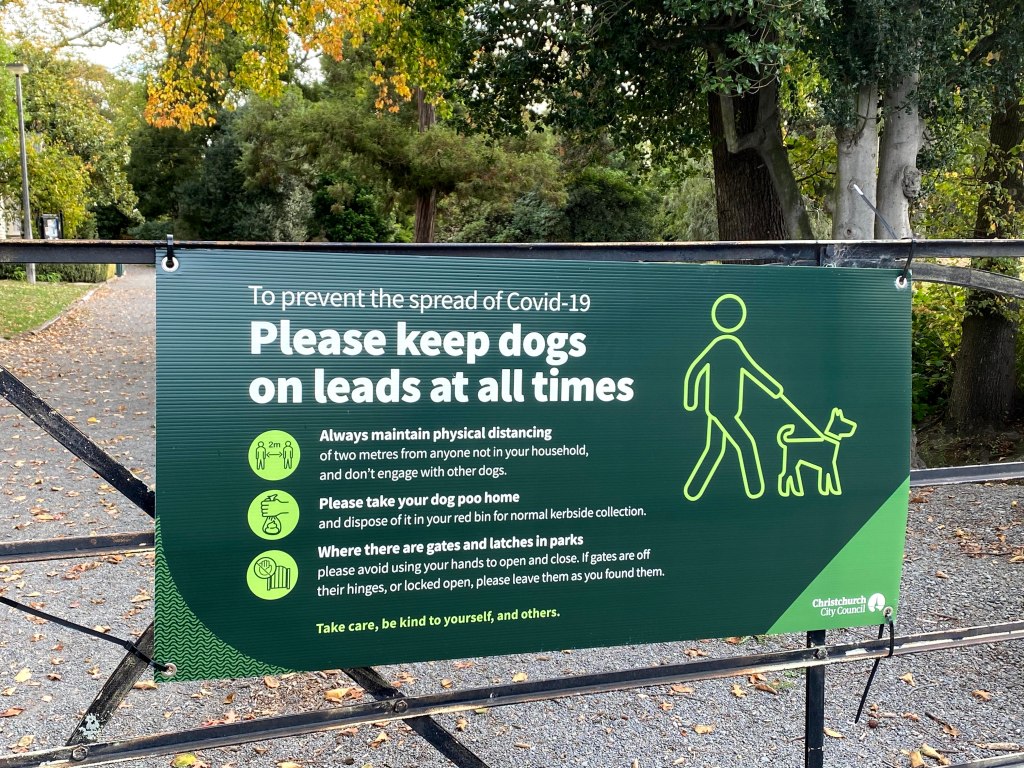
My brother and sister-in-law walk kilometres every day. I don’t go for a walk often, being busy running after the chooks and gardening (or so I tell myself – and isn’t my five minutes of yoga in the morning enough?) but it is nice to go down to the park to see how things are progressing. The new sign at the entrance reminds me I don’t have a dog any more.
Or children to keep away from the fenced-off playground:
It is good to see that there are hundreds of monarch butterflies clustered in the trees and lazily drifting on the warm autumn air currents. The roses are fewer now and autumn leaves are beginning to fall.
Mum often feels the need for a walk, and would love to visit the Abberley Park rose garden, but lockdown rules say to stay at home if you are over seventy. Instead, she has found good exercise sweeping the drive and paths.
Cooking and enjoying the harvest is an “up”:
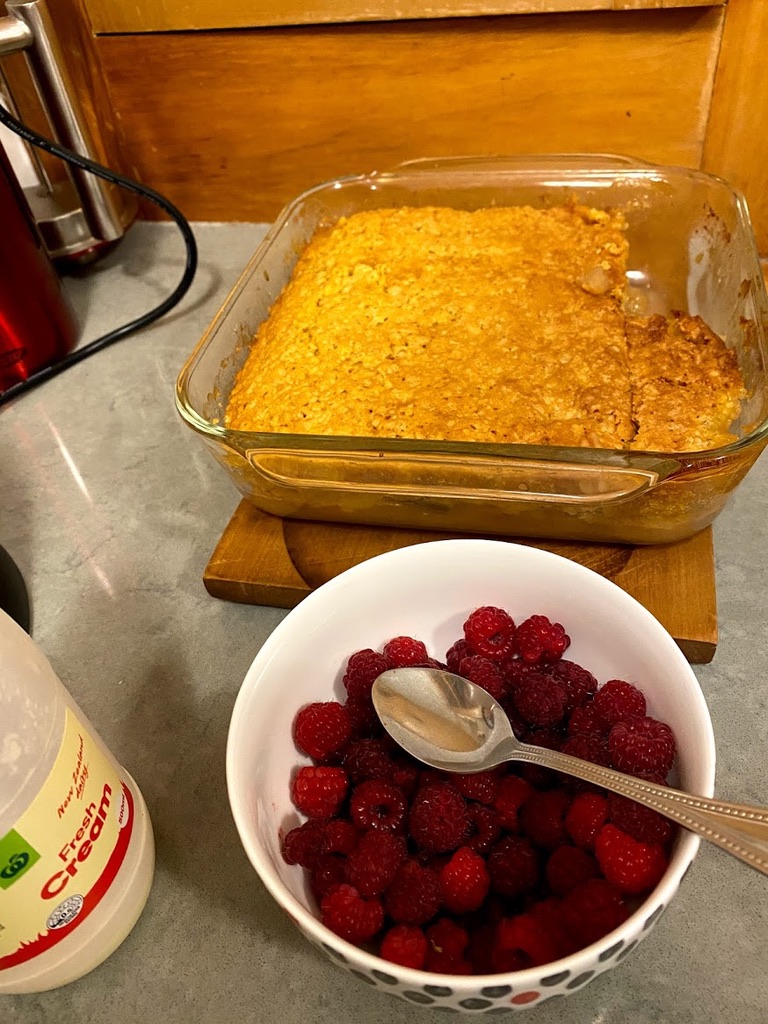
Mum is the pudding maker, and here is her latest: apple and rhubarb (from the garden) pie, and the thirteenth bowl of raspberries I have picked this autumn. Harvesting your own ingredients is very satisfying.
This reminds me of a TV series Keep Cooking and Carry On which Jamie Oliver has created especially for all of us in lockdown. My brother recommended it and I caught up with it on TVNZ OnDemand last night. I enjoyed the bread making. What a joy it was yesterday to find yeast in the supermarket at last! Going to the supermarket is stressful – but at least I can walk there – and there’s no way I can keep two metres away from anyone in those narrow aisles. But there are lighter moments, such as finding the yeast, and this little chap parked outside. I saw a black and tan St Bernard or Newfoundland dog in a cargo bike on Monday. This little dog had a large flowery cushion and a harness to keep him comfortable and safe in his own section at the front while the space at the back is for groceries, I guess. The reflection in the supermarket windows shows a street empty of traffic, making it even safer for him and for us – another “up”.
I was going to call this post The ups and downs of lockdown, but it looks as if it’s all “ups” for me, at least, even the supermarket sometimes, even while I’m acutely aware of the hardship for many, and despite the sad loss of our cherished NZ Listener.
Why don’t we know much about the living things which are all around us? You would think we have had plenty of time to find out.
Now that we are losing so many to extinction, it seems inexcusable that we don’t know how they live. It doesn’t suggest anything good about us that we don’t know, don’t care, don’t want to know. We might watch nature programmes with interest, but often they are about exotic animals in exotic locations, not those which are here with us every day – in decreasing numbers.
These marvellous, tiny fungi appear now and again beside the path. Why? and what are they?
I’ve just finished reading How to Catch a Mole: and find yourself in nature by Marc Hamer. He has learnt as much as he can about moles so that his respect for them, and all the other birds and animals he encounters, has grown. It reminded me that every time I find an insect or observe a bird I wonder how they live. What had happened to the tiny fish washed up on the beach today? What is the word for a baby fish? Where do birds roost at night? Why are they gathered in that particular tree down the road at dusk and not in others? Do I need to put out a bird feeder in winter, or are the birds able to find what they need in the trees and in the empty over-grown section next door? Even the term “over-grown” gives us away; nature should be tamed!
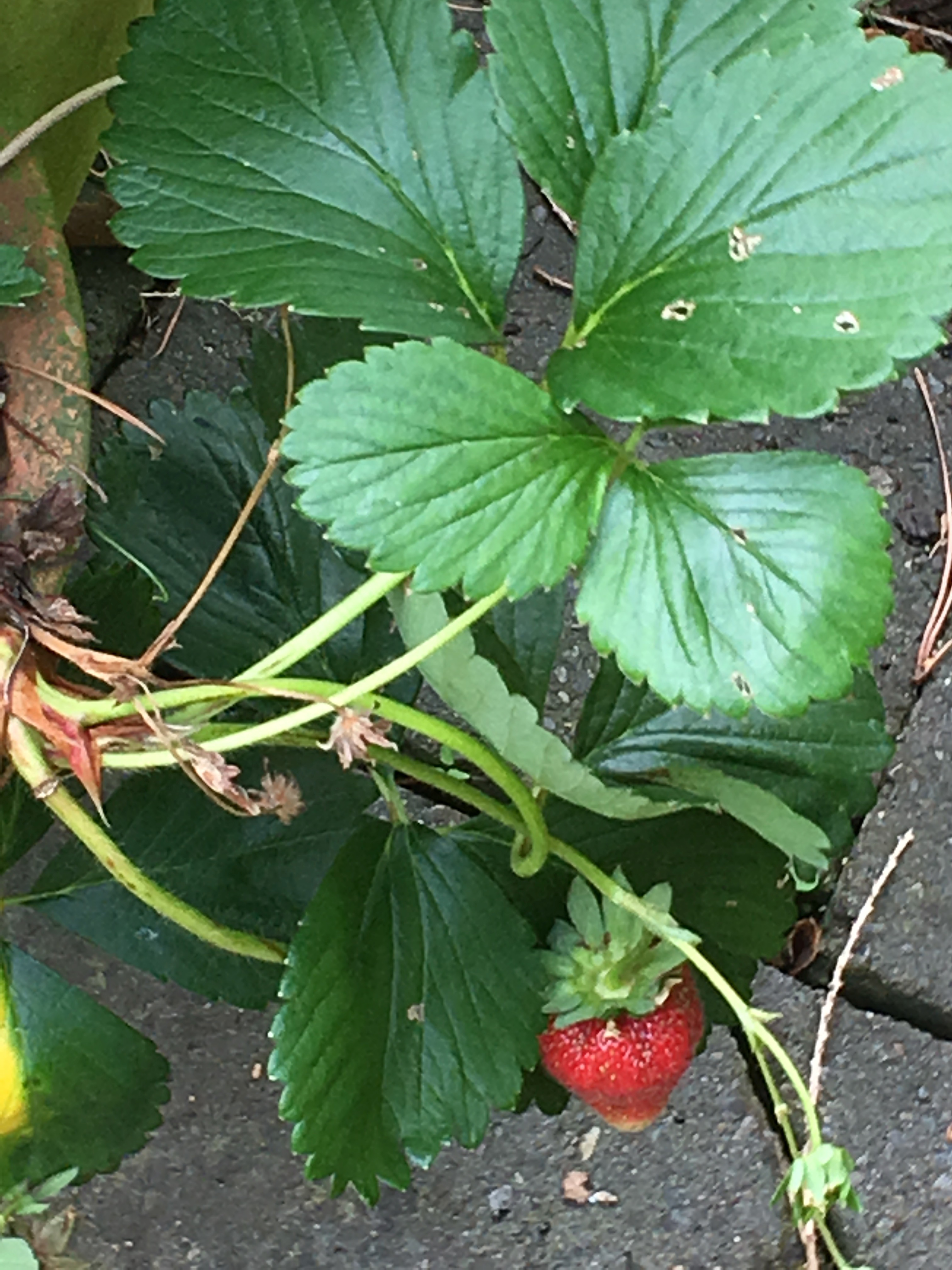
I don’t mind if the birds eat a few strawberries. What insect has been eating the leaves?
There are fewer insects than I remember in the past. I’m relieved if even a solitary moth bounces off the window at night. I found a bright green cricket (or was it a praying mantis without its large pincers? or a grass hopper?) high up on a late-flowering rose I was pruning. I put it carefully on the trunk of the rose, but it was probably too exposed there to survive. How do we know when our good intentions are completely wrong?
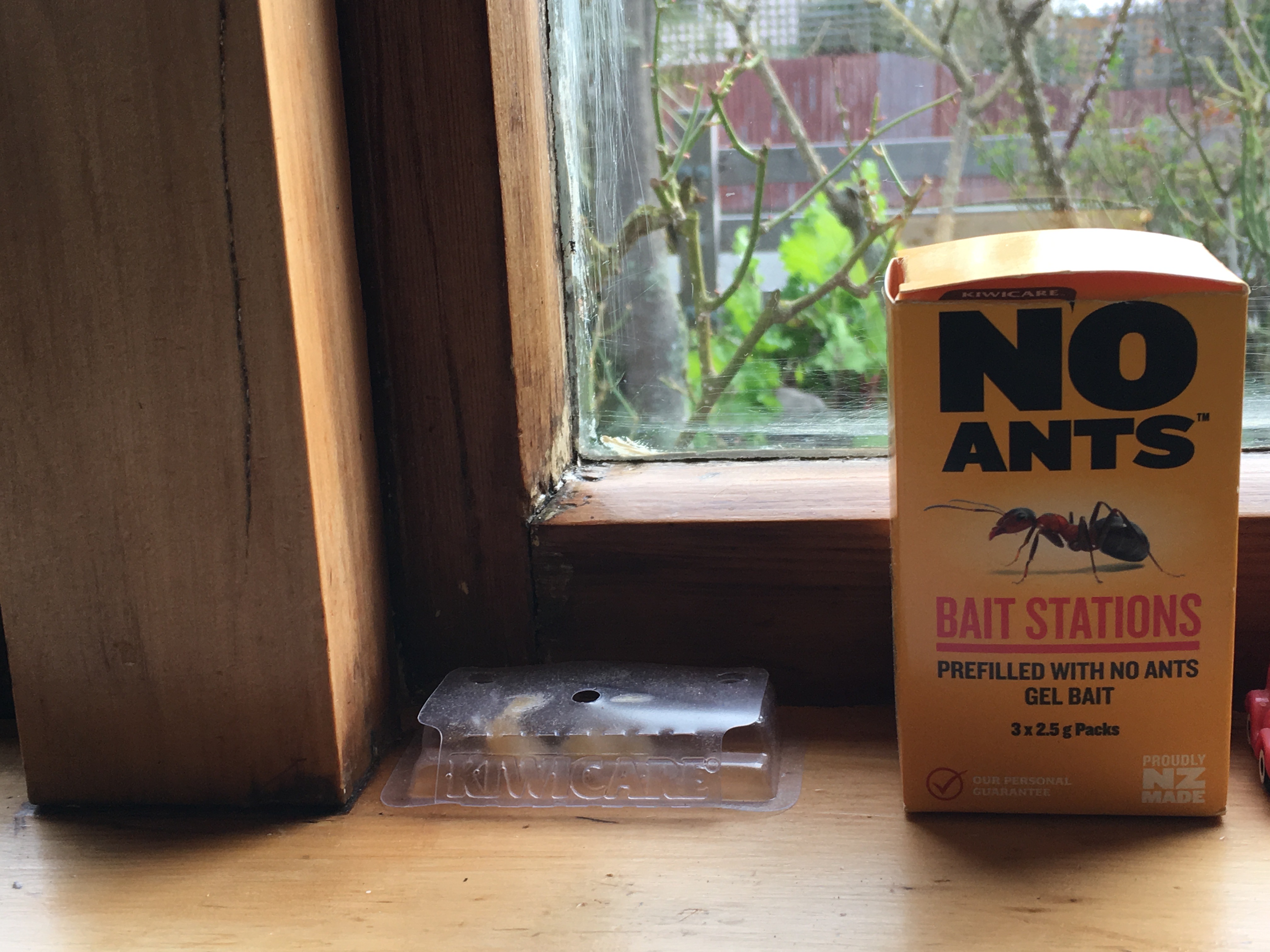
I enjoy the little native spiders which live on the window sills. I’m trying not to reel back in horror if ants arrive in the house – but the ant bait is still there. Apparently, a wipe-over with a vinegar cloth will disrupt their pheromone trails and encourage them to stay outside (something I learnt from a Year 9 student who had studied them – is there hope, then, in his generation?).
The representation of the ant on the box is designed to make us feel repulsed and justified in killing.
I don’t use sprays in the garden, believing – or hoping – that everything finds its own balance and who am I to interfere? However, white-tail spiders bring out possibly irrational disgust and are dispatched quickly (with a shoe). Daddy longlegs spiders (pholcus phalangioides, according to City Nature by Bob Brockie) in the corners of the ceiling get vacuumed up from time to time. Will I learn to leave them alone? They don’t seem to do any harm. Cob webs are swept down. Borer beetles give themselves away by the dust piles they leave. I inject the holes and fill them.
What was supposed to be a brief post is becoming more complicated as I uncover my own guilt in the demise of living things.
I’ve heard that the proclaimed “dominion” over all living things (ironically, when the first people were expelled from Paradise) is a mis-translation. It should be “guardianship” or care for all living things, like the Maori concept of kaitiakitanga.
An attempt to educate visitors about the fruit of the kahikatea tree at a local remnant of native bush. It is called “king” of trees – more irony: a term encouraging us to have respect by relating this natural beauty to human hierarchy.
One has to wonder if the mis-translation was deliberate; that we are hard-wired to put ourselves first at the expense of all else.
................... for lovers of ice cream. Your free on line magazine for sweet frozen treats. Recipes, inspiration, artisanal ideas for your delectation.








 Anne-O-tations