Cottage chic

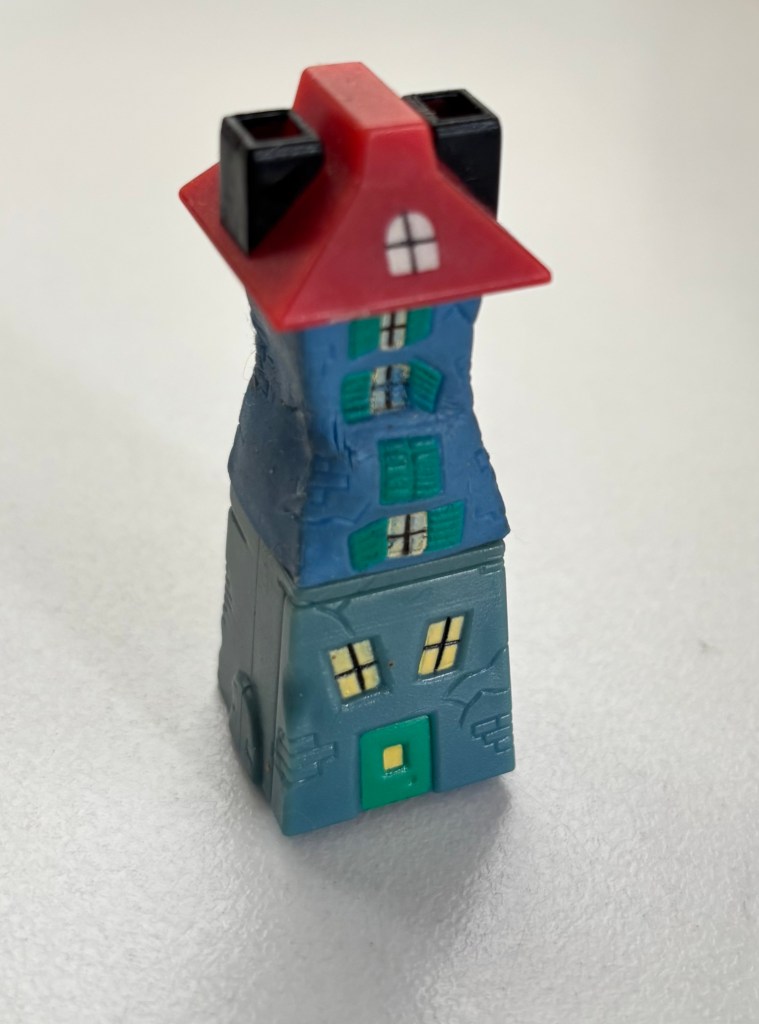
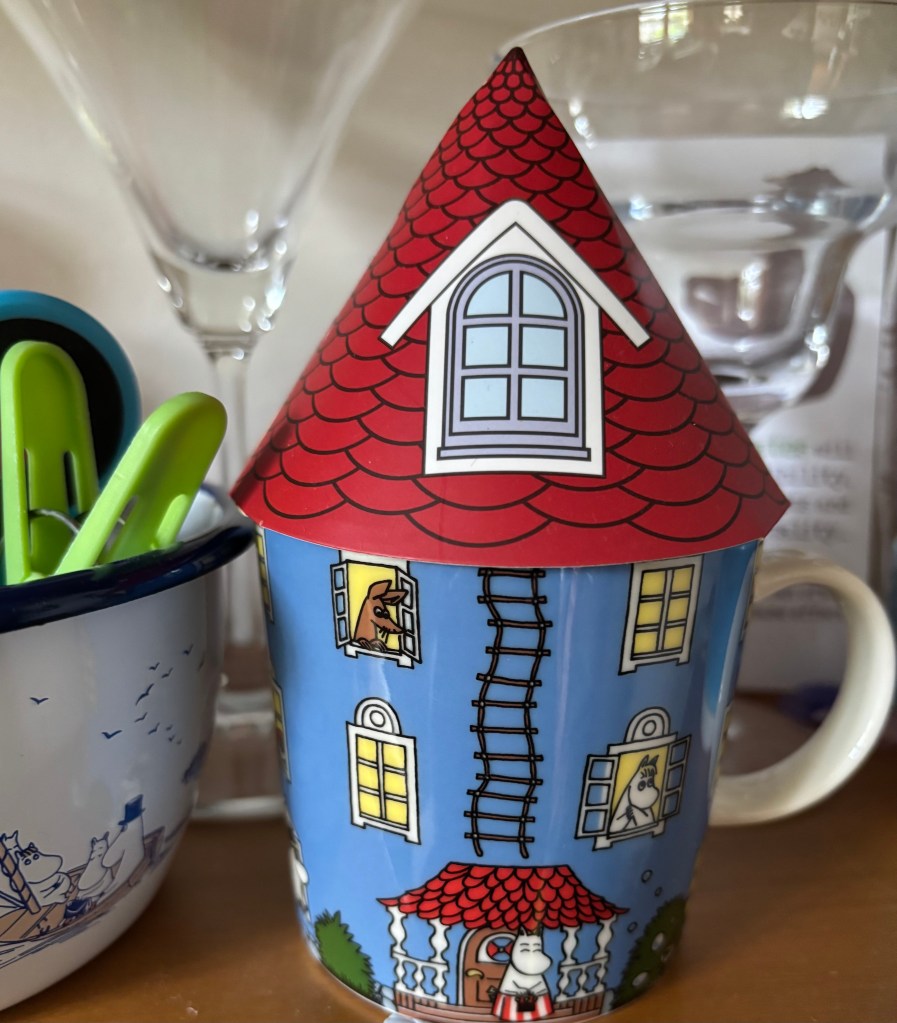
Now I’m seeing evidence of cottages everywhere in my house.

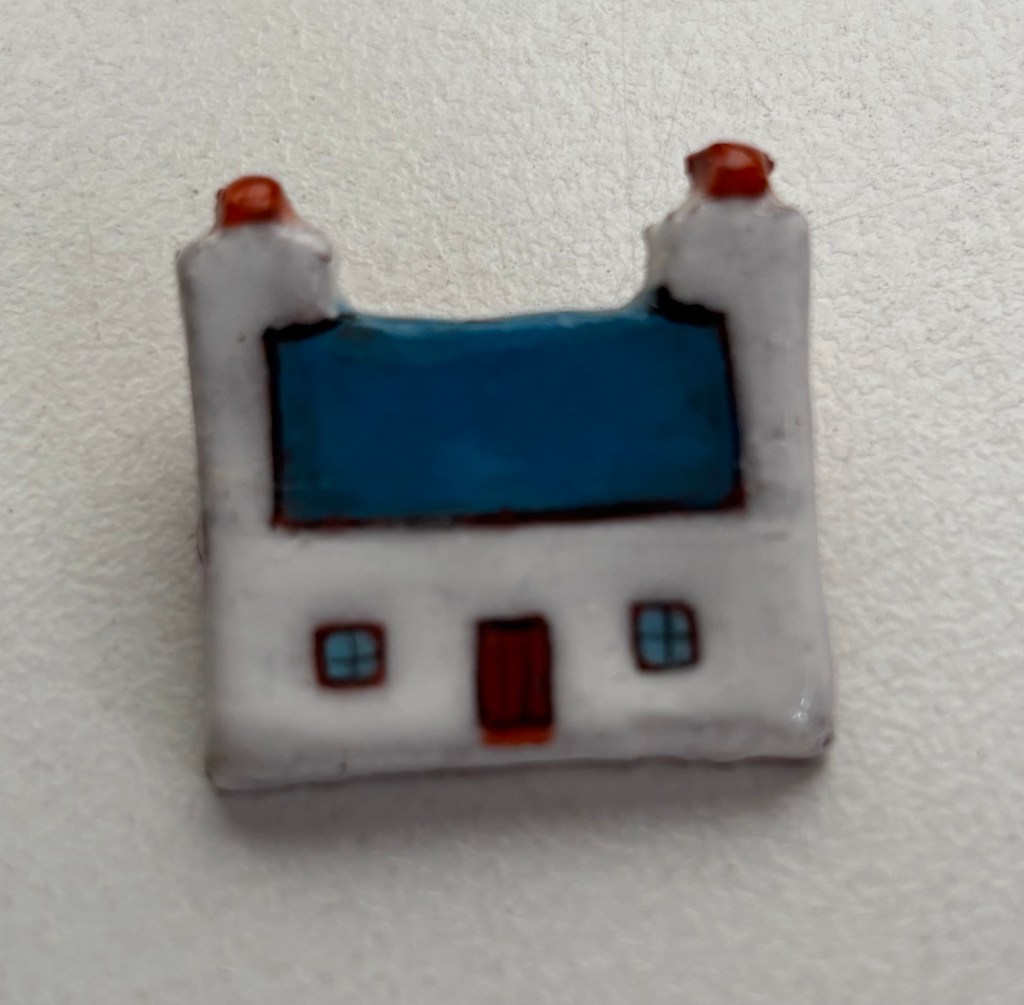
And then there are the many miniatures – a sort of ‘cottage chic’.

It’s no wonder that my brother said, on Friday, that he hopes he dies before I do so he doesn’t have to clear out my house. That comment prompted me to weed my bookshelves in the weekend and give away two boxes of books. I expect he won’t notice the difference!

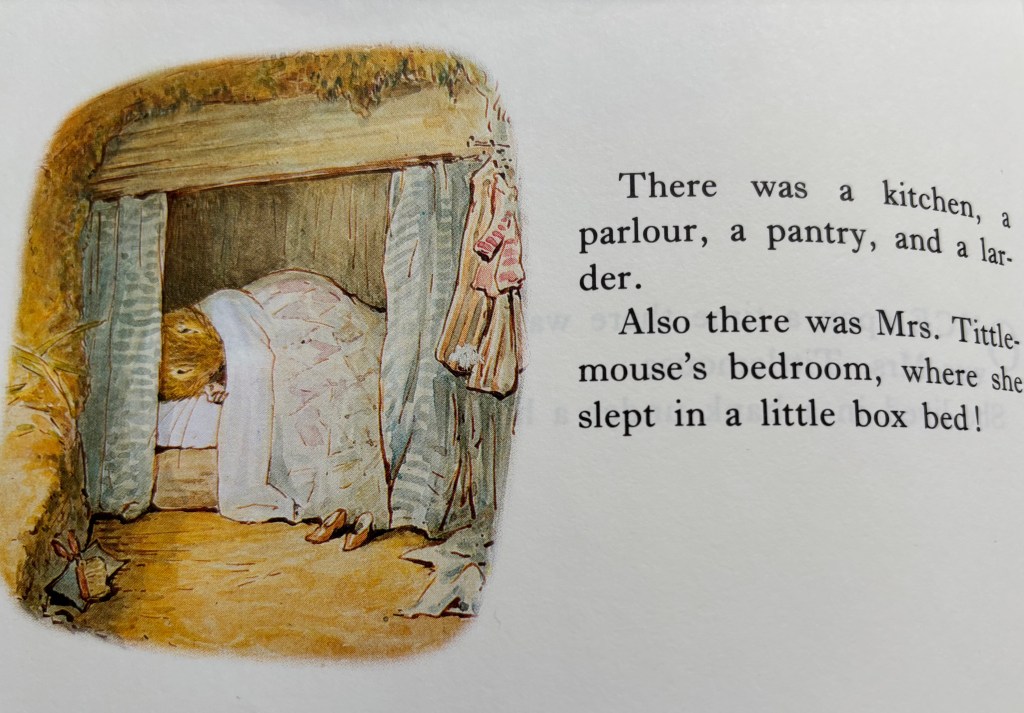
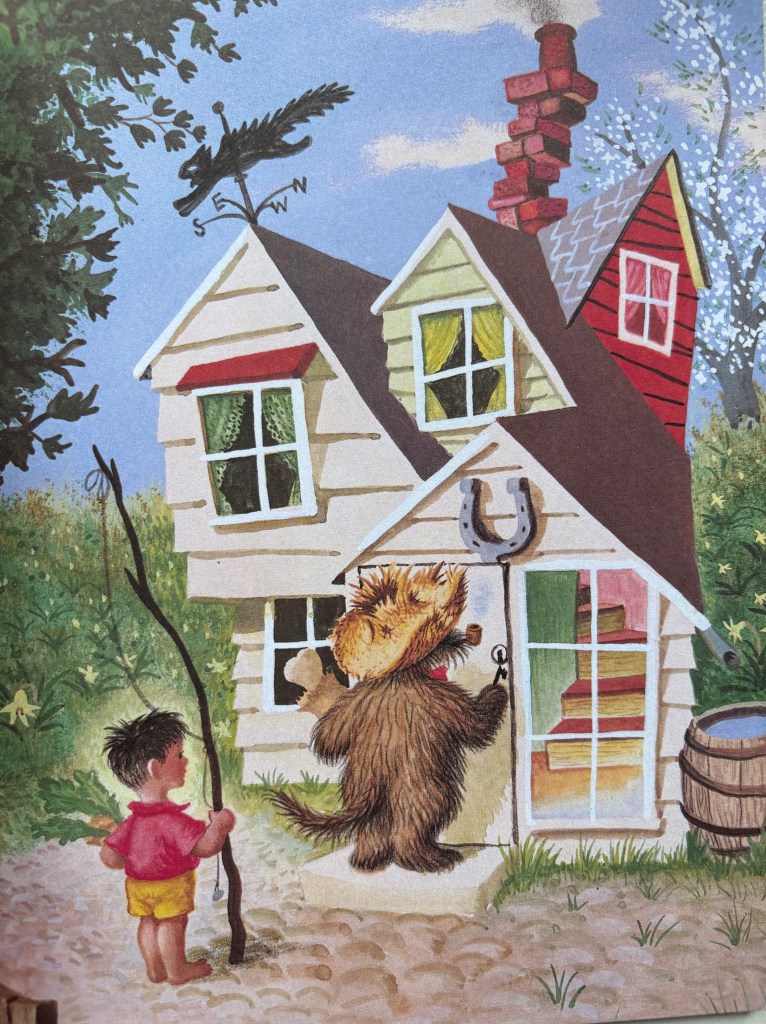
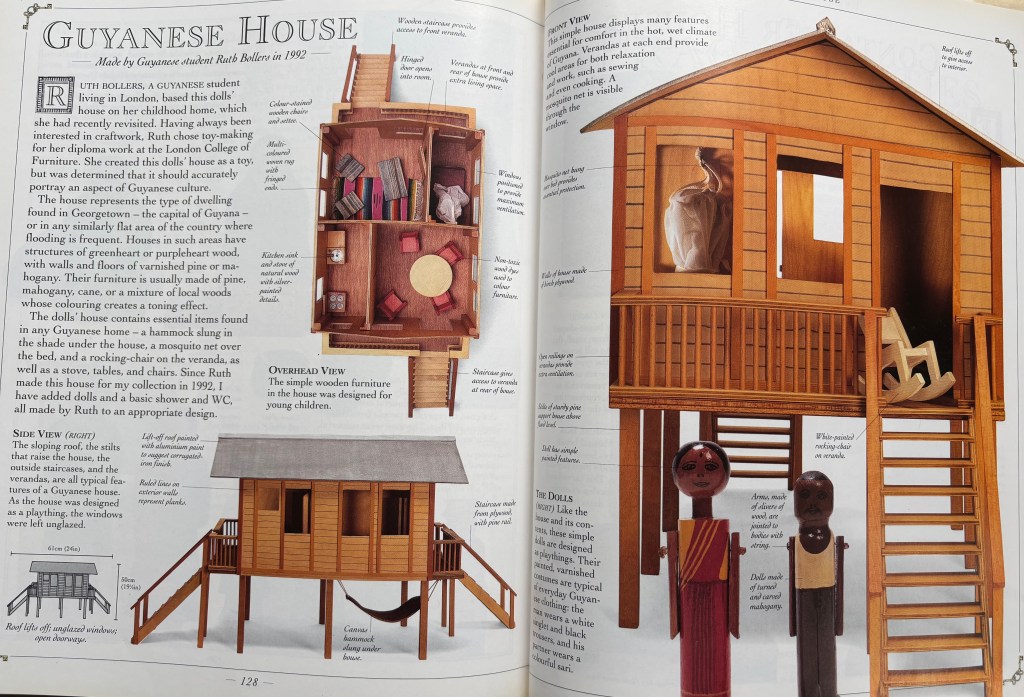
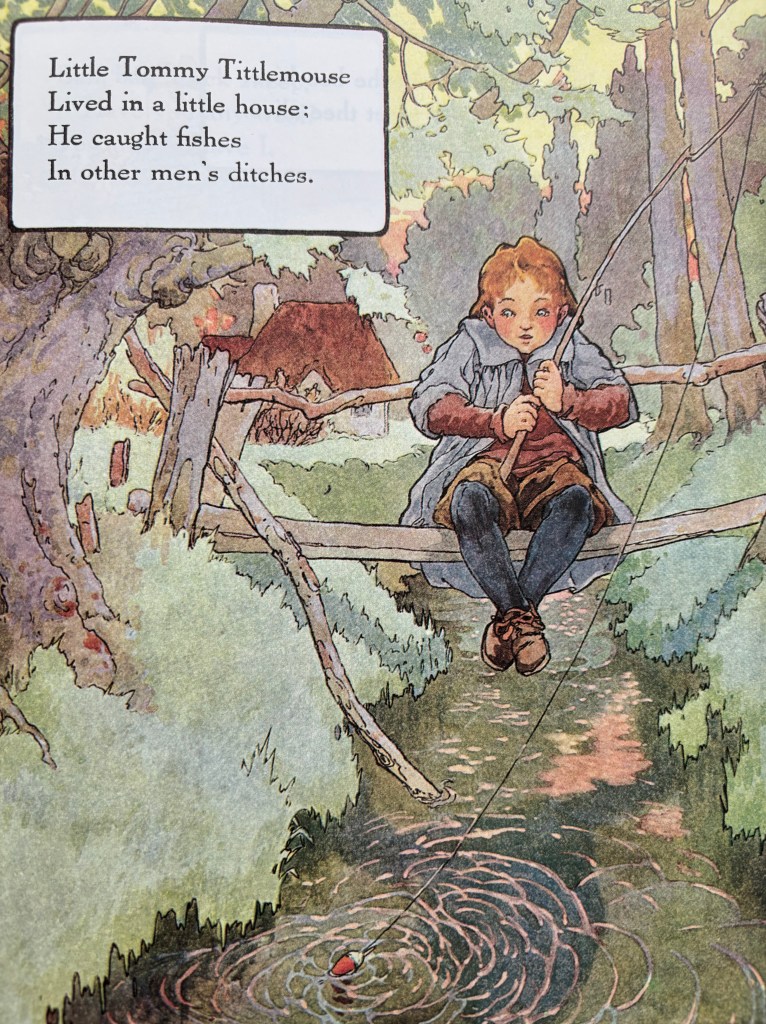
I suspect childhood reading was the source of my fascination with cottages. These pictures are from books I won’t be giving away.
Books with cut-away interiors intrigue me, such as the last photo (above) of a neolithic French rural cottage. As Katherine Mansfield wrote in The Doll’s House: “Why don’t all houses open like that? How much more exciting than peering through the slit of a door into a mean little hall with a hat-stand and two umbrellas!”

My favourite childhood book was Miss Happiness and Miss Flower by Rumer Godden. In it, a Japanese dolls house is built, similar to the one in my copy of The Ultimate Dolls’ House Book by Faith Eaton, along with other interesting cottages, reminding me of the Folk Museum I visited in Korea which replicated the interiors of houses over time.

It’s not only children’s books which feature cottages. There are many books about women (or men, as in The Searcher by Tana French) who retreat to a country cottage to regroup and reshape their lives, with mixed success, such as in Falling by Elizabeth Jane Howard. Miss Marple lives in a cottage in the English village of St Mary Mead. Tove Jansson’s fictional family in The Summer Book live in a cottage on a Finnish island. Other authors have shown the disadvantages of the cottage: Jane Austen in Sense and Sensibility, Claire Fuller in Unsettled Ground. Still, somehow, the romance of the cottage lives on, whether it’s a place of retreat or a place to set out from on adventures.

Book magnet

Everyday we’re either repelled or attracted by what we experience – or somewhere along the continuum from one to the other. Felix is very cute until he brings in a rat. I began this morning’s paper with anticipation only to put it down with distaste. I link these opposing feelings to the kinds of books I’ve been reading. I was a little repelled (that’s NZ-speak for very repelled) by aspects of a book of short stories titled Surplus Women by Michelle Duff. It’s literary fiction, after all the author won the International Institute of Modern Letter’s fiction prize in 2023. The book reminded me of Margaret Atwood’s short stories collected in Bluebeard’s Egg which I puzzled over at university until it clicked that the women were supposed to behave like that and never see the error of their ways – so we wouldn’t make the same mistakes, perhaps? With both authors the writing itself is the most attractive feature.

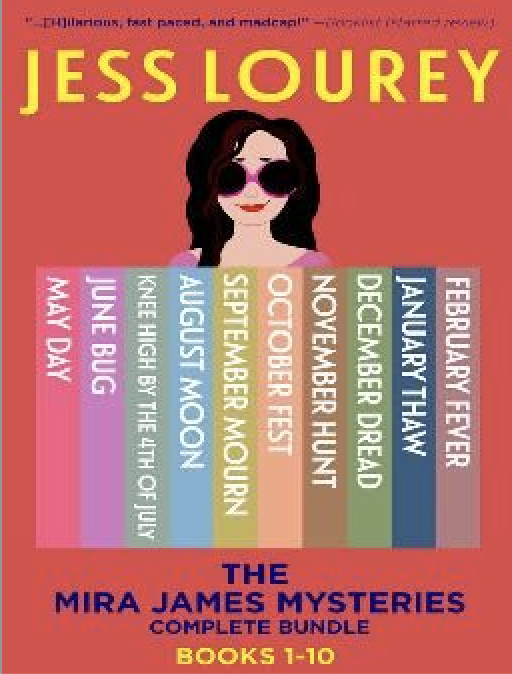
I am never without a book and, ever indiscriminatory (within limits), looked forward to slipping into the more comfortable, but somewhat mis-named, genre of ‘cosy crime’ to give me a break. I decided on May Day by Jess Lourey and embarked on a sometimes attractive sometimes repellent adventure set in the small town of Battle Lake, Otter Tail County, Minnesota (all real places). It’s attractive for the hilarity and social commentary and somewhere on the spectrum to repellent for the food, weird Americanisms (‘a couple moments’ instead of ‘a couple of moments’ is just one example) and quirky characters – reminiscent of Janet Evanovich’s Stephanie Plum series, but engaging for its freshness*. I’m too entertained to be bothered by the sneaking suspicion (i.e. awareness) that the writer knows too well – and manipulates – her reader, but that is perhaps the same for all fiction writers; part of the writer’s craft. Of course, May Day turns out to be the first of a Book by Month series. The first was cheap on Amazon, after which the price of each book quadruples. So I looked it up on the library catalogue and have downloaded all ten books in the series for free and have 14 days to finish them. A fest of alternating attraction and distaste. I’m up to July.

*Both Evanovich and Lourey get a lot of laughs out of the antics of elderly folk – but then, so do I. When I took Mum (aged 96) to have a blood test on Thursday she announced in the waiting room that her stockings were falling down and proceeded to hoist up her neat tweed skirt to make the necessary adjustments. (Luckily, there were only three people in the waiting room, a man intently involved with his phone and two others hastily heading out the door. A courier driver at the counter had his back to us and was taking his time.)

A Different Kind of Power

At the end of her memoir, Jacinda Ardern imagines giving advice to a young girl who doubts herself.

The things you thought would cripple you will in fact make you stronger, make you better. They will give you a different kind of power, and make you a leader that this world, with all its turmoil, might just need (pp131-132).

It was hard to put this book down (in more ways than one). It answered a lot of questions I had about what it was like being Prime Minister, a sensitive, principled, idealistic and female one particularly. No ghost writer was involved here, but surely a good editor. It is very well written and well structured; parts of it echo and link, particularly character-forming moments from early in her life which serve her well when making hard decisions later. It goes well beside Michelle Duff’s biography, which gives the political and social context more than it gives details about her life.

I looked through my 2020 diary to find mention of Ardern’s government and the covid response and was shocked to find there was very little. And yet it occupied our daily lives and our thinking in all her years in government. My journal did a better job, thankfully, and I had slipped newspaper cuttings into it which are interesting to read now. Something else in my journal caught my eye. In November 2021 I was reading Deborah Levy’s first memoir Things I Don’t Want to Know and had copied down this extract where it occurs to her that like other women she is ‘on the run’.

We were on the run from the lies concealed in the language of politics, from myths about our character and our purpose in life…The way we laugh. At our own desires. The way we mock ourselves. Before anyone else can. The way we are wired to kill. Ourselves. It doesn’t bear thinking about (pp158-9).

I remembered Ardern writing in the memoir that she was ‘on the run’ from one thing to another in her life. She discusses with a friend their shared tendency to ‘run away’ from things. The honesty of her self-evaluation is an admirable aspect of the book. When she decides to leave Helen Clark’s office and go to New York she worries that she could not be sensitive and survive in politics.

Was I running away? Probably. But that was better than staying and facing up to the fact that I couldn’t do something (p122).

In the Acknowledgements, Jacinda Ardern thanks her mother for going through ‘endless journals’ for her. Clearly, the family kept better diaries than I, and it explains the careful details of Ardern’s early years and highlights the collaborative spirit of her family who have supported her and her own family consistently.

It seems like a completely different time we lived through during Ardern’s two terms as Prime Minister – certainly a contrast to the current government. An article I found tucked into my journal describes the change as ‘Retrograd’.

People whose outlay involves enormous houses, multiple properties, private schools and expensive cars will demand tax and rates cuts, while furiously complaining about public services…Mention you’ve waited hours for an ambulance, or that mental health services are stretched to the limit, and they’ll be indignant. They will blame the government. Then they will briskly use the tax cut to transport the family to a holiday in Europe. This is Retrograd, where you take it all for yourself, live your best gated life, enjoy the paradise of your own scorched earth.

-Charlotte Grimshaw, Listener, 26 March 2022

A Different Kind of Power gives me some hope that these days won’t last – before climate change beats us to it.

Uproarious!

Two hot days in a row were all the excuse I needed to sit in a cool spot and read. Consequently, I’ve just finished this brilliant, entertaining and educative book by a 27 year-old historian. I had thought of skimming through it quickly, but it was so engaging that I read every word – sometimes more than once! The author would like to rescue the once famous (infamous?) visual satirists (mainly Gillray, Rowlandson and Cruikshank) from Victorian censorship – Prince Albert burnt many he found in the royal collection. She claims that they were such an influence in their time that they likely changed the course of history. As the cover illustration shows, they caricatured political figures, here showing PM William Pitt and Napoleon Bonaparte carving up the globe – you could substitute them for Trump and Putin.

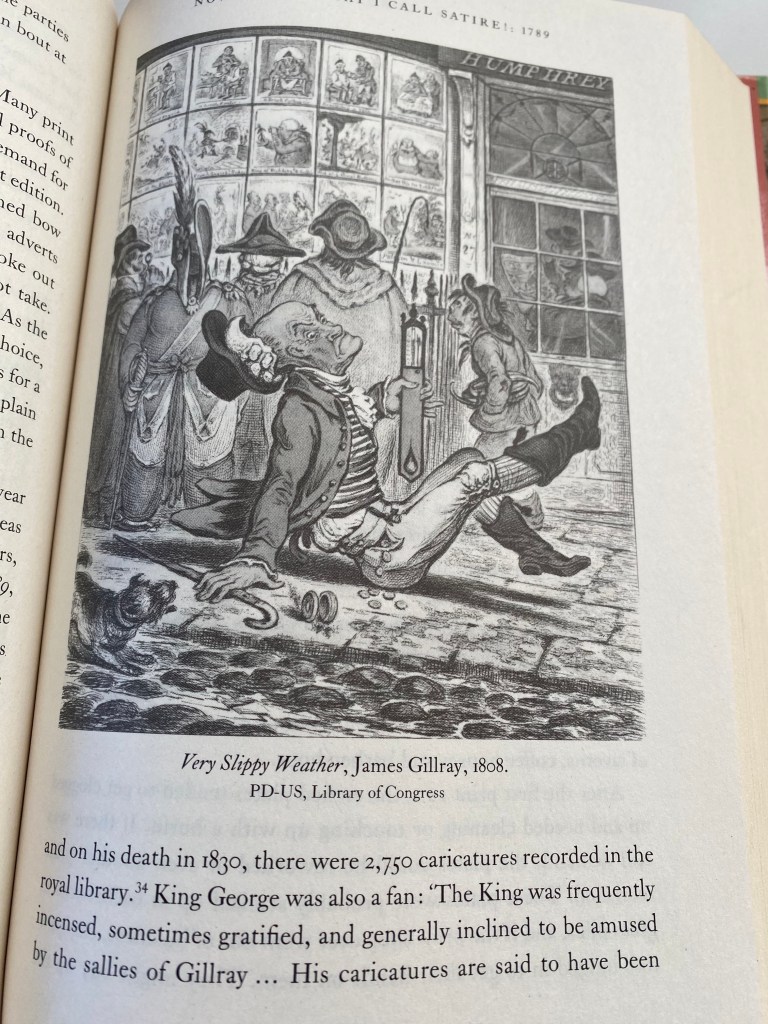
People would crowd to the bow windows of the printmakers (here, the shop of Hannah Humphrey) to see the latest cartoons – often in the hope (or dread) that they might feature in the caricatures themselves – and to buy some to add to their collections.

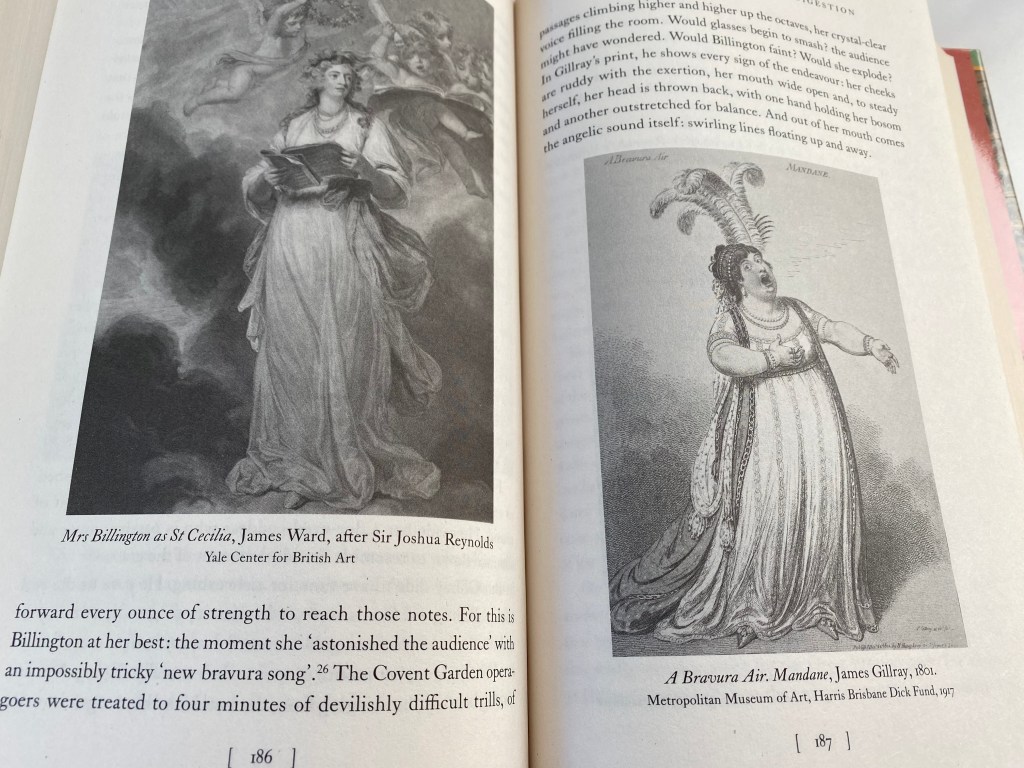
While portraitists and painters may have been held in higher esteem, the satirists were generally formally trained in those skills too. This image shows the contrast between the two forms: one an idealised portrait of a celebrated singer, while the caricaturist brings her down to earth.

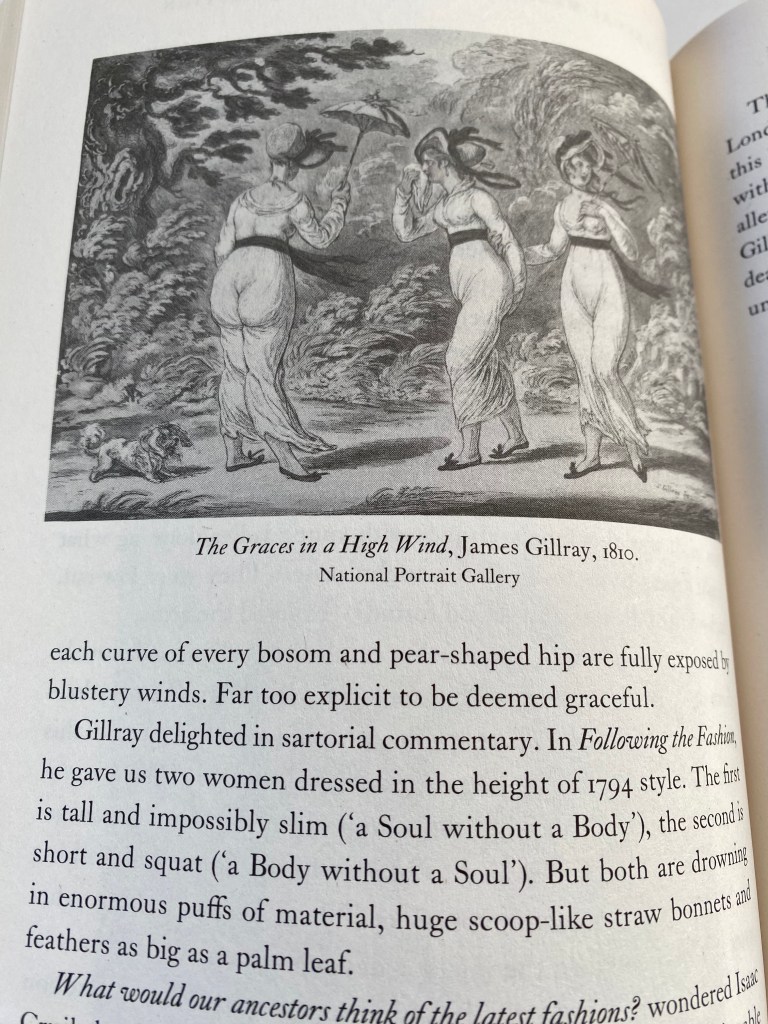
I am amused by this send-up of a fashion trend in muslin dresses better suited to warmer climes than the English weather.

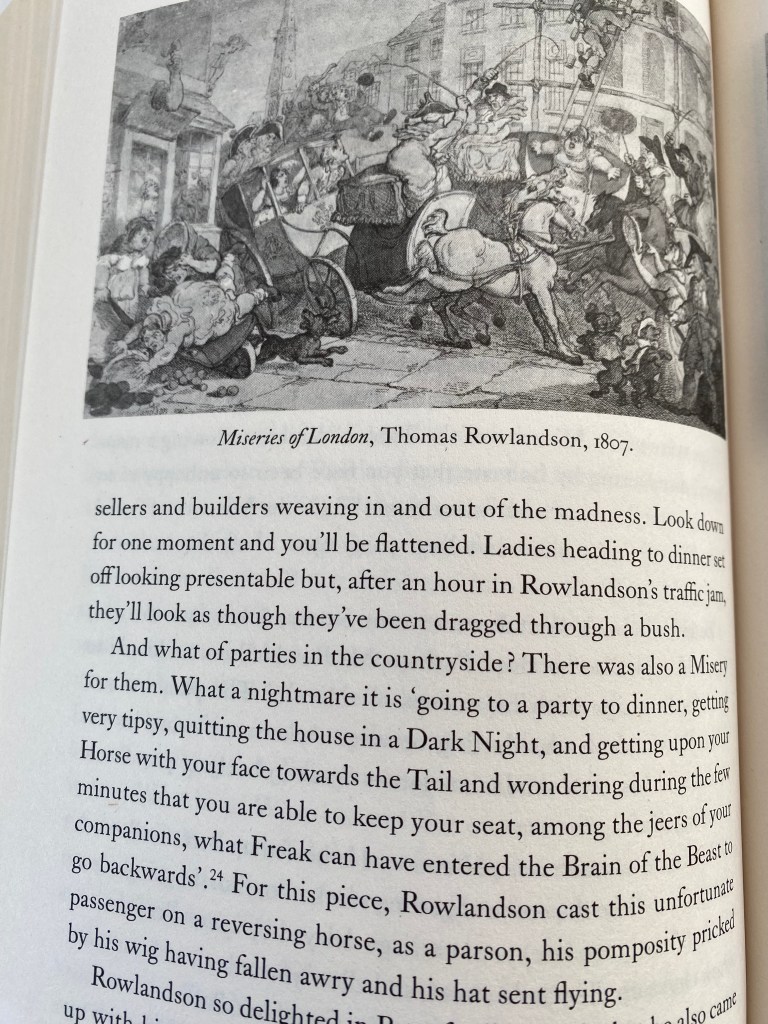
And here’s a Georgian traffic jam in London. I’ve included text again so you can appreciate the author’s very readable writing style.

Many of the caricatures are of brutal scenes, particularly of the French Revolution, which shocked the public and, despite general disapproval of George III and more so of his profligate heir, may have put people off trying the same thing at home.

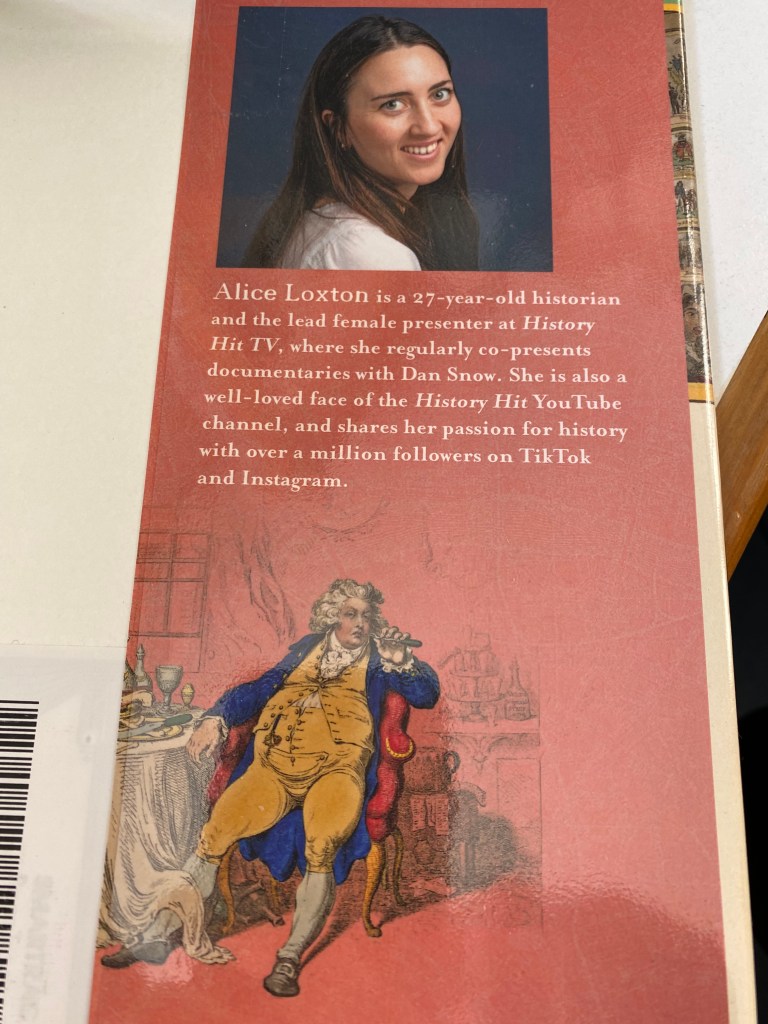
Here’s a bit about the author, with a caricature of the Prince of Wales (later George IV) by Gillray below.

Unruly

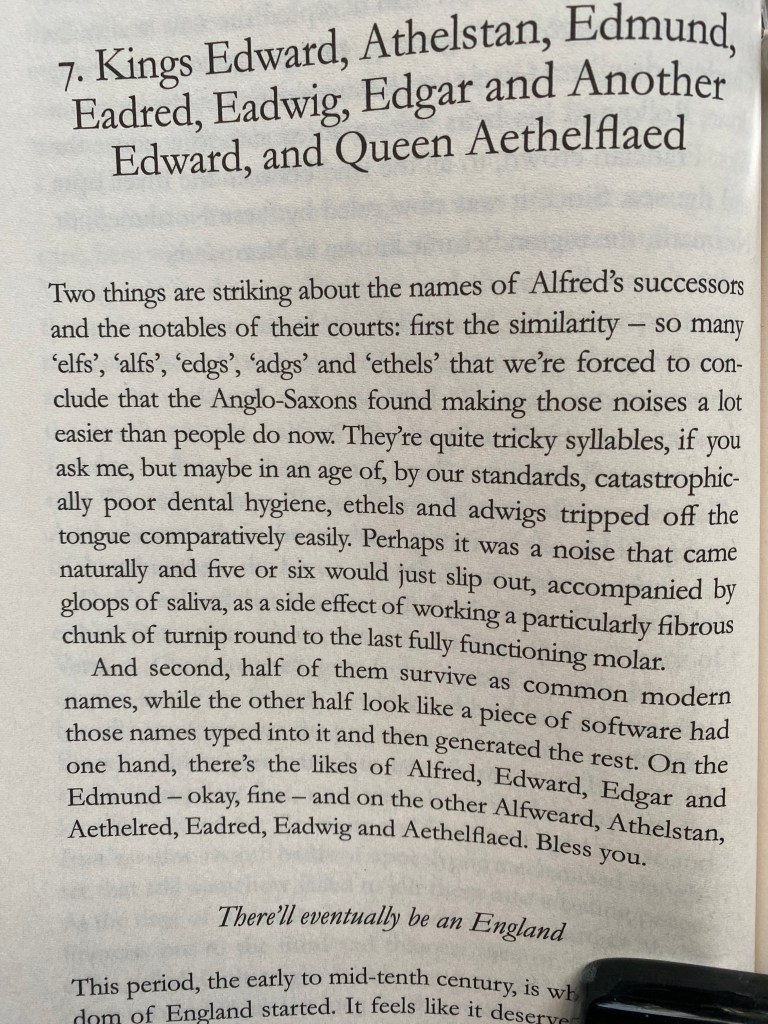
An appearance by David Mitchell to promote his book on The Graham Norton Show prompted me to order it from the library. It is proving to be an excellent complement to other history books I have been reading and the courses I am attending this term about women leaders in history. I had though Joan of Arc was the first woman to wear armour and go into battle, but it seems Aethelflaed (see fragment of notes in photo below) did that too – and, we now know that Viking women operated as warriors too – not to mention the Amazons. However, this is not the subject of this book which is about the men, mainly, who became kings by various means – not usually pleasant (either the kings or the means). And, he stresses, King Arthur was not real. He was an ideal which none of the kings lived up to, but loved to use for propaganda purposes.

Unruly is a refreshing book to read. Although David Mitchell has an academic background and a life-long interest in history, he is also a comedian with a somewhat cynical and humorous take on human behaviour, getting quite worked up about some of it, as you will know if you have seen him on QI or Would I Lie to You. There are many laugh-out-loud moments in this book.

It’s nice of him, I guess, to apologise for the lack of women coming to the forefront in history. Mainly, they are married off (at around the age of 12) to cement alliances with ‘noble’ families or the rulers of other countries. Unruly gives a fuller picture to the books I have read which focussed on women in history such as Femina, Unquiet Women and The Good Wife of Bath. He is blunt and forthright about the men who fought their way to the top, as you might expect from the clever title. Basically, most were a bunch of thugs who wreaked havoc on the lives of ordinary people in their quest for power and domination. The ‘harrying of the north’ is a case in point, where William I (the Conqueror) ‘went around slaughtering people and burning villages, crops and crop stores. The hope was that the area would no longer be able to support the king’s enemies’. This sounds sickeningly similar to the headlines in the news this morning. I really do get the sense from all this that human nature has not changed one bit. It’s kind of nice, in a perverse way, to learn that William the Conqueror eventually exploded. You’ll have fun finding out how if you read the book.

As you can see, the author is happy to refer to himself and to make parallels with modern times – a refreshing change from more ‘academic’ writing. However, like these serious tomes, it has coloured plates, an index, and a list of further reading. In the Acknowledgements he says his intention is to produce ‘a history book that aims to be funny but not spoof, irreverent but not trivial’. He has achieved that.

Back on form

There were a couple of ‘blah’ days this week. I guess I was worn out from the long drive south, all that emotional energy spent, the socialising, swimming in the salt-water pools, watching albatross soaring so easily after flying hundreds of kilometres, relaxing with sea views…

However, I hit the ground running yesterday. Two loads of washing, vacuuming, and supermarket shopping filled the morning. My mojo’s back! Even this morning I’m getting ready to wash the floors – and there’s more washing on the line.

In the afternoon I searched the internet for a copy of A Book of Noises by Caspar Henderson and found that it was available at the University Book Shop. I’d read a review of it in the Listener. The review mentioned that there’s hardly any sound in space, although the author wittily wrote, “Except, perhaps, for the occasional billionaire shouting ‘Whee!'”

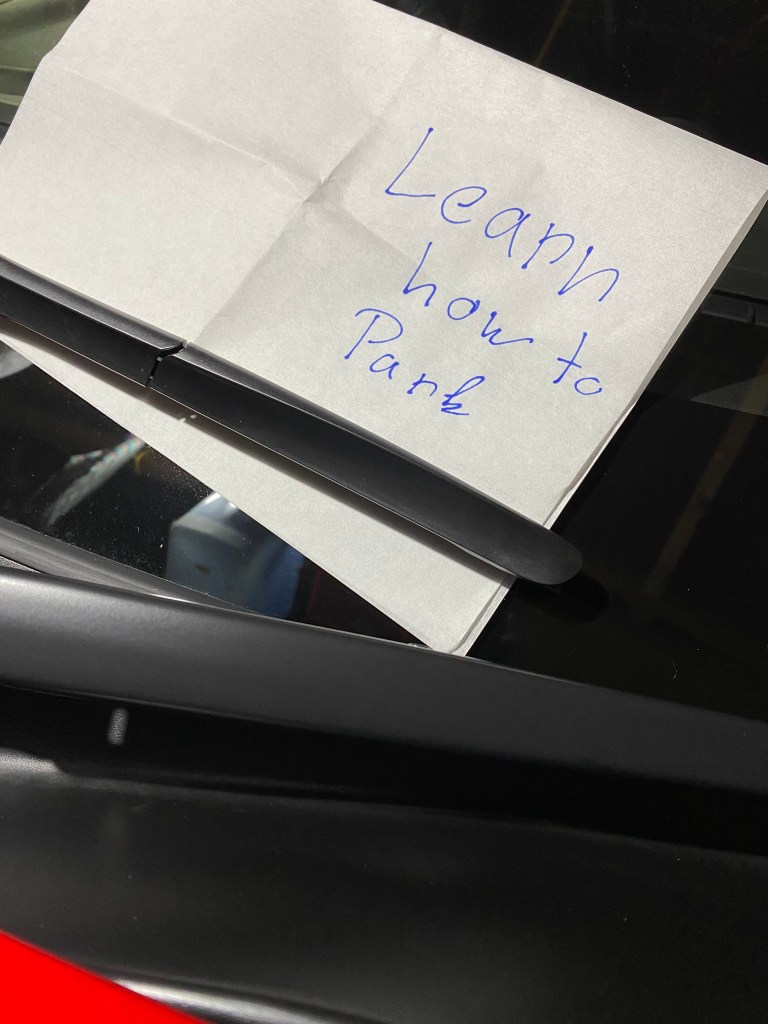
I drove to the University and squeezed into a tight angle park. My front wheel was a bit over the line into the neighbouring space, but I didn’t bother straightening up, thinking I’d only be a minute, and my energy levels were dictating that I keep moving.

Of course, I was in there for more like 30 minutes. There’s so much to see, and I came out with six books, not one.

There was a piece of paper under my windscreen wiper. A flier about some student activity, I thought. But, no. This made me laugh out loud:

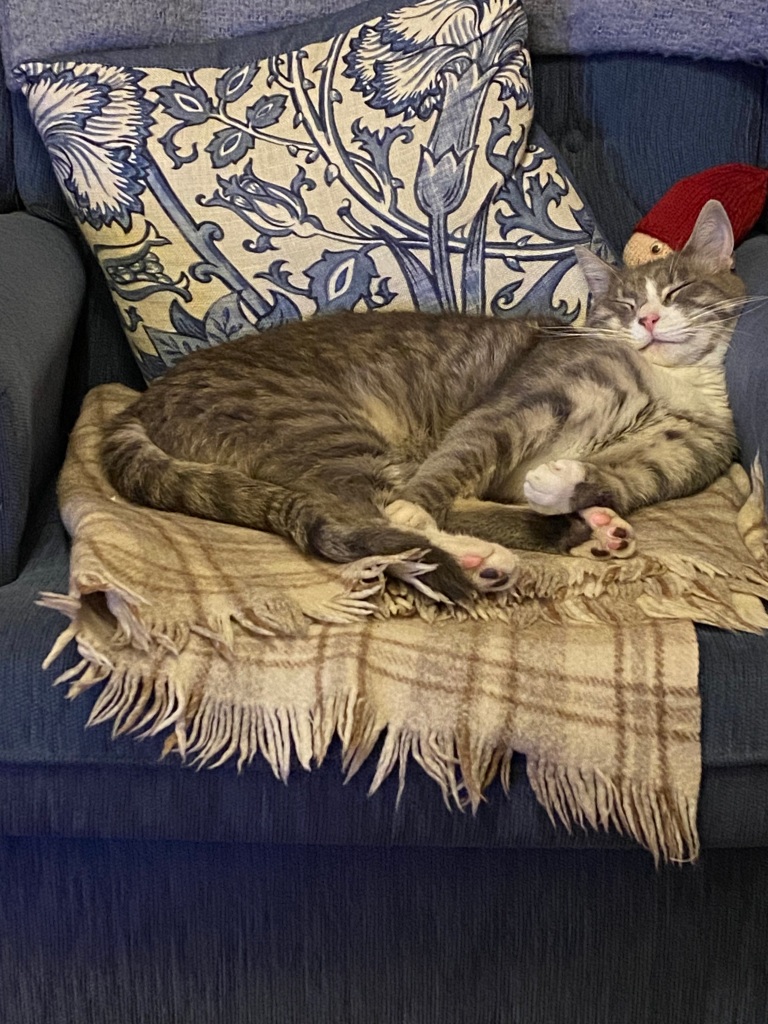
Felix is also back on form – much more laid back than I am – and with the habit of occupying my chair if I happen to leave it for a moment. He’s an expert at looking instantly relaxed (although his tail puffed up to four times its normal size yesterday morning when, having followed me to the gate, he was surprised by the near silent approach of a passing jogger).

Now, where’s that mop and bucket?