It’s the time of year when going to the movies – into a darkened room – is more appealing than during summer. I walked into town in brisk, windy weather after getting my flu injection this morning. During the 20 minute waiting time before I could leave the medical centre, I looked up what is on at the movies and found one perfectly timed after my singing class and just a block away at the Arts Centre. I am impressed by the art of Frances Hodgkins, have been to the European Journeys exhibition and read the book, and was delighted to see that the documentary Frances Hodgkins: Anything but a Still Life which first screened almost a year ago was making a return visit to the Lumiēre cinema. It proved to be wonderful and completely absorbing.
The cinema is pretty impressive too, making excellent use of a part of the Arts Centre overlooking the Botanic Gardens and decorated with style.
After taking this photo, I turned to take one of the gilt mirror with seashell motif opposite and, of course, found I was reflected in it. Not only that, but my lovely passed-on jacket almost matched the colour scheme. I sent the photo to the friend who passed on the jacket and she advised me not to sit on the sofa in case I became invisible!
I was tempted to go to the movie which was about to begin as I left (Wicked Little Letters) but decided to save it for another day and walked home, scuffing through leaves on Montreal Street, dodging scooter riders in Cranmer Square, and reliving the documentary I had just seen.
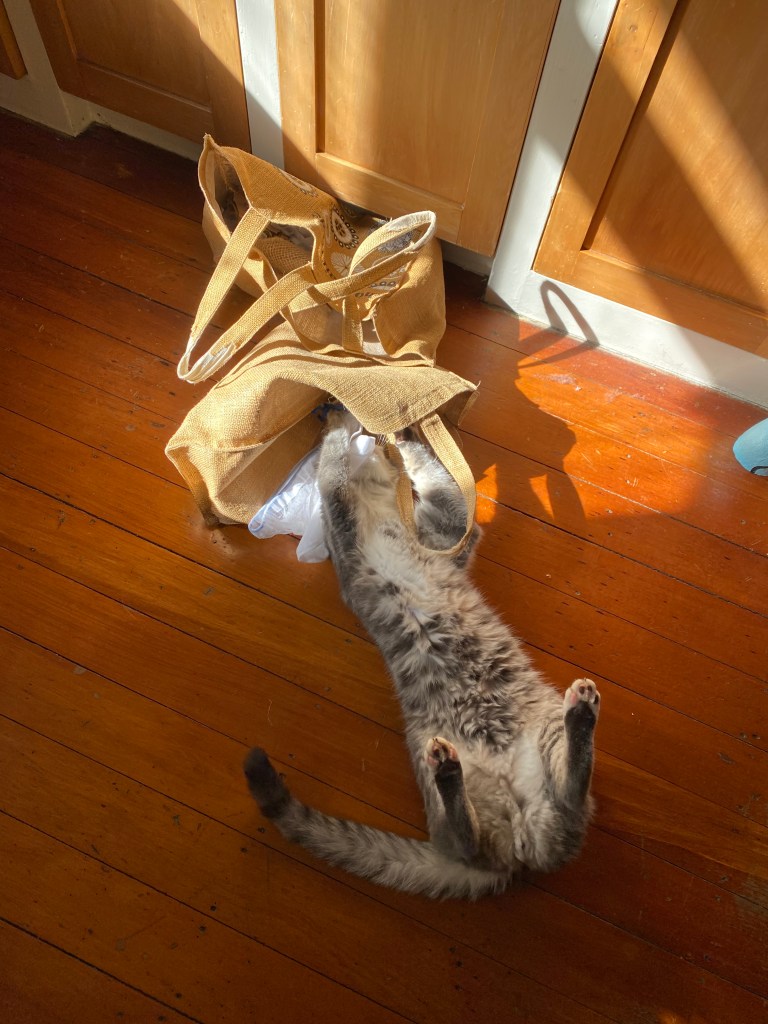
Post Script for Felix fans: Felix helped unpack the shopping (again) this afternoon.
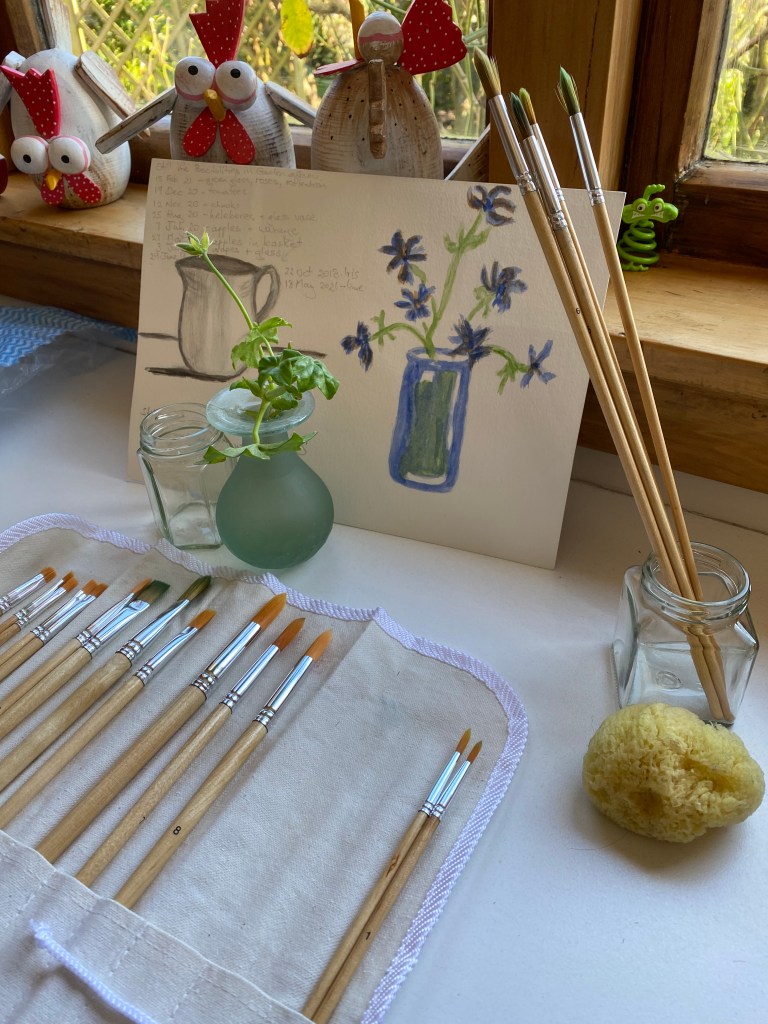
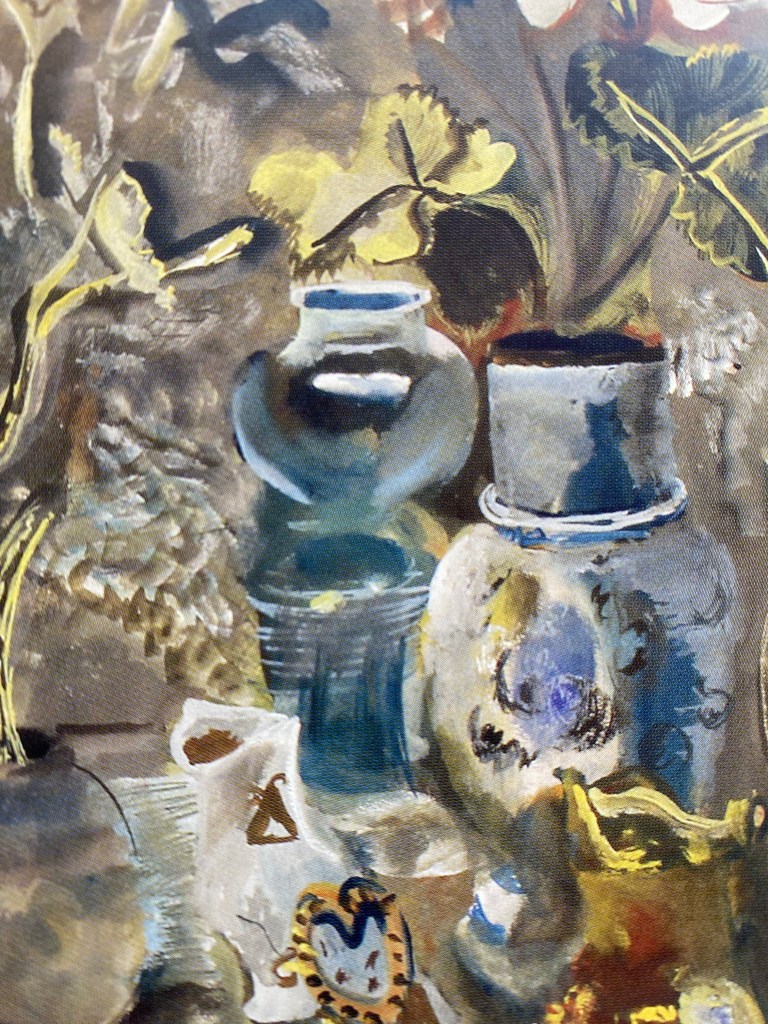
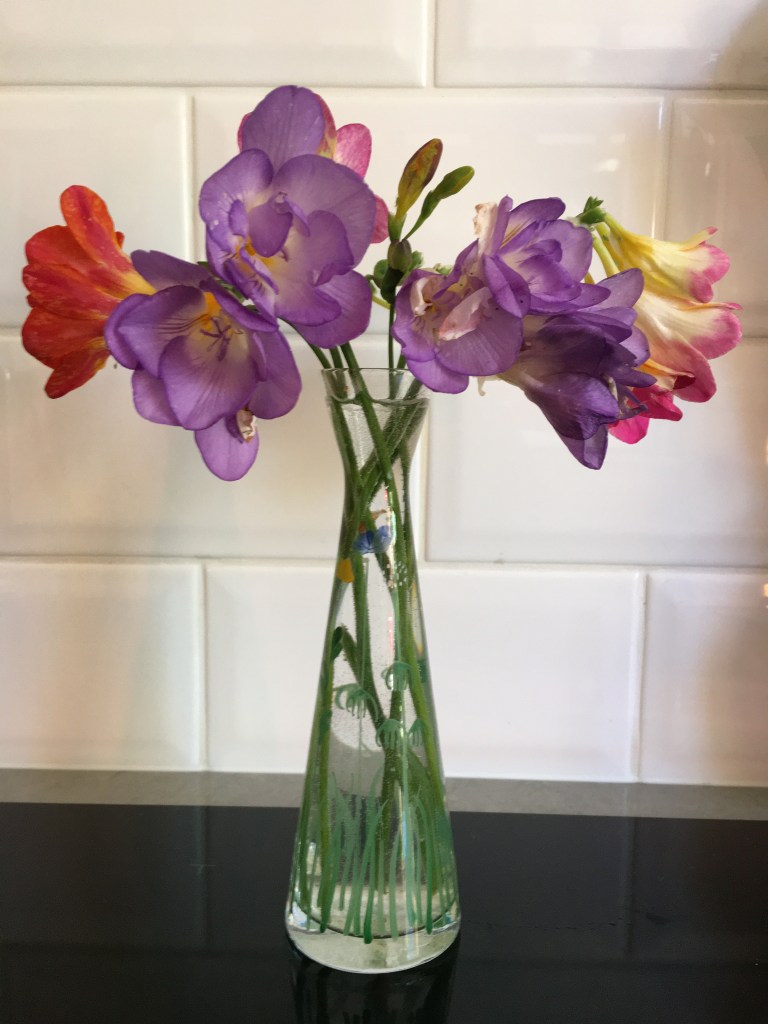
The second session of watercolour painting yesterday went better than the discouraging first. I was slightly better pleased with my effort, having decided to attempt still life images with flowers and the shapes of vases and jugs. The translucency of glass interests me – with inspiration from Frances Hodgkins.
Chairs and Pots, 1937China Shoe, 1942
Well, I will have fun trying anyway!
The shapes of chickens might be achievable as well, such as these images which appeared on the windows on a frosty morning in the weekend. I had moved the decals a few times and the shapes were revealed in the condensation on the glass.
There’s a lot going on this Frances Hodgkins painting, but you may be able to find the chooks in there. I suppose you would call this a busy scene as opposed to a still life.
A Barn in Picardy, 1914
A number of ‘still life’ photographs I have taken at home and in the garden could be useful for inspiration, but I suspect some things are better left as photos!
Here’s a very faded print of the ultimate still life which points out that all our efforts are in vain – which gives me an idea: I could attempt visual metaphors. A dead bee beside the vase of flowers…
Now that the art galleries are closed, I’m pleased I spent so much time carefully viewing each painting in the Frances Hodgkins European Journeys exhibition on three occasions. By my third visit we knew more about Covid-19 and I was not keen to use the touch panels! There was an elderly couple carefully viewing the paintings. I felt quite sorry for them (even when one of them sneezed copiously); they looked quite frail. It would be a last treat, I expect, as before long over-70s were asked to remain at home.
I took note of who owned the paintings. The Auckland Art Gallery seems to own most of them. Other owners include the Christchurch Art Gallery, Te Papa, the British Council, Dunedin Art Gallery, and some private owners such as the Fletcher Family Trust. I was a little disappointed not to see the painting entitled Loveday and Ann. I looked it up online and found it is currently with the Tate St Ives. This seems fitting, as Frances Hodgkins lived and worked there for some time after she had to return to England from France at the beginning of World War I. The painting is dated 1915 and had two private owners (one of whom inherited it) before being purchased by the Tate London in 1944. It shows two women with a basket of flowers. The different characters of the women are quite striking, not to mention the bright colours.
The striped chair in Loveday and Ann reminds me of Hodgkins’ self-portraits which feature a favourite chair with objects belonging to her arranged haphazardly. I like this way of doing a self-portrait.
After my second viewing of the exhibition, I found the way I looked at things was enhanced. I would be struck by how a scene looked like one of her paintings. Even the pink bathroom cloth hanging over the window catch with pink flowers in the garden beyond reminded me of the rose tones she used in her later work particularly. She had a number of paintings which showed objects in the foreground and views through an open window or door.
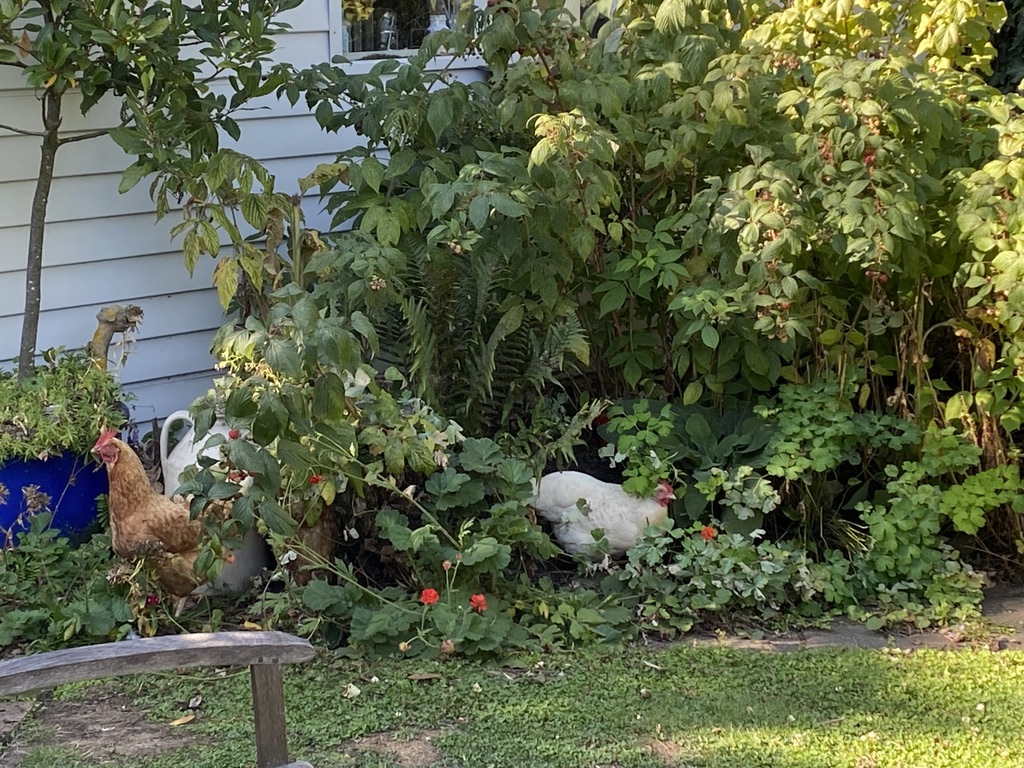
The first time I experienced this “painterly eye” effect, was on observing my hens scratching about under the raspberries.
I wasn’t sure, but I thought one of Hodgkins’ paintings featured hens. On my third visit I found it.
This is an early work, painted in 1914; watercolour and charcoal. It is entitled Barn in Picardy. (I’ve also caught the reflection of the exit sign in my photo!) This painting is owned by our art gallery, so I look forward to seeing it more often.
Many of Hodgkins’ paintings respond not just to landscape in the many places she worked, but to events at the time, particularly wartime. In World War I she tended to paint portraits or inside scenes, as she could come under suspicion for painting outside in St Ives, on the Cornwall coast. In World War II more abstract trends in painting seem evident in her work, but rendered in her distinctive style. Her portraits too, could make social comment, such as The Edwardians (1918).
I like this photograph of her, particularly her woollen socks! Worn over thick stockings, I could see, by looking closely at the bigger-than-life photo on the wall at the exit from the exhibition. Yet bare arms. Practical considerations, perhaps when painting. And does her slumped posture indicate how grateful she is to sit after painting for long hours? She was 76 in the year this was taken (1945).
The Press today lists online exhibitions we can visit while the galleries are closed. A nice way to feast on visual experiences and nurture (code cracker word today) the painterly eye.
Dull weather today and a great opportunity to get stuck into these great books.
I used part of a book voucher given to me on my retirement by my department colleagues to purchase We are Here. Thank you! I want to use the voucher for books which will give me years of enjoyment and interest. This one is sure to do just that. It is informative and beautiful to look at; deservedly on the shortlist of the illustrated non-fiction section of the Ockham Book Awards. I am pleased to see Wild Honey, previously reviewed on this blog, is shortlisted in the general non-fiction section. I like the Table of Contents pages in We are Here. It’s like the formatting of websites where you can choose list view or icons. Here you get both simultaneously. There’s a ribbon page marker too.
There is a lot of written text in the book, but the illustrations make it particularly captivating and informative in an accessible way about all manner of aspects of Aotearoa from living things to a musical timeline.
The knowledge and creative energy which have gone into this book are astounding.
As I write this, I can feel the earth stretching and rolling below the house – a 3.2 quake, 12 km deep, 5km east of the city, according to Geonet. Such events are featured in the book.
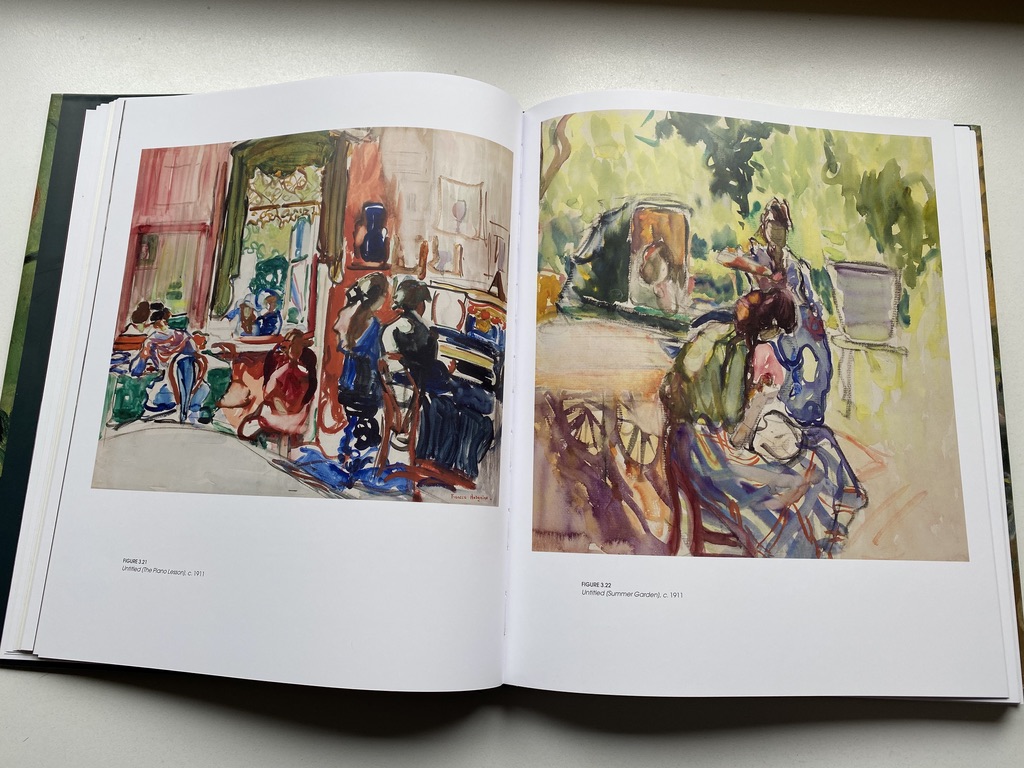
The other “hefty tome” is Frances Hodgkins European Journeys which accompanies the touring exhibition, currently at the Christchurch Art Gallery Te Puna o Waiwhetū. This book came free from the Listener when I renewed my subscription last year. I cruised lightly through the exhibition a week ago intending to read the book and then re-visit. The book is fascinating. I’ve read a lot about Katherine Mansfield heading off to Europe to pursue her art at about the same time. Rather than her being all alone in that pursuit, albeit prose and poetry rather than painting, this book records lots of artists from New Zealand doing the same. Hodgkins’ work was, perhaps, more sociable than the necessarily isolated work of the writer. She made friends of fellow artists who worked together in London, Europe, North Africa and Cornwall and who supported one another. Like Mansfield, Hodgkins was fierce in sticking to what she was good at rather than being swept up by current trends – although these were influential too. “It is a difficult game I am playing but I must play it my own way though it is hard sometime to keep one’s head level & ones heart brave – but I feel my work must win in the long run” Hodgkins wrote to her mother in 1907 – with her idiosyncratic spelling (p73). She resisted abstract art. The book is beautifully illustrated, showing how her style developed.
19111931
I like the still life with watermelons. (Watermelons are available now and they are delicious, cool and palate-cleansing. The chooks like them too.) Hodgkins’ still life paintings are interesting in the way they use colour and light and shape or form rather than realistically reproducing objects – and they place interesting views behind, such as the view through the window, so you have still life and landscape at once.
You can explore more of Hodgkins’ work and life here.
................... for lovers of ice cream. Your free on line magazine for sweet frozen treats. Recipes, inspiration, artisanal ideas for your delectation.










 Anne-O-tations