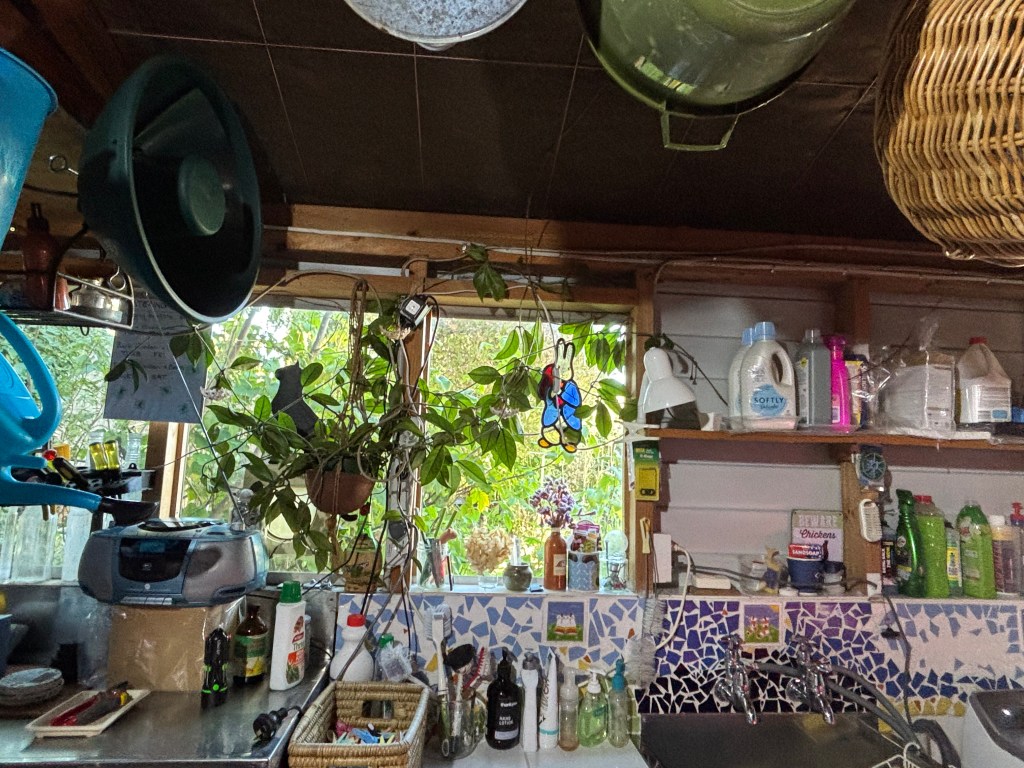
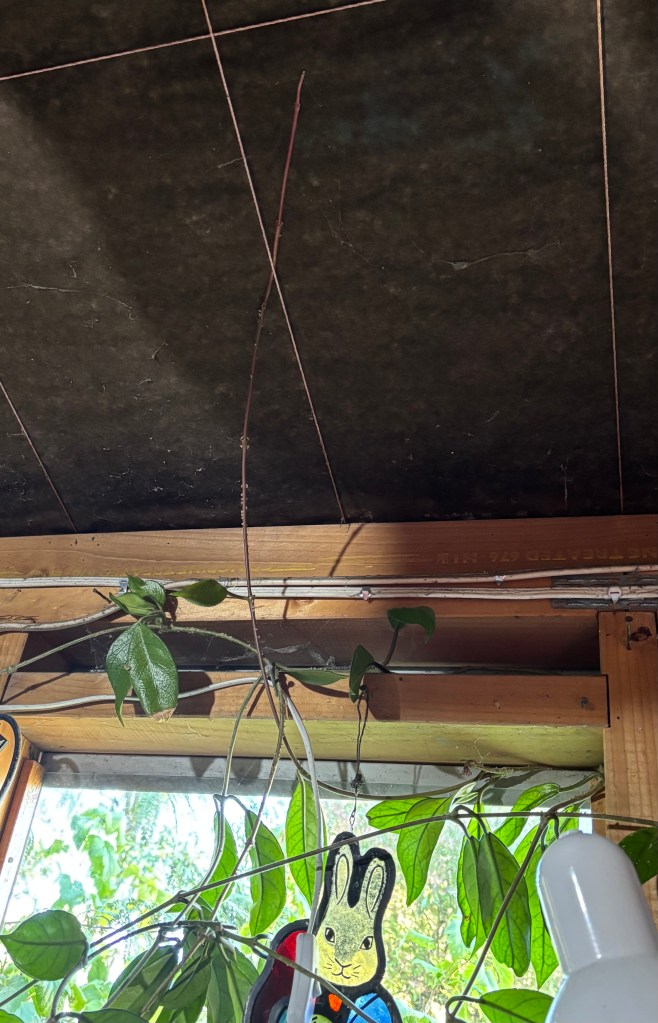
A wide shot shows the extent of the plant from far left to far right, and up to the roof.
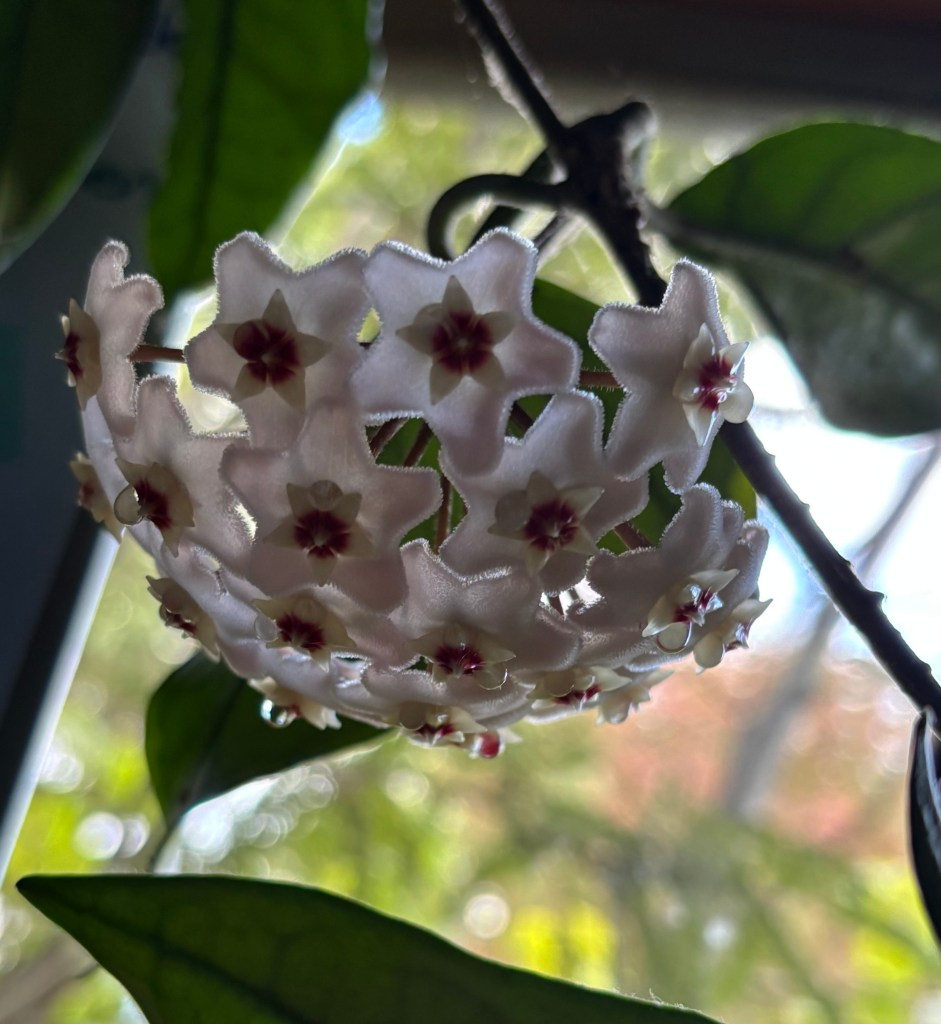
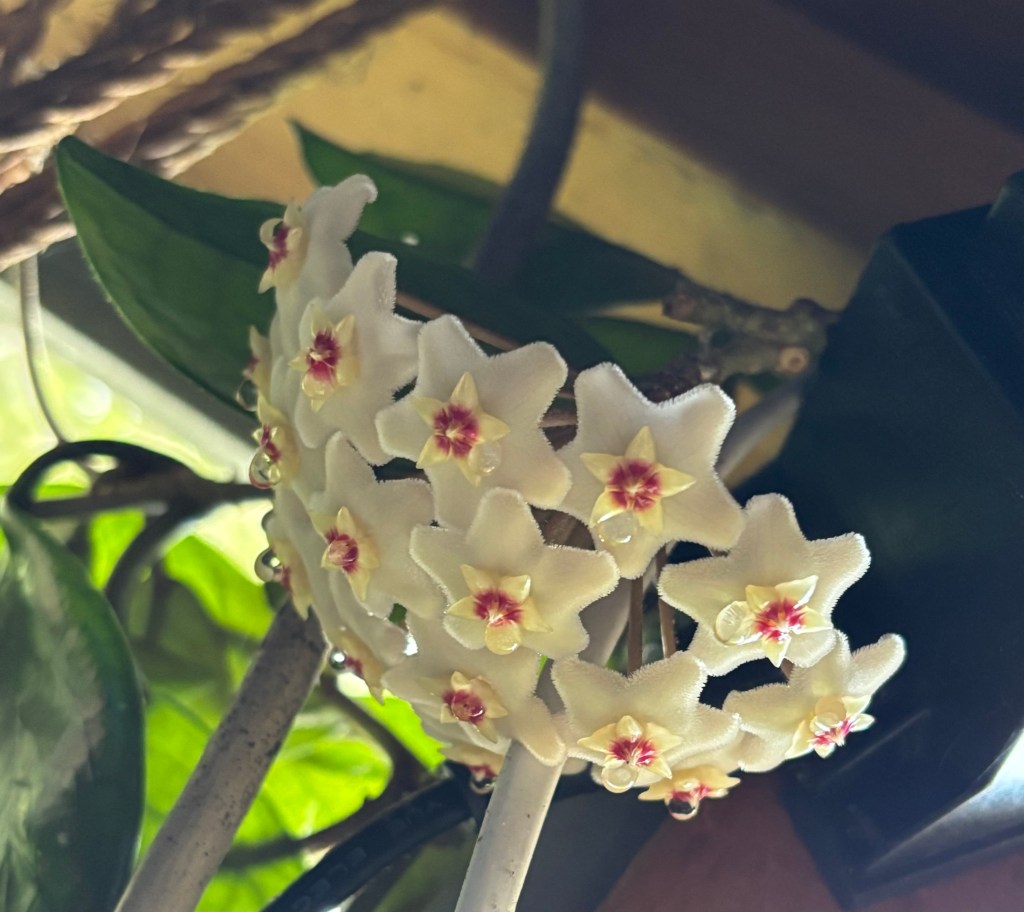
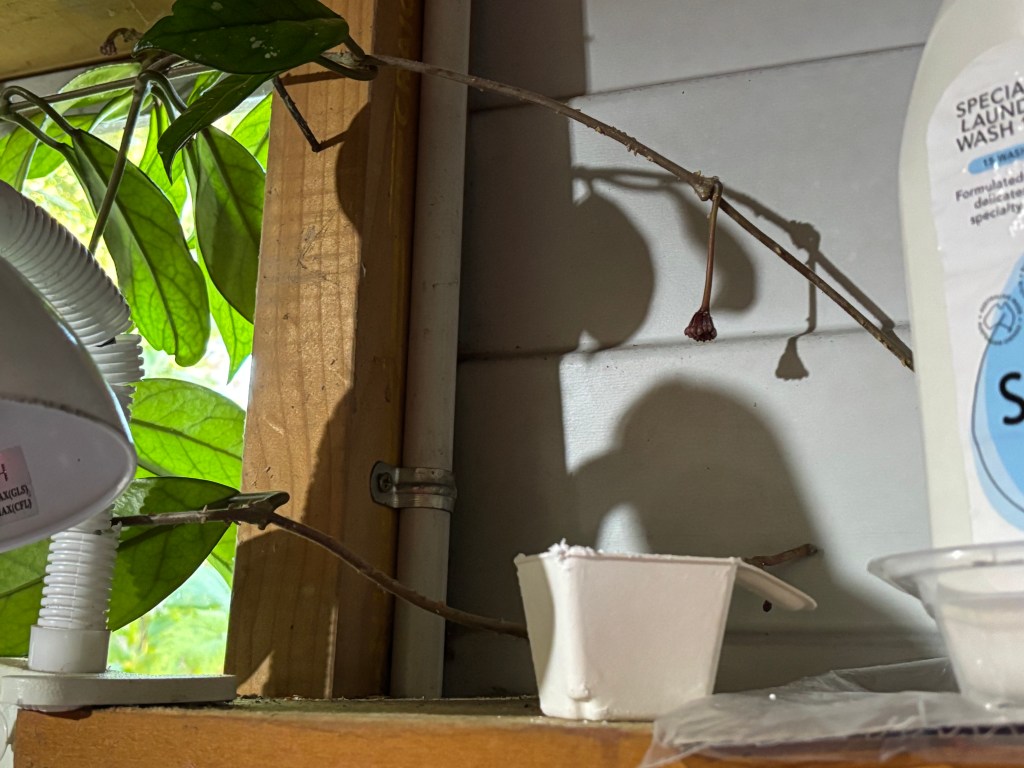
There’s a sweet honey scent in the garage; the hoya is flowering. Its flowers are sometimes called porcelain flowers, which seems apt as they hardly look real. There are three clusters of flowers this summer. You can see nectar dripping from the centre of each flower.
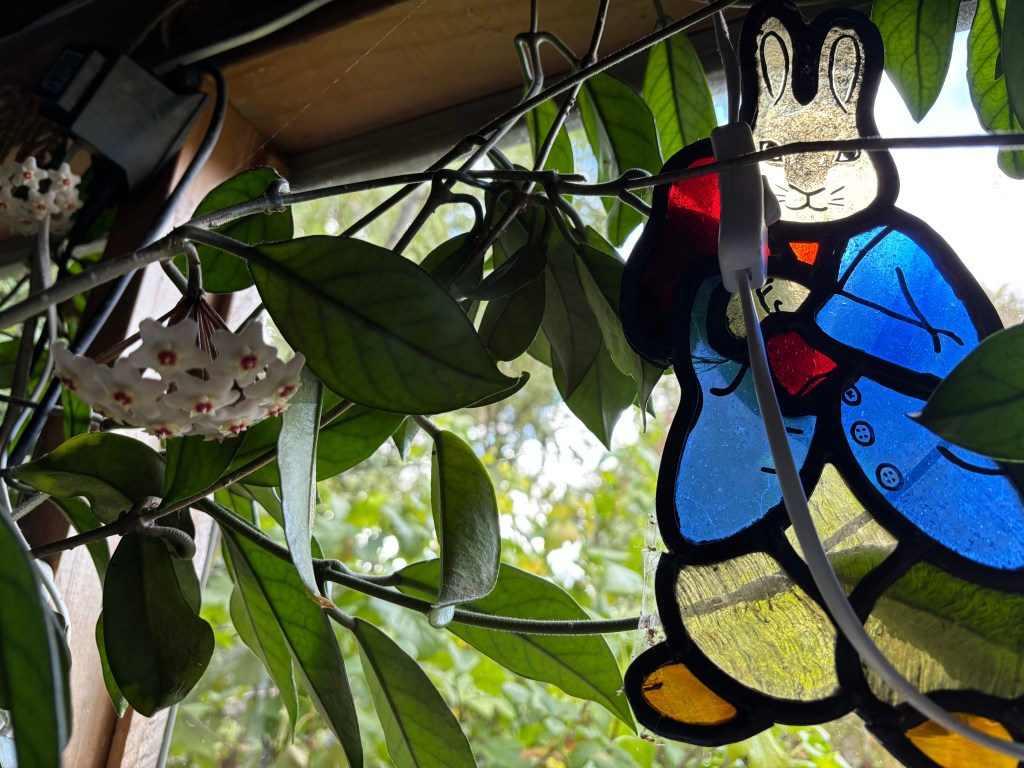
Another budding flower clusterNew shoot heading up into the roof
I have had the plant since the late 1970s when house plants were all the rage – as they are again now. It’s still in the same small pot and macrame hanger. Long ago, I decided to divest myself of indoor plants (but do enjoy a couple of small ones I have been given) particularly when the monstera deliciosa grew monstrous (think Little Shop of Horrors) and the spider plants looked tired. They ended up in my classroom and in the department resource room for years. I liked to think they removed pollutants from the air, but apparently, you need to have a room crammed full of plants for that to happen. I would bring them home over summer, not into the house but into the garage or sheltered spots in the garden. One, a Fatsia Japonica, didn’t make it back to school. It is now about three metres tall and about as wide, growing happily in the garden – despite at times attracting blackbirds (for the seeding flower heads), scale, aphids, whitefly, sooty mould and ants.
The hoya remains on the laundry side of the garage where it seems to be thriving beside the window, growing in and out of electrical cables and the laundry stuff. I try to remember to water it, feed it occasionally and wipe the leaves with Conqueror Oil sometimes. When it threatens to spread itself around the garage I cut it back but, undeterred, it sends out new tendrils with ambitious intent.
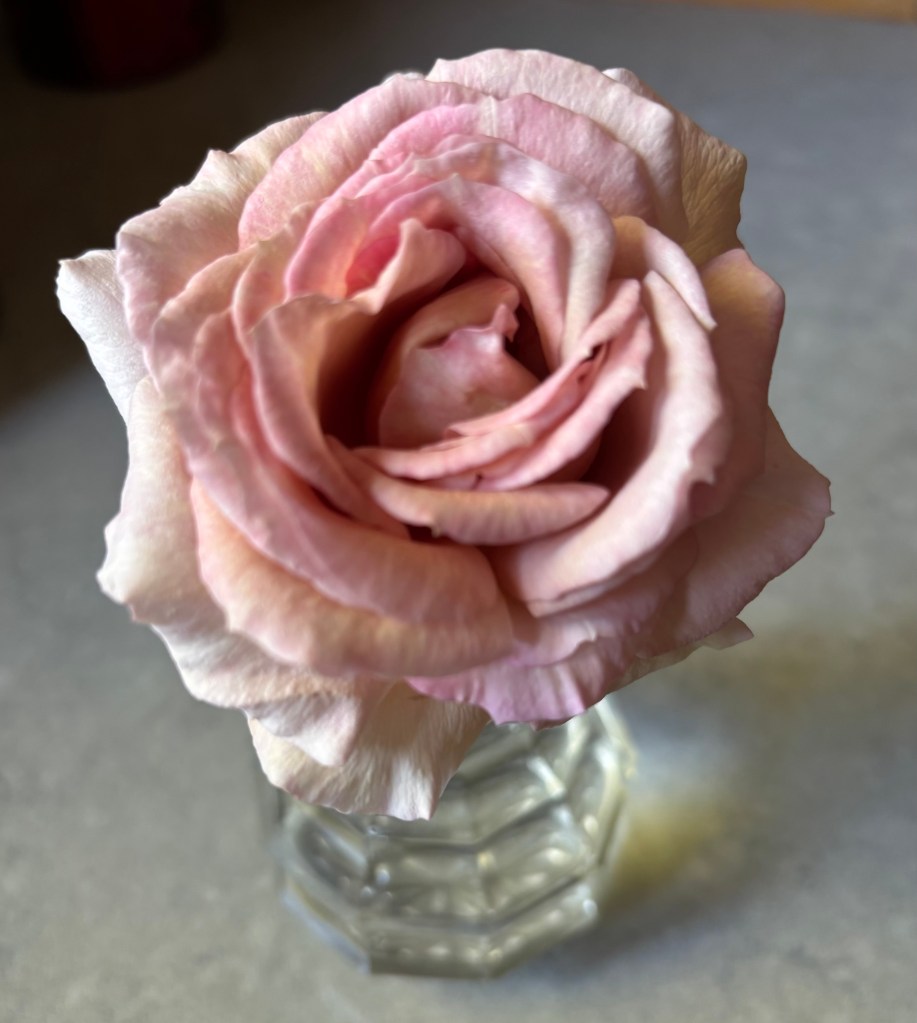
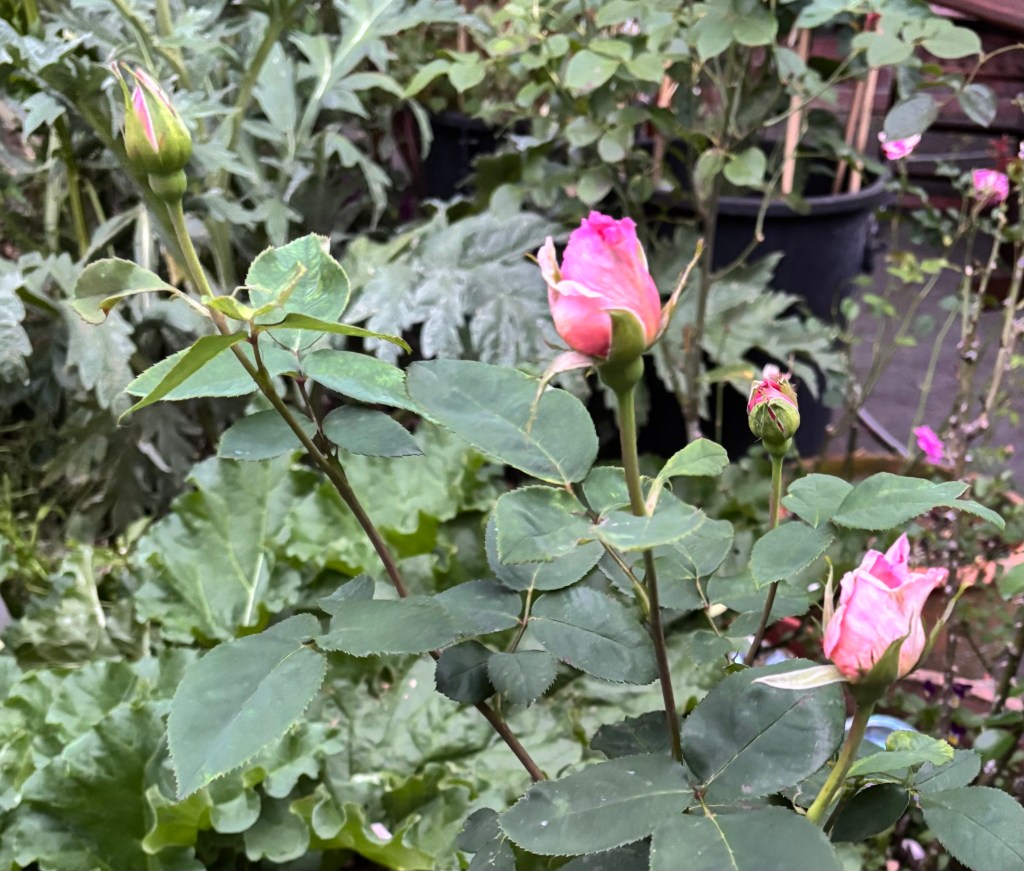
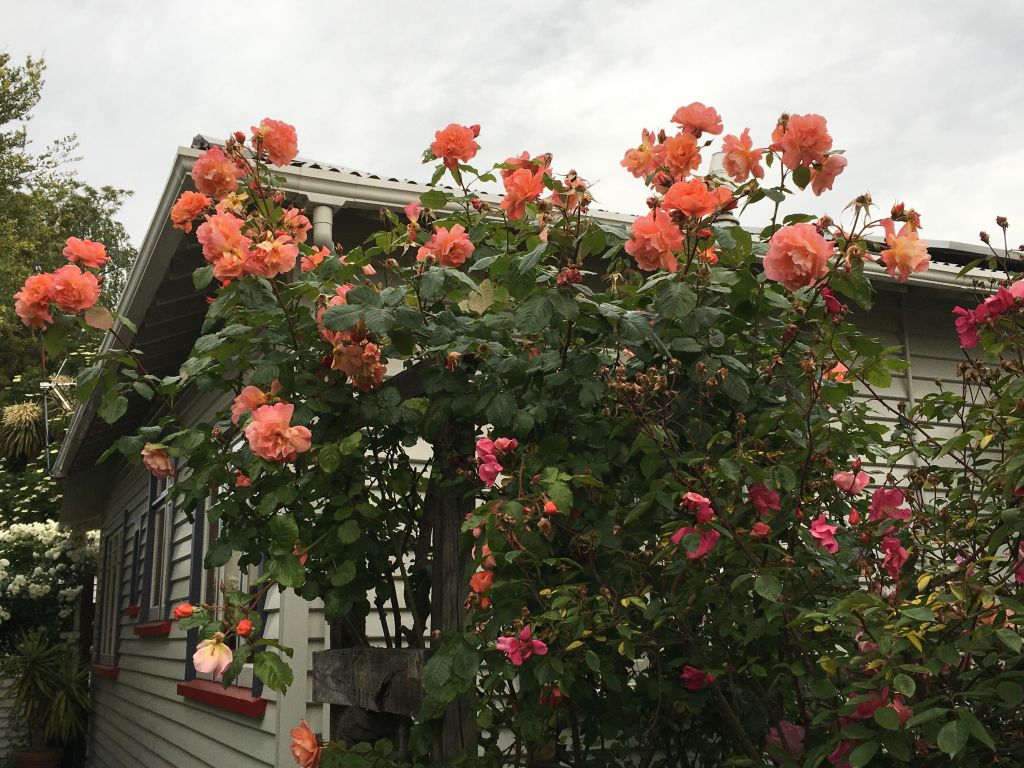
I love the old-fashioned pink of the Spiced Coffee rose. Today I picked the first flower to open. It has a delightfully spicy scent.
There are more flowers to come which is lovely to see as the plant has had a hard life. I moved it to comparative safety in a pot and it is good to see it, still delicate, but thriving.
Here is the first Precious Platinum of the season, picked for Mum. It’s her favourite, with a divine scent. The rose was transplanted from her garden.
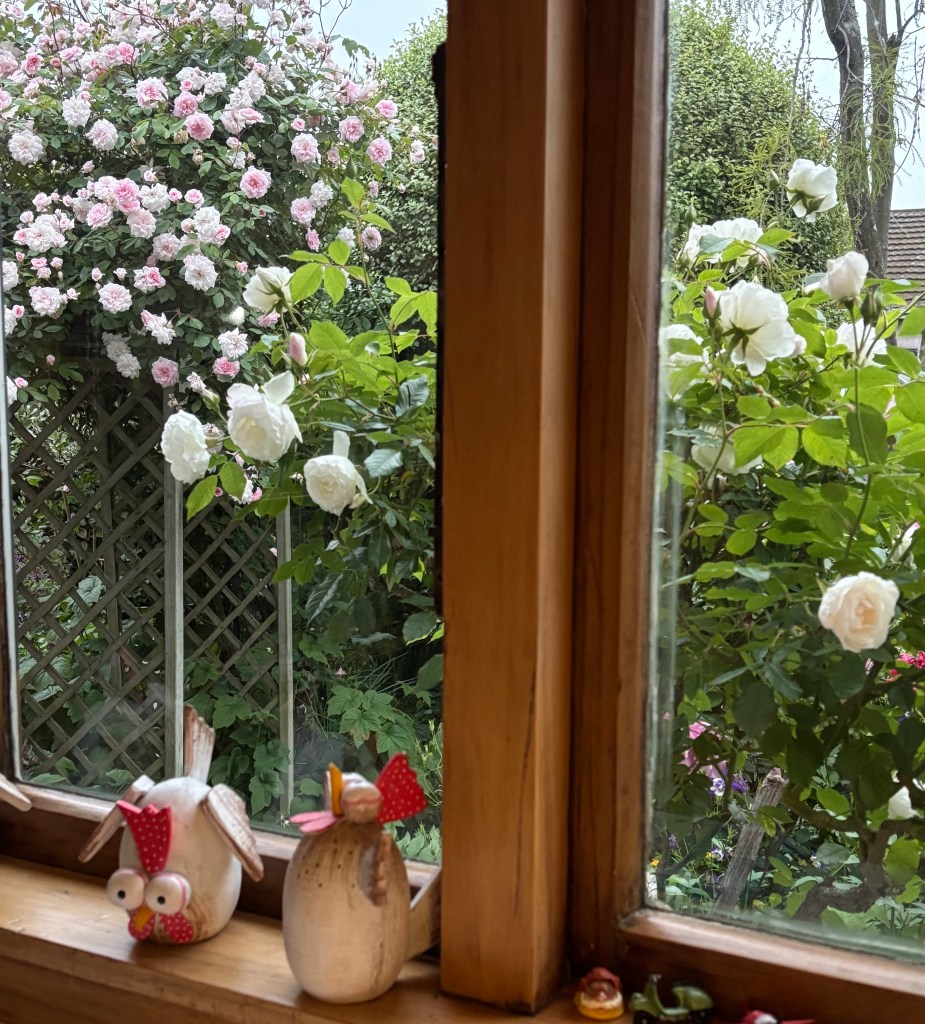
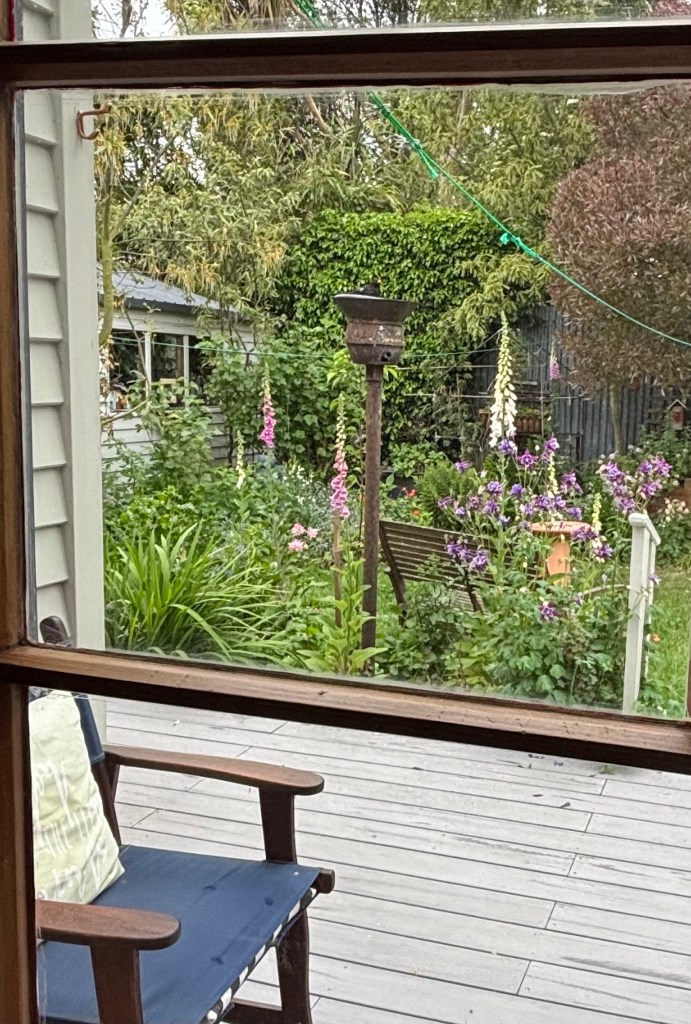
There’s hardly any need to pick flowers to bring inside; they are visible from nearly every window. From my computer this evening I have this view:
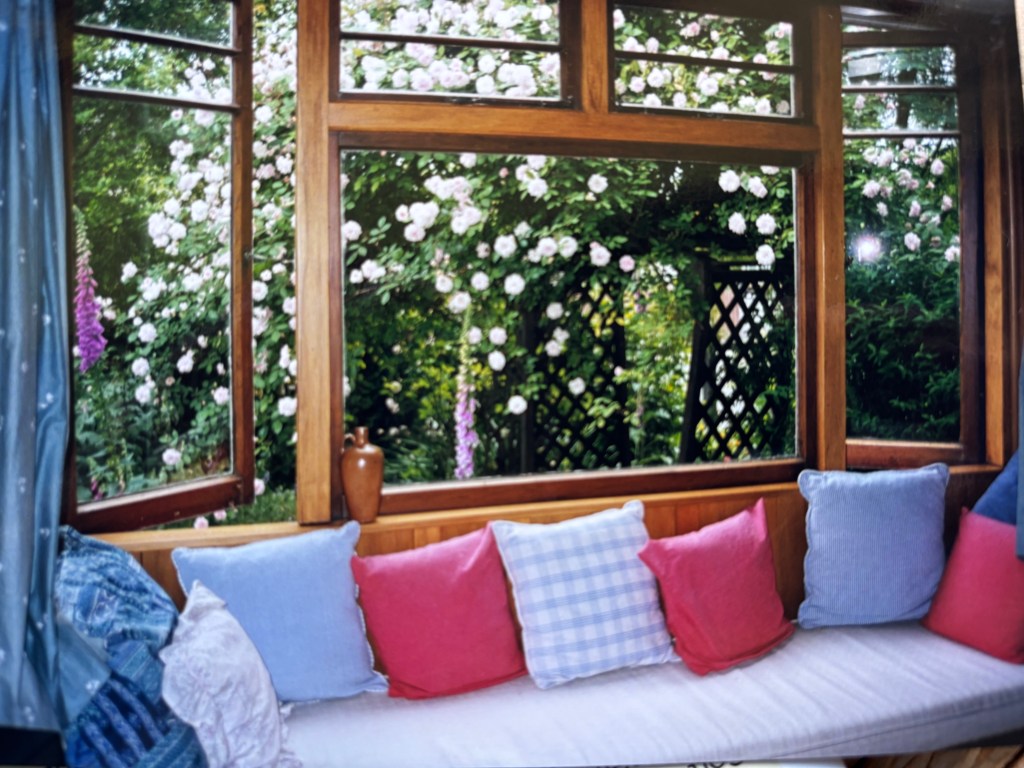
The Cecile Brunner has always been lovely at this time of year, but not quite as good as it was, filling the whole window, when I took the photo below (left) in the 1990s. The photo on the right was taken today.
I look through the window in the morning and plan what I will do in the garden that day, or maybe later that week.
Spot the blackbird in the bird feeder
Today I planted two tomato plants and some lettuces. Next, the lawn needs mowing and there are some geranium cuttings to pot up. The roses in containers could have some liquid fertiliser and the citrus trees are due for more food. Now that it’s summer weather, it’s time to put saucers back under the pots and containers. That’s tomorrow’s jobs sorted.
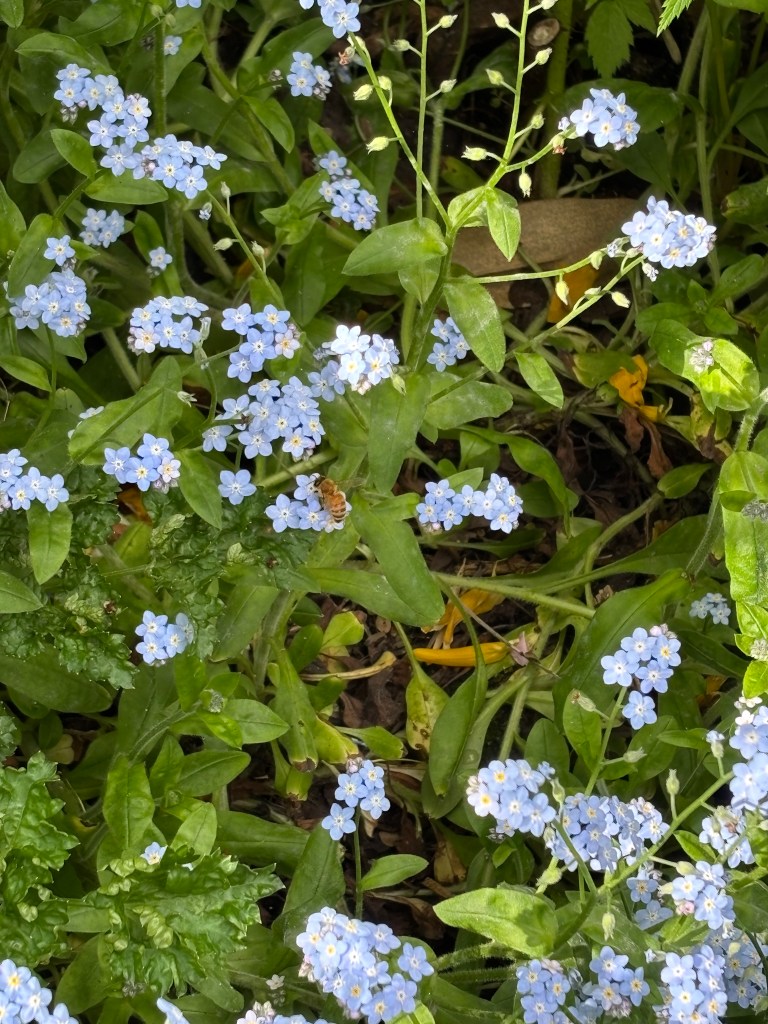
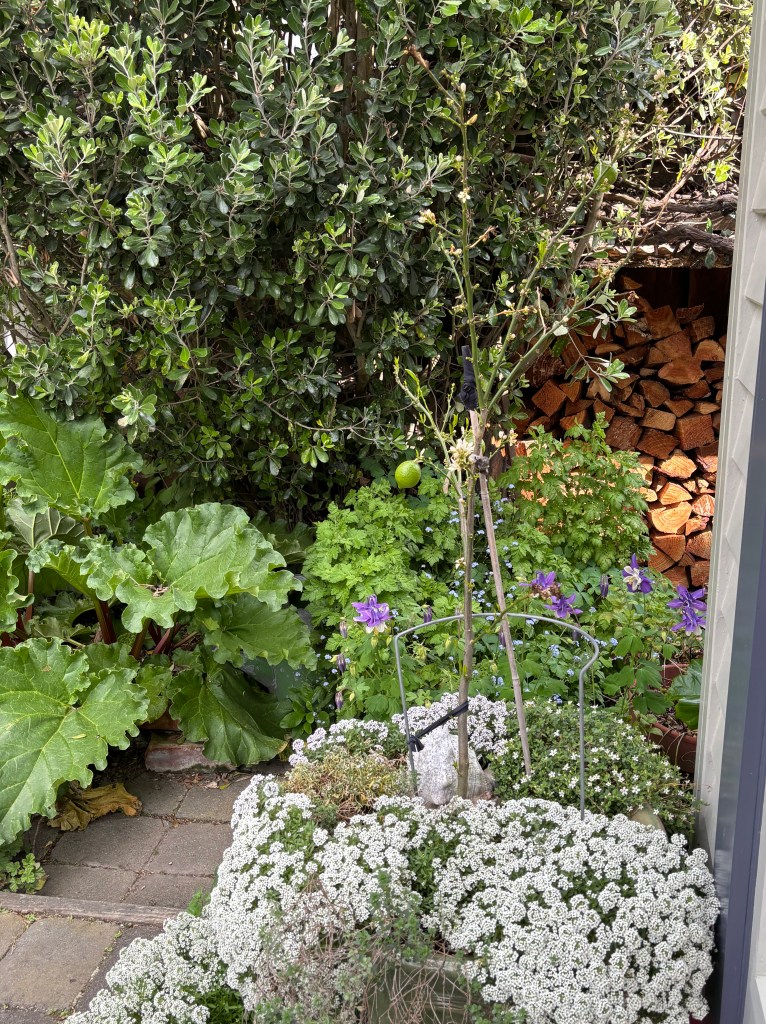
A woman looked over my gate this week and asked, ‘How do you get your flowers to grow?’ I looked with some despair at the cloudy masses of forget-me-nots and couldn’t think of an answer. ‘They just do,’ I said lamely, in the end. Which is true. I didn’t plant the forget-me-nots. They just come up every spring. So do a lot of other things which I inherited when I moved in nearly 40 years ago. ‘What about those,’ she asked, pointing at some aquilegias. I planted aquilegia seeds – probably decades ago – and they continue to come up every year. Often in less than convenient places. Fox gloves come up randomly, as does Solomon’s Seal, feverfew, borage, parsley, lemon balm, wind flowers, marigolds, geums … She told me that she’d tried to grow some daffodils in a pot but they got knocked over by the wind. Gardening’s like that, I reassured her, a roller coaster of success and failure.
Bees like the forget-me-notsAquilegia growing between paving stonesFox glove beginning to flower
While I have planted roses, herbs, fruit trees, vegetables, pansies, sweet peas, geraniums, raspberries, blackcurrants, and so on, many plants are self-sown or grown from cuttings I’ve been given. Others have spread of their own accord. Or contrarily given up the ghost.
Planted, gifted, transplantedGeraniums grown from cuttings left by a neighbour at my gateBanksia I planted, now needs support
Many large trees in the garden are self-sown and are usually indigenous such as several kōwhai, ake ake, pseudopanax, pittosporum and cabbage trees – or were planted by previous owners, such as the beech, karo, a very old hebe and a myrtle. The ake ake has an interesting trunk.
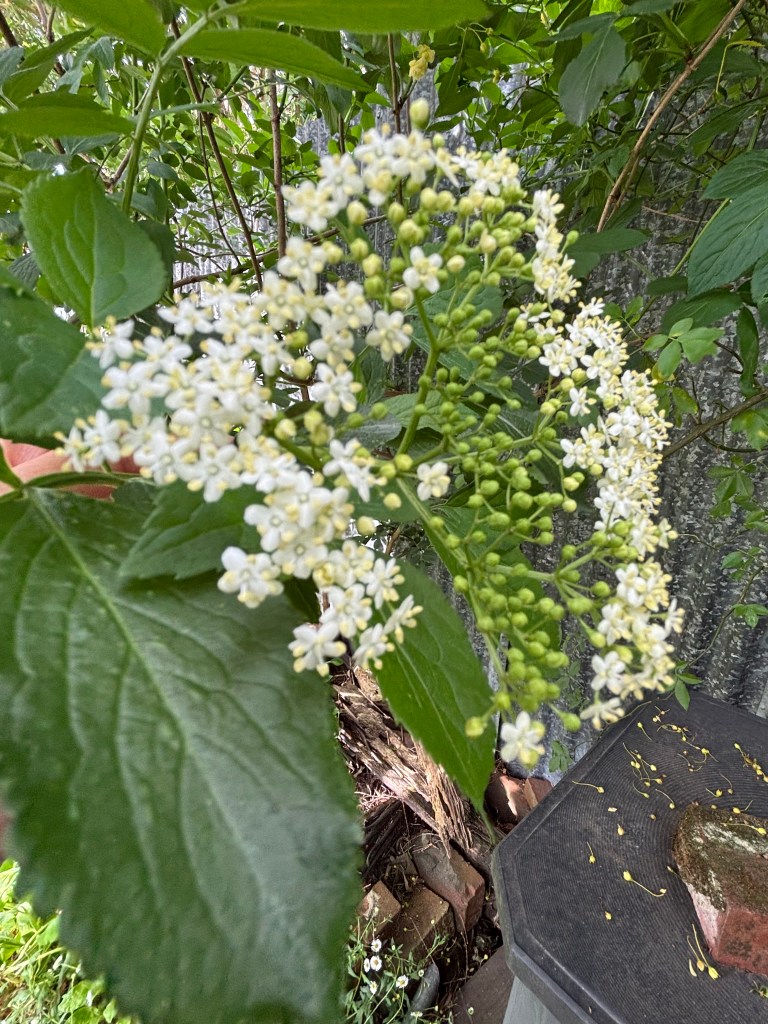
Although not a great fan of succulents, several years ago I bought some cute little ones at a market. Now they are in various parts of the garden, completely hidden by cottage garden plants at the moment except for some in pots. I’m encouraging some self-seeded elder plants to grow so I can make elderflower cordial.
Trunk of ake akeFlowering succulentFirst elder flower
Dips in the gardening roller coaster include plants which do not thrive or suddenly sicken. This has happened recently to a bay tree in a pot which was thriving until a few weeks ago when its leaves began to turn brown. It was badly affected by scale. I trimmed it back and administered what first aid I could. Now it’s just a matter of wait and see. A lime tree in a pot lost all its leaves, but there are new ones appearing, so I’m hoping it will recover. My lemon tree gets sooty mould from time to time, and once a more serious disease from which it has recovered. I had to remove all the affected fruit in the serious case, and pruned the tree in both cases to let air flow through. I’m still mourning a beautiful rose, a Westerland, which died last year.
Ailing bay treeRecovering lime treeRecovered lemon tree
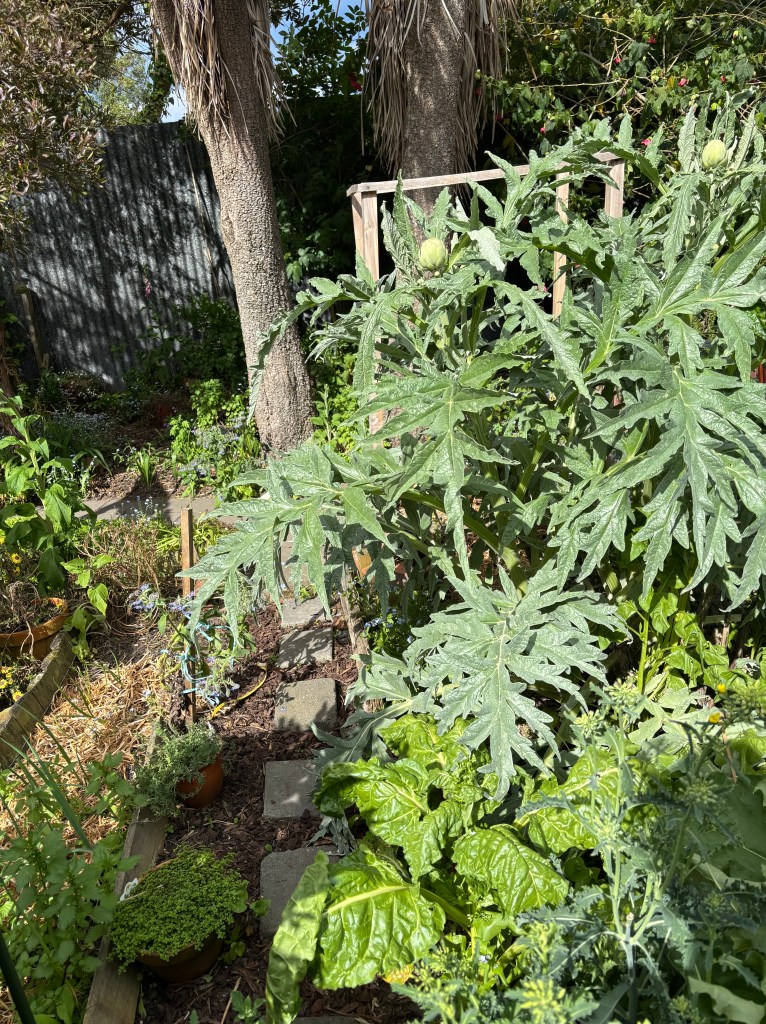
A bit of a softie about what gets to grow, I often can’t bear to pull things out (except convolvulus). Children passing by might enjoy the dandelion clocks on the front berm. This week a gardener on tv was advocating for weeds in the garden. While not exactly a weed (whatever a ‘weed’ is) my artichoke is a bit of a thug in the garden, overshadowing the vegetables and rhubarb, but it is pleasing to look at. Today I noticed the first globes appearing.
I spend a lot of time just looking at the garden. Once the forget-me-nots have finished, other plants will re-emerge to take their place.
My sister and I went to the garden centre with a couple of small specific items in mind. I came home with a new garden seat. (A slight exaggeration; my sister and my nephew collected the seat later in their trailer and delivered it to my house.)
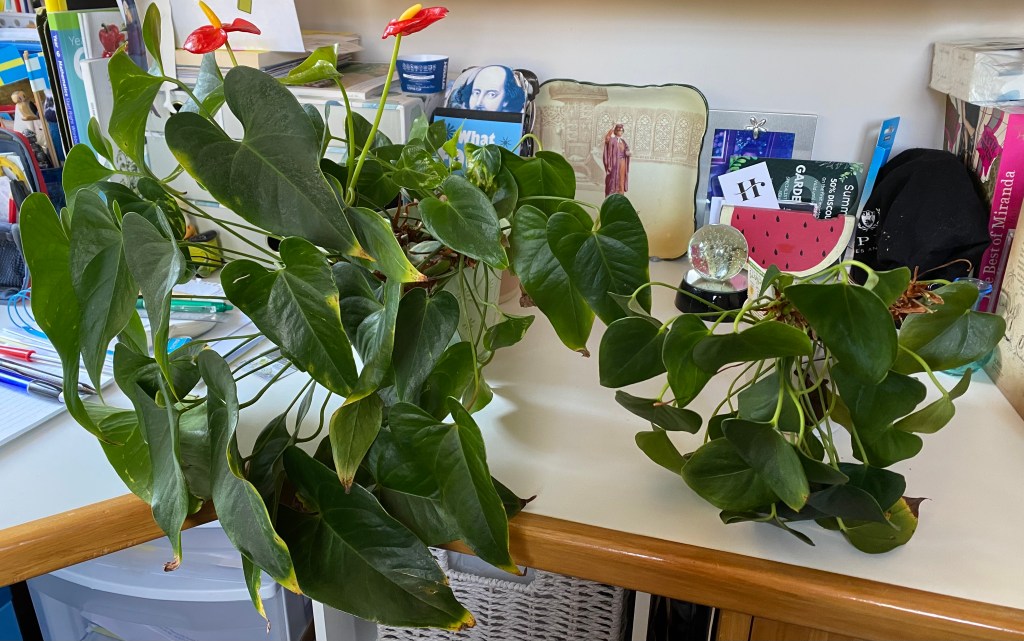
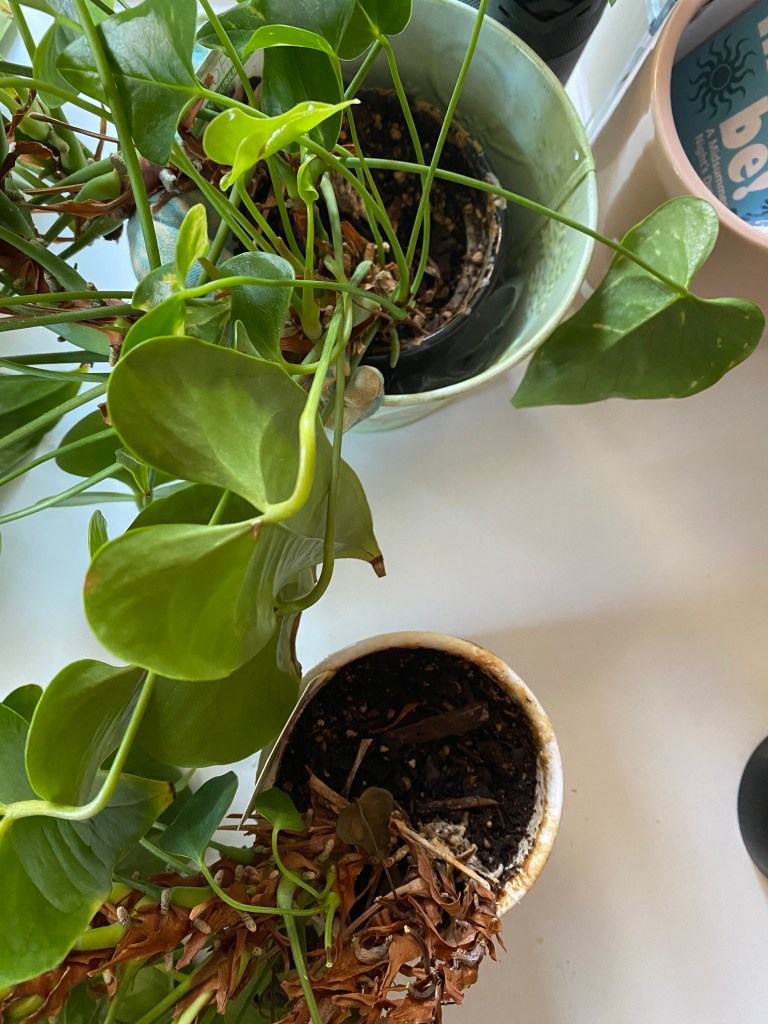
My specific item was some potting mix to re-pot two anthuriums which were looking a bit tired. I took photos of them to show the garden centre experts in case they had some advice.
The plant on the left is bigger than the otherOne has dry soil, the other seems to stay quite damp
As we walked in I noticed large signs advertising 20% off everything in store. I eventually found my potting mix and a pack of lettuce plants as well. Then my sister met someone she knew and began a long conversation. This gave me time to look around. That’s how I found the seat. It’s been in the back of my mind to look for a new garden seat as the old one has begun to fall apart. Added to my existing patio furniture, the new seat creates a friendly, conversational vibe.
As for re-potting of the anthuriums, it turns out I didn’t read the instructions closely enough. Pots of at least 200mm are required, it seems. Sounds like another trip to the garden centre. Yippee!
It’s great to be back working in the garden after a ‘gardening drought’. Once I got started, I was encouraged by my progress and have been gardening for several days. Tidying around the edges came first and led to more deadheading and cutting back the raspberry canes. I mulched the berry patch with leaves from the cherry tree.
The vegetable garden required more thought. I want to rotate the vegetables, but it’s difficult when I have no success with some things. I drew up a plan and made a to-do list, then researched the prices of vegetables packs and bark for the paths. I bought the plants at a favourite nursery (Oderings) – and added a Pink Princess daphne plant to my trolley as well. I prepared the beds and planted most of the vegetables (broad beans, and onions) until I ran out of daylight around 5pm – so frustrating, but time for cheese and crackers and gin and tonic.
Today I went to Mitre 10 for bark – and bought some pea straw and thyme plants. (I recycle used plastic plant pots here too.) I planted the remaining vegetables (rainbow chard and curly kale). The daphne required a bit more care according to my research. I measured the soil ph/acid levels, dug the hole wide but not too deep, put bark mulch in the hole to aid drainage, and added sheep pellets and a bit of acid fertiliser. The daphne looked a little sad in the nursery I thought, but it was the last they had of the variety I had seen recommended in an article. I hope she cheers up!
Pink Princess
I bought three varieties of thyme (lemon, golden and common) and put them in terracotta pots to go alongside the stepping stones which I’ve put through the centre of the vegetable patch. I’ve widened the garden by moving the brick edging further into the lawn. It felt creative, deciding to add some stones here, bark mulch there, and some old boards as edging. Pea straw around the chard and kale added the rustic look I like – and it smells wonderful!
Yesterday I was concerned by my lack of energy. It was a dull day which often seems to mean my ‘solar panels’ aren’t charging. Today I realised my energy was back when I began to visualise doing the gardening I’d been waiting to do when I had the energy. It was a warm, sunny day.
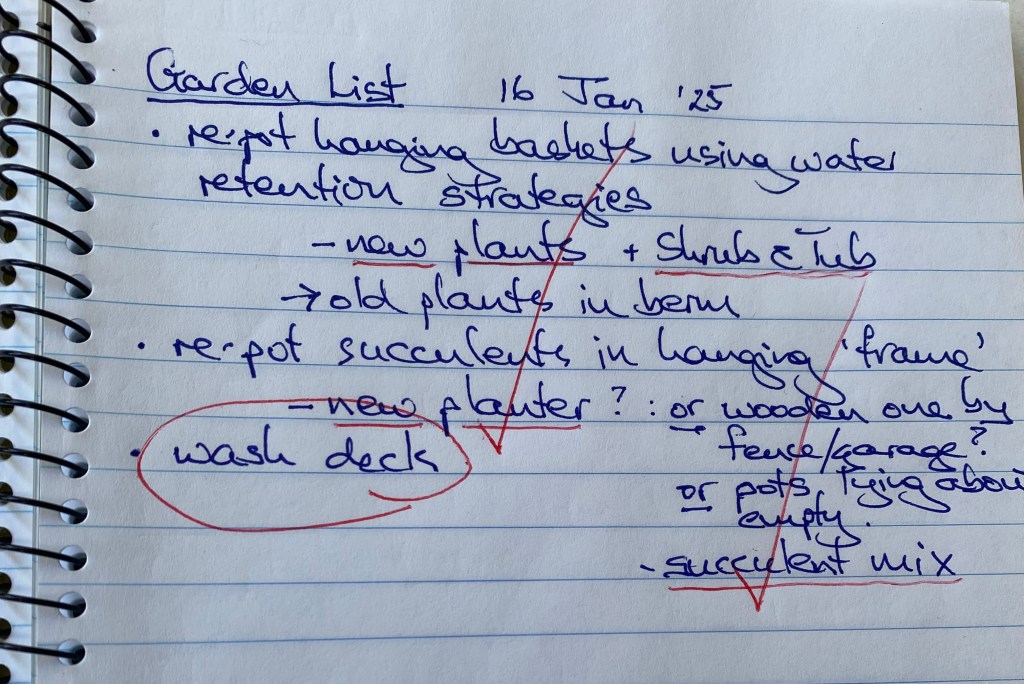
I made a list and completed it, except for washing the deck.
Potted up succulentsRepotted and refreshed
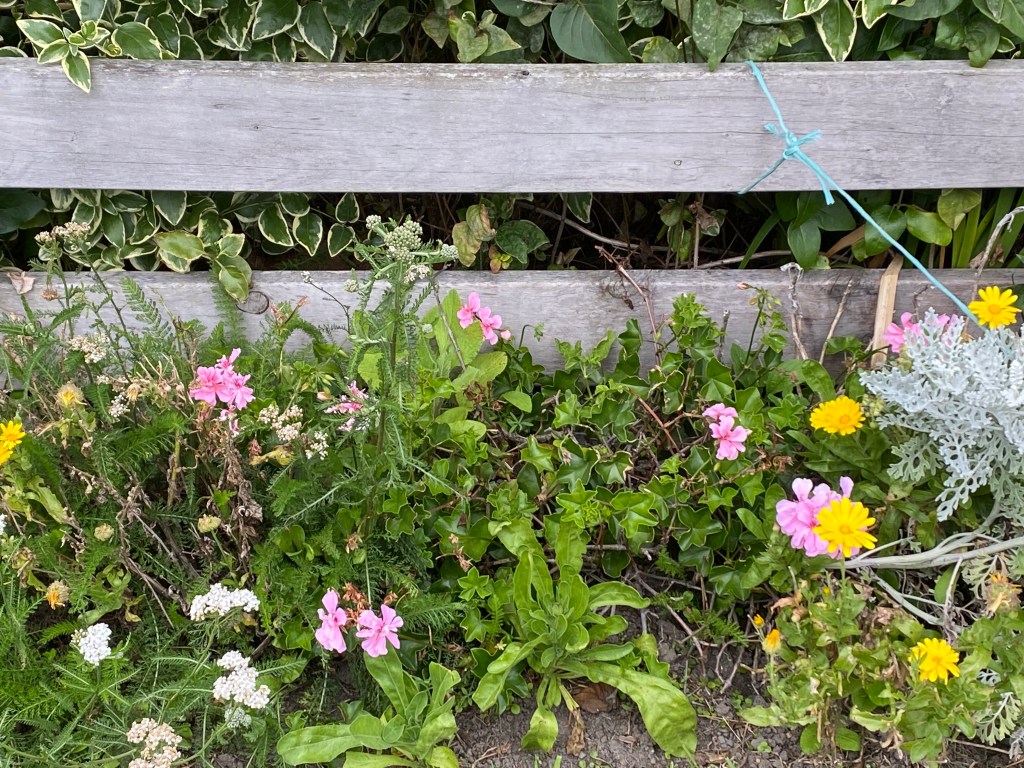
I have been transplanting worn-out plants from pots and hanging baskets into the front berm. Because of all the rain we’ve had, the soil is not like concrete as it was last summer when I planted lavender – only two of the six plants survived. This summer, a pink geranium which was looking very tired in its hanging basket is looking much healthier in the ground. A transplanted cineraria is also thriving. These plants add colour and variety to the garden strip between the fence and the grass berm. Today I transplanted snapdragons and pansies, digging out some of the over-abundant lemon balm to make room.
Geranuiums happily mingling with yarrow and marigoldsCineraria add interest with their silver leaves – and bees love the flowers
I tell myself that I can’t be on the go all the time and need some time to rest, ready for the next effort in the garden or whatever, but it has always worried me when I have no energy – is it creeping old age? Yet I remember in my twenties asking a friend to calculate my bio-rhythms on her phone app (did we have those then?) when I felt lacklustre or out of sorts. “That explains it!” I’d say.
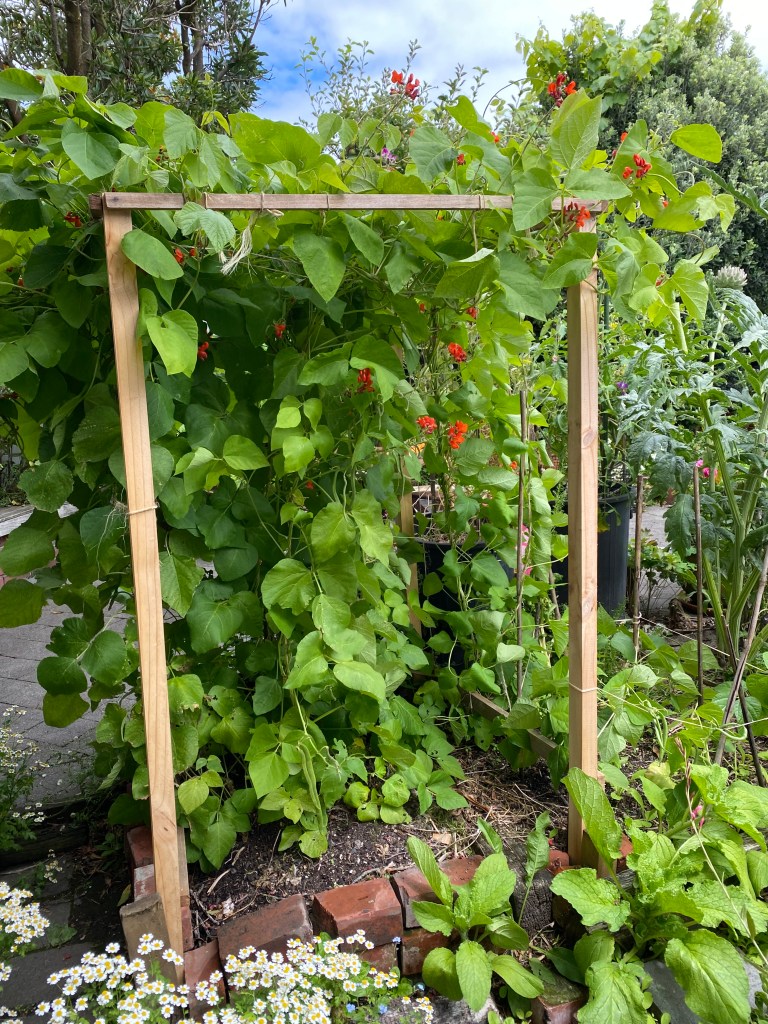
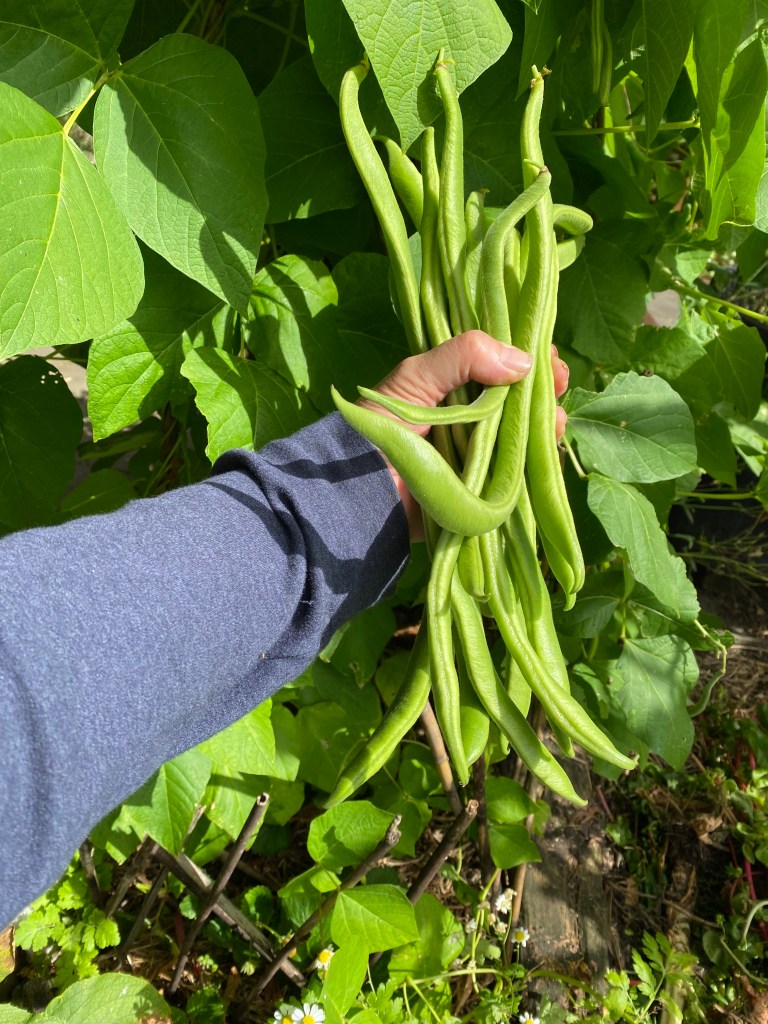
I thought they are called ‘runner beans’ because they climb, but perhaps its because of the rate of their growth. Not quite overnight, as in Jack and the Beanstalk, but pretty quick all the same. Today I noticed that there are a few beans ready for picking. I looked back at my photos to see how long they took from the start.
9 Nov – just showing through the soil12 Dec – reaching the top of the frame6 Jan – ready to start picking
The dwarf bean plants beside the runner beans were planted on 11 December and they are almost ready for picking now. The zucchini plant went in the ground on 11 December and I have already picked two, with one more almost ready to harvest.
Dwarf beansZucchiniFelix
It looks as if the runner beans will have a long picking season as the beans which are ready are lower down the stalks and there are loads of flowers at the top.
These scarlet runner beans come up year after year from the same roots which I planted in 2021. The bean frame has made all the difference as, last year, the beans were ruined by strong winds. In 2022 and 2023, however, I had great harvests.
27 Feb 2022 – a later picking by the look of them12 Jan 2023 – the first pickingMar 2023 – with only thin bamboo poles for support, the beans leaned into the trees, forming an arch
The Sunday sky beyond is about to turn pink with a dramatic sunset and, to the east, a rainbow appeared.
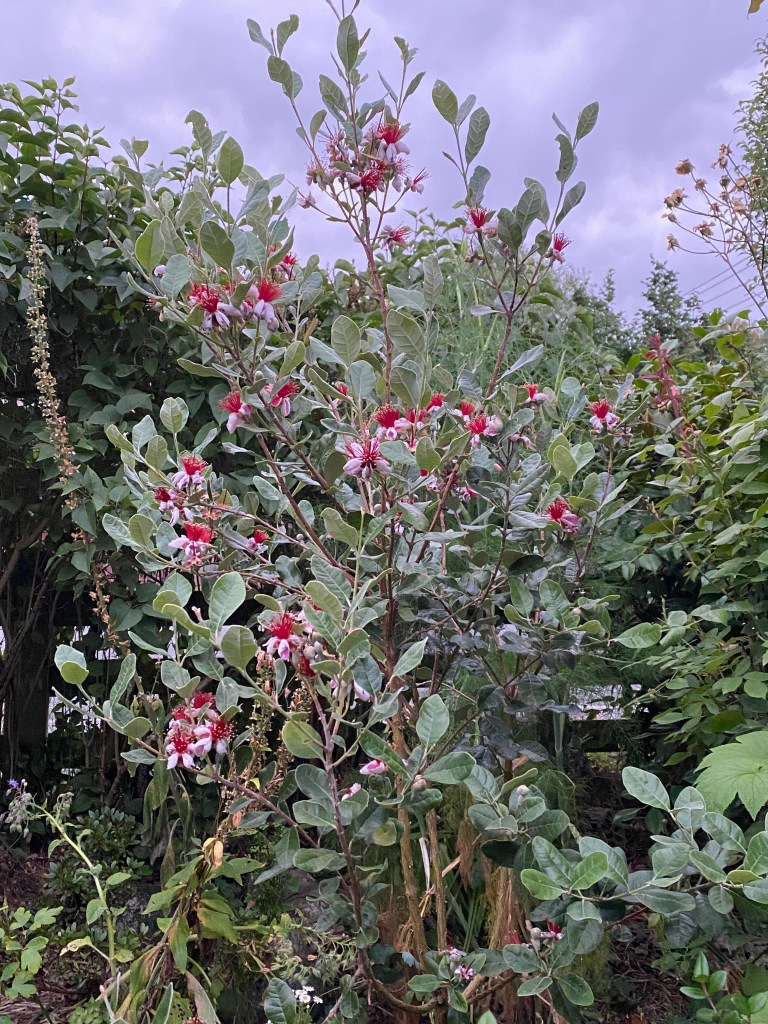
The feijoa tree is covered in flowers this year. As we put the Christmas tree (exotic pine) inside the house on Sunday, we looked out and said, ‘There’s a real one!’* It is native to South America and is of the myrtle species, so related to the pōhutukawa aka the Aotearoa/New Zealand Christmas tree (beautiful pictures and the full story on this link).
I have a New Zealand myrtle in the garden. It is covered with fluffy white flowers at Christmas time, which prompted me to post about it last year (Christmas Trees, 8 Dec 2023 – also A White Christmas 14 Dec 2021). The Southern rata, another myrtle, was in flower when I was in the Botanic Gardens the Sunday before last.
Feijoas are very popular in New Zealand, and Kate Evans has written a book about them.
Here’s a close up of the pretty flowers which make the feijoa a self-decorating Xmas tree.
Myrtle rust is a problem for myrtles, so let’s hope it doesn’t become the grinch for future Christmases.
*My sister and brother-in-law, who gave us the inside Christmas tree also gave us the feijoa tree.
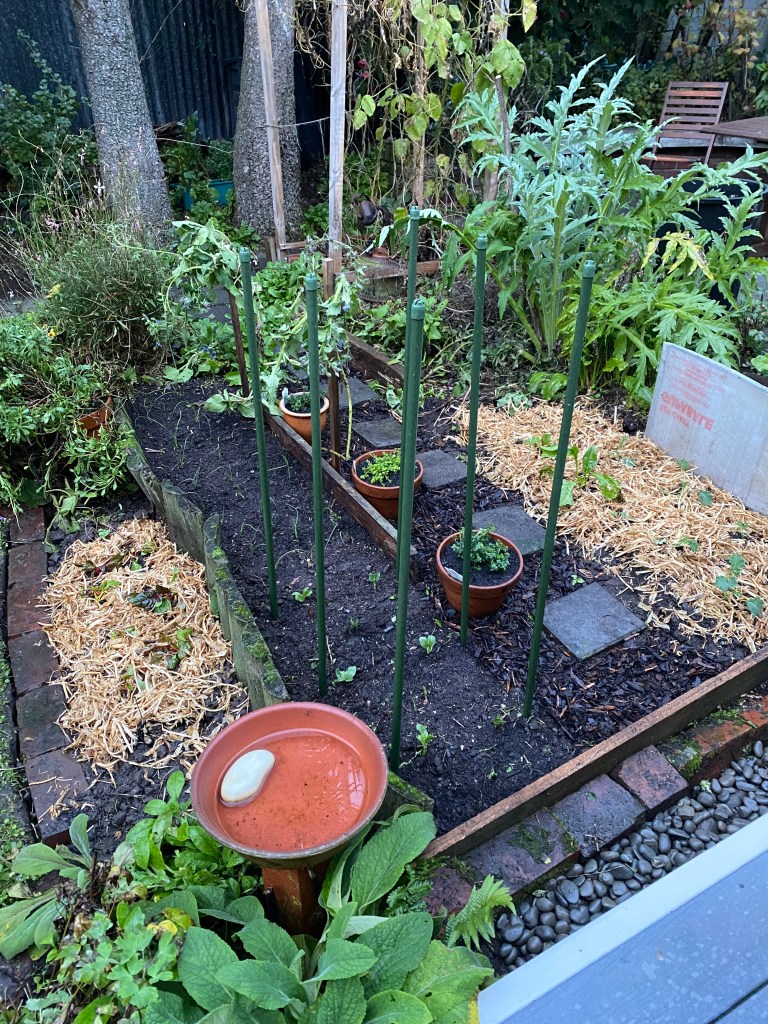
The broad beans have finished and new plants are in the garden. I’m using the four stage rotation system and planted a tomato plant and a green zucchini where the beans were, and dwarf beans where the silver beet was. Beyond them, you can see how much the runner beans have grown since I posted about the bean frame recently (Old school tools, 9 Nov). The artichoke (on the left in the photo) takes up a lot of room in the garden but it is sculptural and interesting, even if I have found the artichokes pretty much inedible (Artichoke, anyone? 29 Dec 2020) or, at least, not worth the effort.
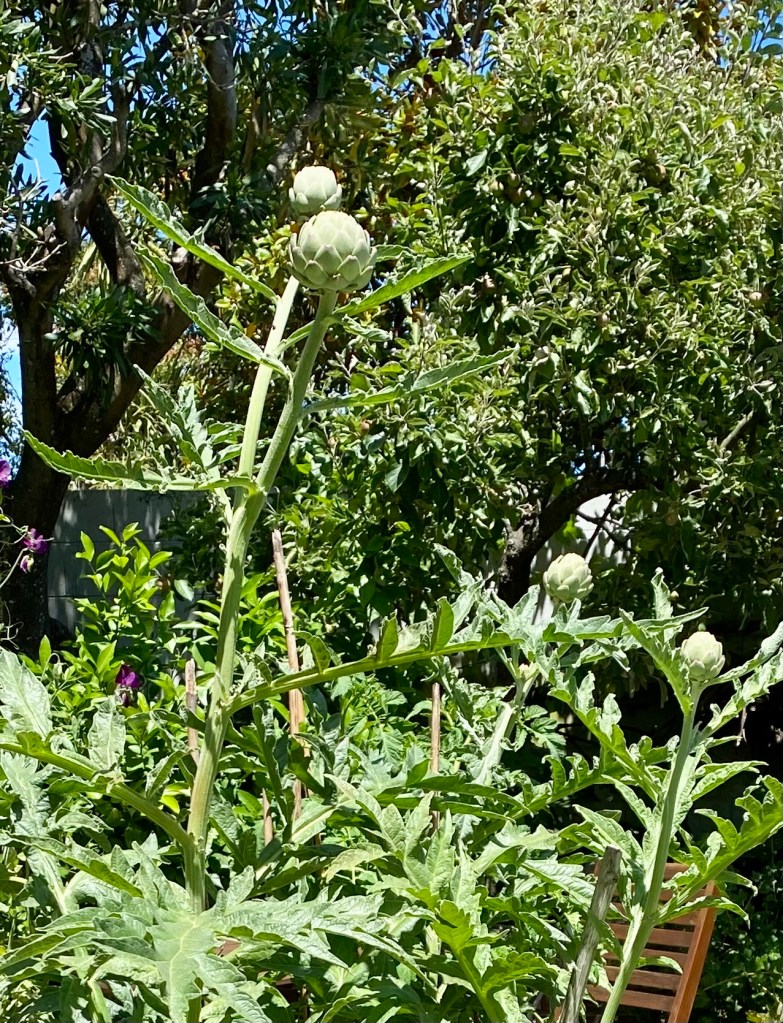
Artichokes are forming on the plants now and give the impression of bobble-headed stick figures throwing their arms upward as they ‘dance’ in the breeze. I’ve posted about their antics before (Wind-ravaged 21 Dec, 2021).
Having this anthropomorphic view in my subconscious, I was interested to see the artichoke had leaned across with one of its leaves as if to shade the zucchini plant from the sun. When the sun moved off that part of the garden, the leaf lifted up again.
................... for lovers of ice cream. Your free on line magazine for sweet frozen treats. Recipes, inspiration, artisanal ideas for your delectation.

























 Anne-O-tations