Fascinated not obsessed

There’s quite a collection of books about Katherine Mansfield on the bottom shelf of one of my bookcases. S0me of them I haven’t read yet – and wonder if I will. When I read Claire Harman’s book All Sorts of Lives recently, I realised how limited my knowledge of ‘our’ famous writer is, and promptly followed it with Katherine Mansfield’s Europe by Redmer Yska. I learnt that Mansfield smoked constantly, was probably addicted to morphine, had indeed ‘gone every sort of hog’ as Virginia Woolf commented, lived beside the Seine during WWI and endured Zeppelin bombing raids, and is now a celebrated writer in France. And in other parts of the world, too, according to the back cover of the Collected Poems.

It seems people keep writing about KM whether from academic or personal or journalistic perspectives. In the last week, I’ve read two reviews of KM’s Europe in the digital newsletter ReadingRoom. The first was very thorough and academic as you’d expect from C.K. Stead. The second is a more personal response, by Miro Bilbrough, who finds KM relatable for her inability to be careful of herself. Ali Smith wrote about a woman obsessed by Mansfield in her story ‘The ex-wife’ (in Public Library and other stories). When Ashleigh Young became director of the Katherine Mansfield Birthplace people commented on her likeness to Mansfield. The volunteers and other staff were pretty much obsessed with KM and seem, in Young’s essay ‘Katherine Would Approve’ (in Can You Tolerate This?), distinctly unhinged. At the end of her time as Director, Young concludes that she probably would not much like Mansfield if she met her and is somewhat appalled to find she is going off her stories as well.

Katherine Mansfield was obsessed by her own writing, as she would have to be to have completed so much work (not to mention the letters and journals – plus reviews for literary magazines) in her short life. She needed to publish to earn a living, but she was also aware that her TB, complicated by venereal disease and a history of childhood respiratory illness, was going to finish her off before long. She seemed unaware that smoking was not helping to prolong her life.

I am neither obsessed nor indifferent to Mansfield. Redmer Yska’s earlier journalistic work, A Strange Beautiful Excitement about KM’s Wellington childhood which I finished reading this week, has added yet more depth to my understanding. I will dip into her stories now and again and continue to find them fascinating.

Hefty Tomes

Dull weather today and a great opportunity to get stuck into these great books.

I used part of a book voucher given to me on my retirement by my department colleagues to purchase We are Here. Thank you! I want to use the voucher for books which will give me years of enjoyment and interest. This one is sure to do just that. It is informative and beautiful to look at; deservedly on the shortlist of the illustrated non-fiction section of the Ockham Book Awards. I am pleased to see Wild Honey, previously reviewed on this blog, is shortlisted in the general non-fiction section. I like the Table of Contents pages in We are Here. It’s like the formatting of websites where you can choose list view or icons. Here you get both simultaneously. There’s a ribbon page marker too.

There is a lot of written text in the book, but the illustrations make it particularly captivating and informative in an accessible way about all manner of aspects of Aotearoa from living things to a musical timeline.

The knowledge and creative energy which have gone into this book are astounding.

As I write this, I can feel the earth stretching and rolling below the house – a 3.2 quake, 12 km deep, 5km east of the city, according to Geonet. Such events are featured in the book.

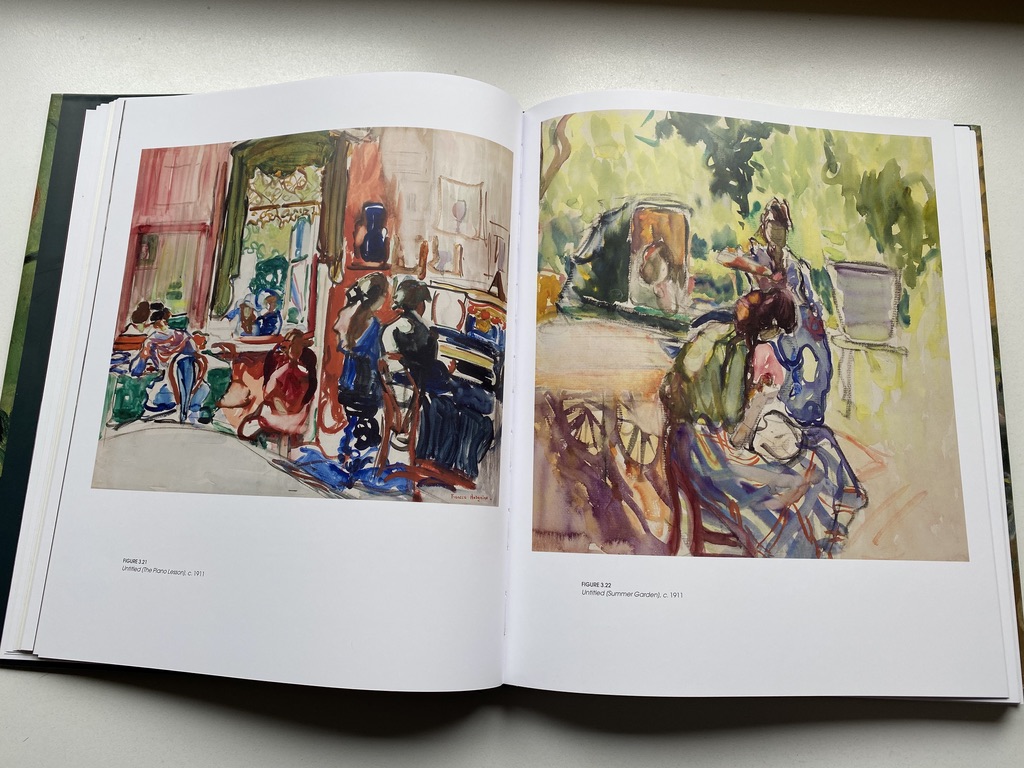
The other “hefty tome” is Frances Hodgkins European Journeys which accompanies the touring exhibition, currently at the Christchurch Art Gallery Te Puna o Waiwhetū. This book came free from the Listener when I renewed my subscription last year. I cruised lightly through the exhibition a week ago intending to read the book and then re-visit. The book is fascinating. I’ve read a lot about Katherine Mansfield heading off to Europe to pursue her art at about the same time. Rather than her being all alone in that pursuit, albeit prose and poetry rather than painting, this book records lots of artists from New Zealand doing the same. Hodgkins’ work was, perhaps, more sociable than the necessarily isolated work of the writer. She made friends of fellow artists who worked together in London, Europe, North Africa and Cornwall and who supported one another. Like Mansfield, Hodgkins was fierce in sticking to what she was good at rather than being swept up by current trends – although these were influential too. “It is a difficult game I am playing but I must play it my own way though it is hard sometime to keep one’s head level & ones heart brave – but I feel my work must win in the long run” Hodgkins wrote to her mother in 1907 – with her idiosyncratic spelling (p73). She resisted abstract art. The book is beautifully illustrated, showing how her style developed.

1911
1931

I like the still life with watermelons. (Watermelons are available now and they are delicious, cool and palate-cleansing. The chooks like them too.) Hodgkins’ still life paintings are interesting in the way they use colour and light and shape or form rather than realistically reproducing objects – and they place interesting views behind, such as the view through the window, so you have still life and landscape at once.

You can explore more of Hodgkins’ work and life here.