Bookshelf

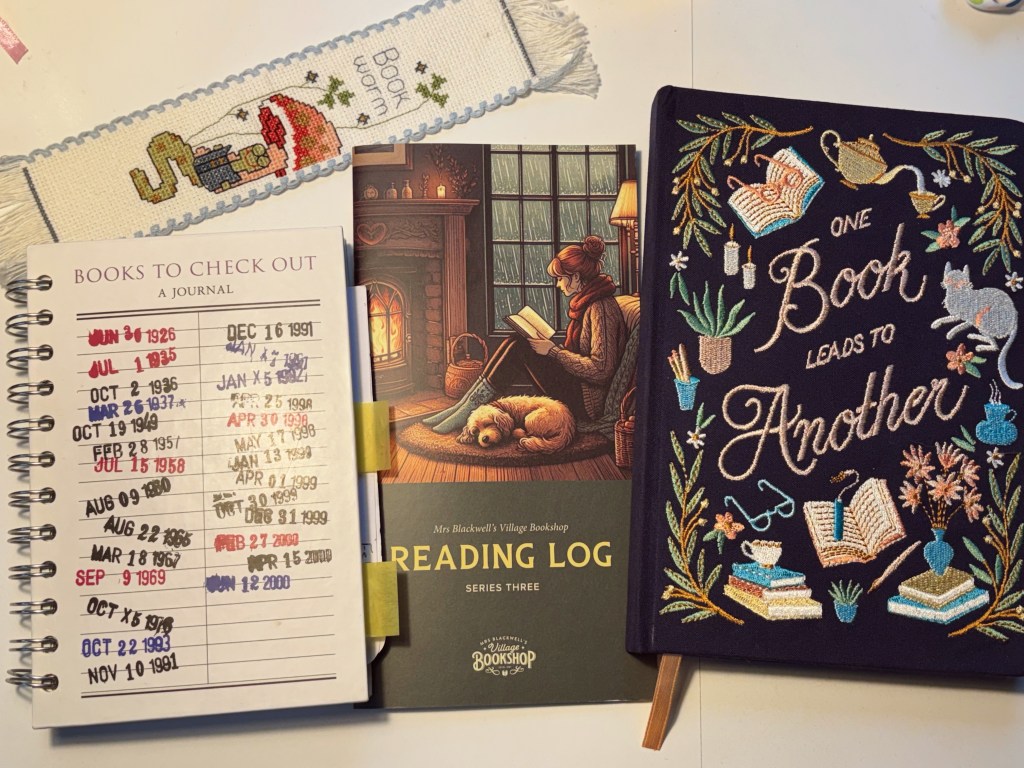
My reading log notebook (on the left) is full. I like to keep a written record of my reading, although I have a digital one on goodreads. For my next log, I’ve chosen the one in the middle which I bought last year at Mrs Blackwell’s Village Bookshop in Greytown. When that’s full (it’s small, it won’t take long) I’ll move on to the one with the embroidered cover from Scorpio Books. Your suspicion that I have a thing for all things book would be justified.

I’ve read eight books in the last month (August). My favourites were Be Brave, The Life of a Pacific Correspondent by Barbara Dreaver, and Memorial Days by Geraldine Brooks. Both of these are memoirs. Another notable book I read was Relearning to Read: Adventures in Not-Knowing by Ann Morgan who encourages the followers of her blog to read books in translation to widen our understanding of the world.

In her latest post, she writes that in this kind of reading:

… I am a guest in someone else’s space, given the opportunity to see how things are done elsewhere, without any attempt to mediate or dilute them for my perceived taste. This can be challenging, particularly if you are used to being centred in the books you read, but it is also a great privilege: a welcome disruption to the habits that surround us and a reminder that customs that can often seem mandatory are just choices. 

Her recommendations have opened up new worlds to me, but so too have books written originally in English. Two of these I have read on the cusp of the month of August: The Mighty Red by Louise Erdrich, which I finished at the end of July, and The Calamity Club by Kathryn Stockett which I finished just after midnight last night. Another is a biography: Fulvia: The Woman who Broke all the Rules in Ancient Rome by Jane Draycott. Fluvia, born in 80 BCE, has been mis-represented in history, according to the author who sets out to make corrections to the record. In the process, she educates the reader about the lives of Roman women and the mine-field that was politics of the time. It was somewhat distressing to find parallels with today.

In between these books, I have kept up a pretty steady stream of so-called cosy crime for sheer pleasure and, perhaps, for restoring my equilibrium (or complacency?). I identified with this comment about the genre by a friend who often recommends good cosy crime books: “Reading this was like a cat soaking in warmth in a puddle of sunlight”.

A Different Kind of Power

At the end of her memoir, Jacinda Ardern imagines giving advice to a young girl who doubts herself.

The things you thought would cripple you will in fact make you stronger, make you better. They will give you a different kind of power, and make you a leader that this world, with all its turmoil, might just need (pp131-132).

It was hard to put this book down (in more ways than one). It answered a lot of questions I had about what it was like being Prime Minister, a sensitive, principled, idealistic and female one particularly. No ghost writer was involved here, but surely a good editor. It is very well written and well structured; parts of it echo and link, particularly character-forming moments from early in her life which serve her well when making hard decisions later. It goes well beside Michelle Duff’s biography, which gives the political and social context more than it gives details about her life.

I looked through my 2020 diary to find mention of Ardern’s government and the covid response and was shocked to find there was very little. And yet it occupied our daily lives and our thinking in all her years in government. My journal did a better job, thankfully, and I had slipped newspaper cuttings into it which are interesting to read now. Something else in my journal caught my eye. In November 2021 I was reading Deborah Levy’s first memoir Things I Don’t Want to Know and had copied down this extract where it occurs to her that like other women she is ‘on the run’.

We were on the run from the lies concealed in the language of politics, from myths about our character and our purpose in life…The way we laugh. At our own desires. The way we mock ourselves. Before anyone else can. The way we are wired to kill. Ourselves. It doesn’t bear thinking about (pp158-9).

I remembered Ardern writing in the memoir that she was ‘on the run’ from one thing to another in her life. She discusses with a friend their shared tendency to ‘run away’ from things. The honesty of her self-evaluation is an admirable aspect of the book. When she decides to leave Helen Clark’s office and go to New York she worries that she could not be sensitive and survive in politics.

Was I running away? Probably. But that was better than staying and facing up to the fact that I couldn’t do something (p122).

In the Acknowledgements, Jacinda Ardern thanks her mother for going through ‘endless journals’ for her. Clearly, the family kept better diaries than I, and it explains the careful details of Ardern’s early years and highlights the collaborative spirit of her family who have supported her and her own family consistently.

It seems like a completely different time we lived through during Ardern’s two terms as Prime Minister – certainly a contrast to the current government. An article I found tucked into my journal describes the change as ‘Retrograd’.

People whose outlay involves enormous houses, multiple properties, private schools and expensive cars will demand tax and rates cuts, while furiously complaining about public services…Mention you’ve waited hours for an ambulance, or that mental health services are stretched to the limit, and they’ll be indignant. They will blame the government. Then they will briskly use the tax cut to transport the family to a holiday in Europe. This is Retrograd, where you take it all for yourself, live your best gated life, enjoy the paradise of your own scorched earth.

-Charlotte Grimshaw, Listener, 26 March 2022

A Different Kind of Power gives me some hope that these days won’t last – before climate change beats us to it.