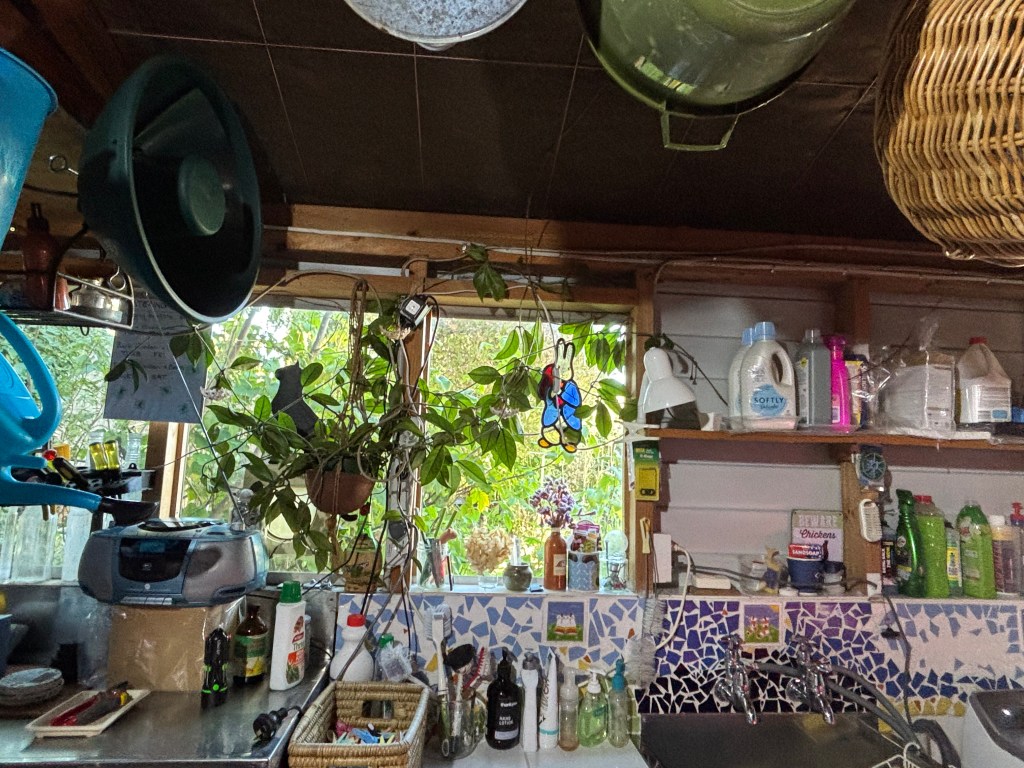
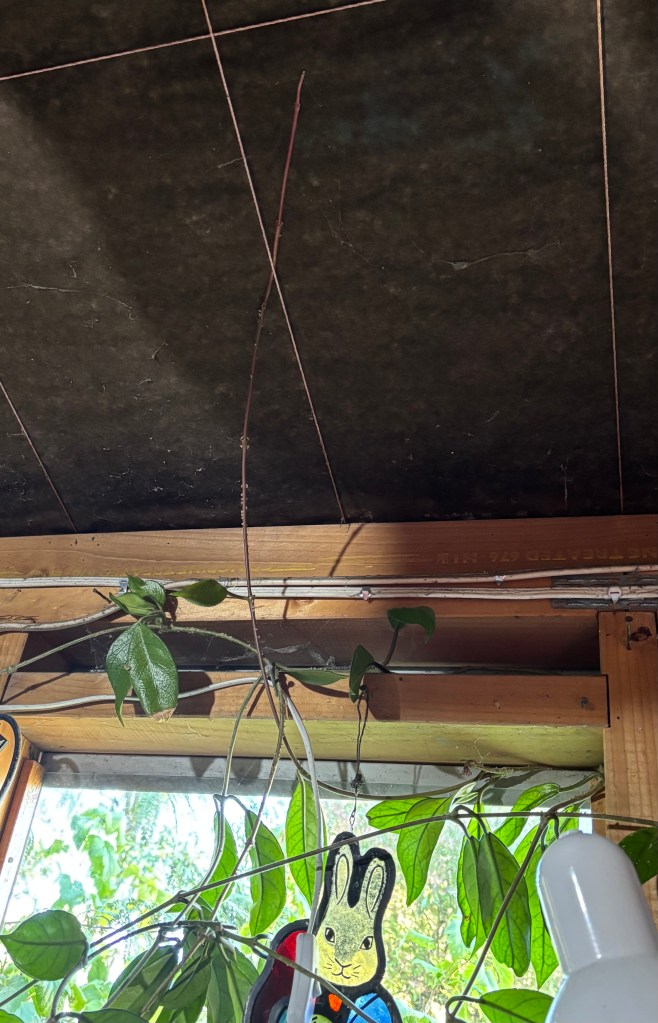
A wide shot shows the extent of the plant from far left to far right, and up to the roof.
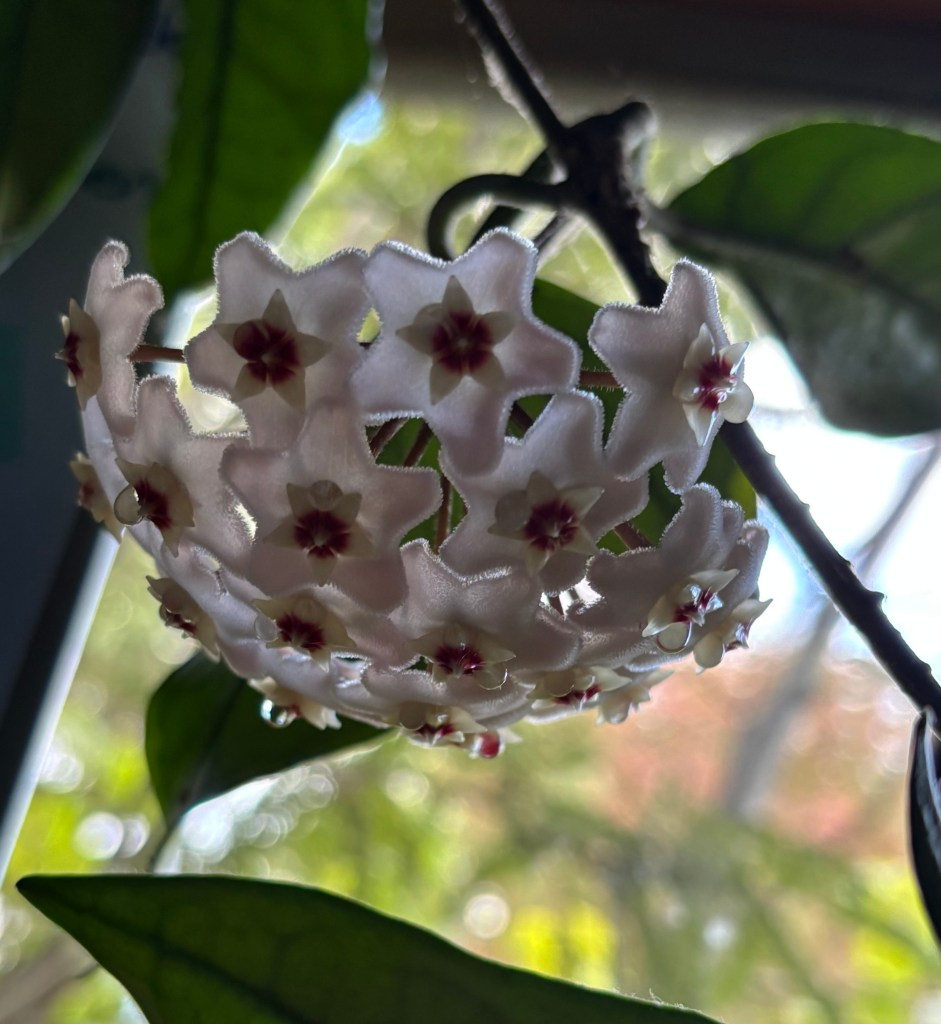
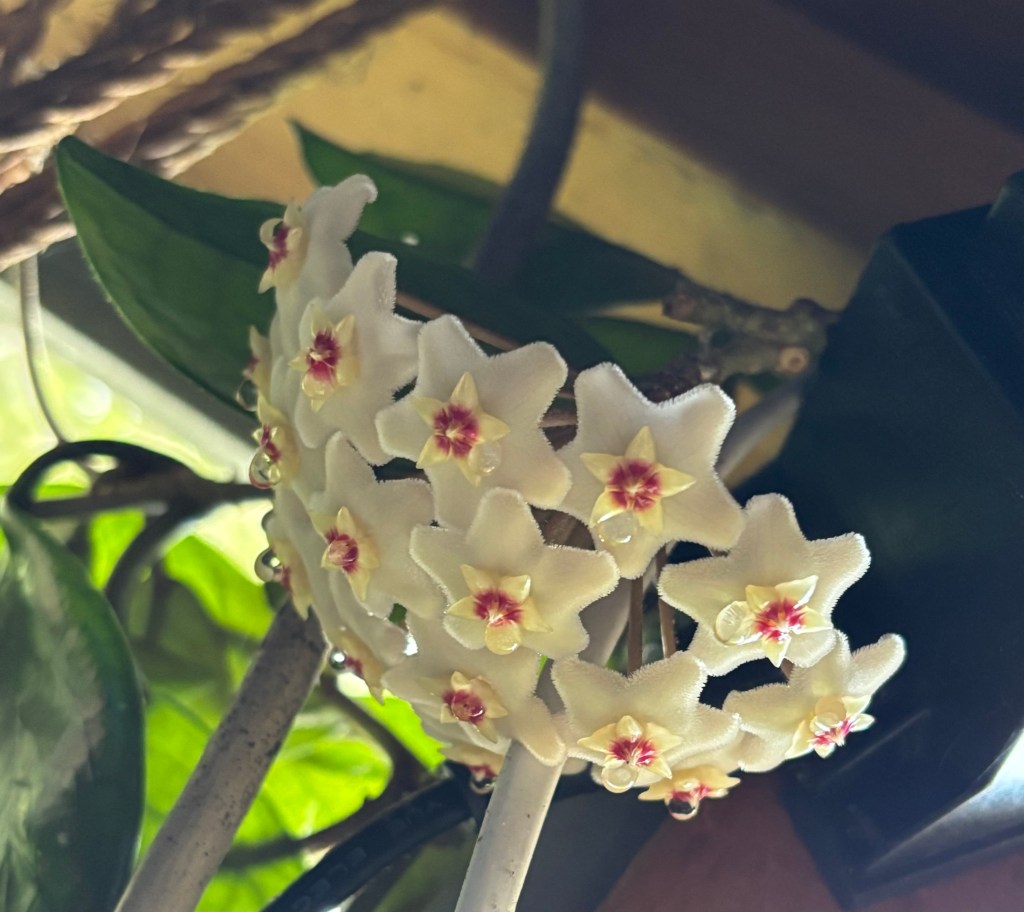
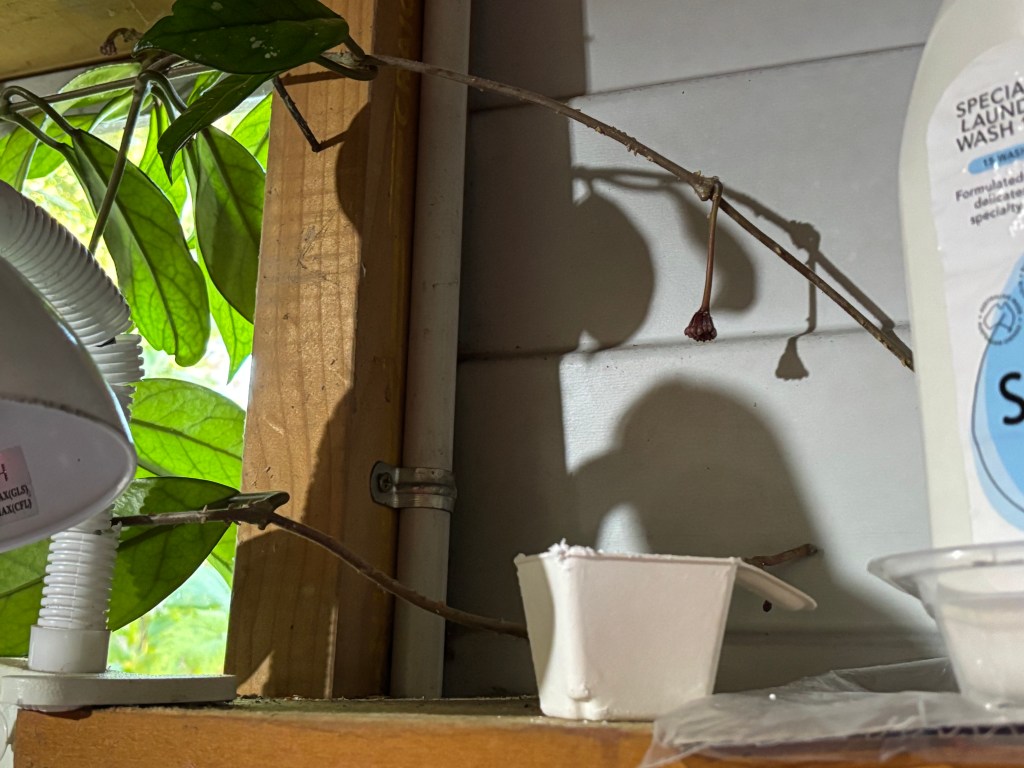
There’s a sweet honey scent in the garage; the hoya is flowering. Its flowers are sometimes called porcelain flowers, which seems apt as they hardly look real. There are three clusters of flowers this summer. You can see nectar dripping from the centre of each flower.
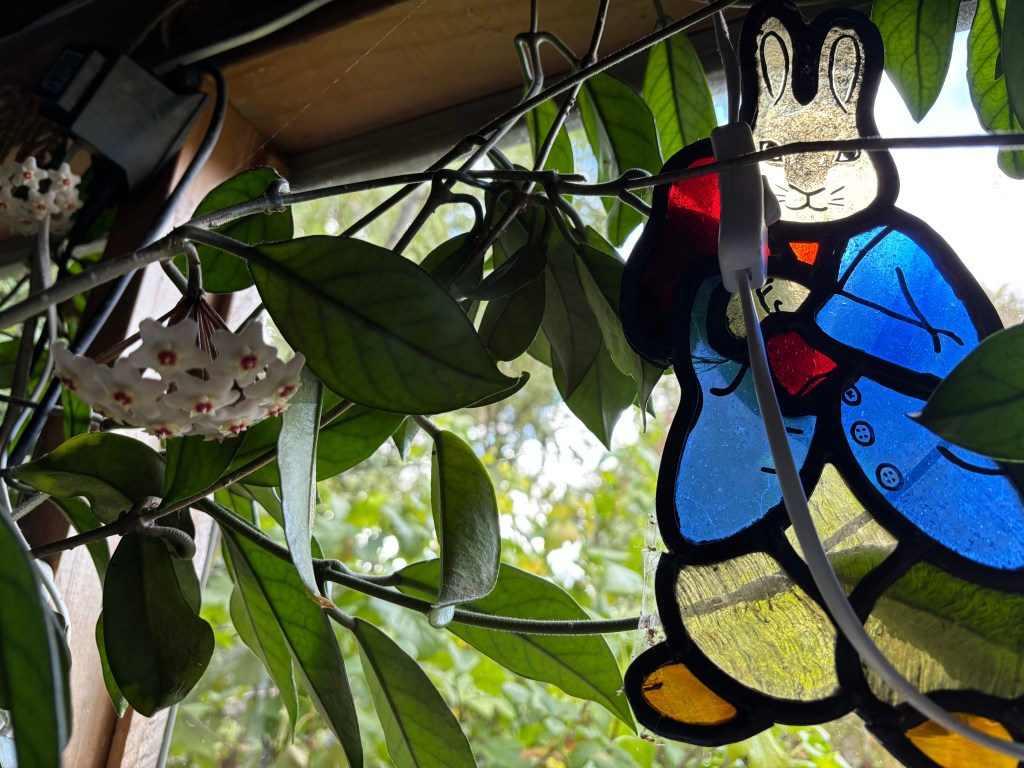
Another budding flower clusterNew shoot heading up into the roof
I have had the plant since the late 1970s when house plants were all the rage – as they are again now. It’s still in the same small pot and macrame hanger. Long ago, I decided to divest myself of indoor plants (but do enjoy a couple of small ones I have been given) particularly when the monstera deliciosa grew monstrous (think Little Shop of Horrors) and the spider plants looked tired. They ended up in my classroom and in the department resource room for years. I liked to think they removed pollutants from the air, but apparently, you need to have a room crammed full of plants for that to happen. I would bring them home over summer, not into the house but into the garage or sheltered spots in the garden. One, a Fatsia Japonica, didn’t make it back to school. It is now about three metres tall and about as wide, growing happily in the garden – despite at times attracting blackbirds (for the seeding flower heads), scale, aphids, whitefly, sooty mould and ants.
The hoya remains on the laundry side of the garage where it seems to be thriving beside the window, growing in and out of electrical cables and the laundry stuff. I try to remember to water it, feed it occasionally and wipe the leaves with Conqueror Oil sometimes. When it threatens to spread itself around the garage I cut it back but, undeterred, it sends out new tendrils with ambitious intent.
We are more warmly dressed than usual for our beach walk this morning; it is still cool after yesterday’s thunderstorm. The air is fresh and clear, with a brisk easterly wind. From the crest of the dune pathway, we can see three ships on the horizon. The Port Hills to the south are outlined against billowing ‘cauliflower’ clouds, and the distant Kaikoura mountains are clear to the north. At the foot of the dunes, families gather around Santa Claus for photos.
The sand is firm under our feet as we head north along the beach with many others, most with happy dogs. We pass a circle of people discussing the coastal environment. Overhead, a motorised kite flies by, turns and disappears into the distance. Two light aircraft follow the line of the beach, one is white and heading south, the other is red and travelling north. ‘It’s the Red Baron,’ I say.
Later, we heave ourselves upright from the log where we stopped for morning tea, and come upon two people launching colourful kites which swoop and glow against the bright blue sky. I count two dozen birds flying in formation and intersecting a jet trail – and, in this photo, forming an angle with the kite’s string line.
The kites make undulating shadows on the sand.
As we near the pathway we can see that the swim-between-the- flags are out in front of the surf club. Families are organising themselves for photos with Santa, choosing props such as hats, a cricket set, rugby ball, surfboard, and a bent (purposely?) Christmas tree – and even the Grinch – although he seems to have retreated to a distance now, perhaps to keep in character.
It’s perfect kite-flying weather. A local, walking by with her small terrier whose ears and fur are pinned back by the wind, asks us if we have been to the annual kite day – this is just a taste of it. The next one will be at the end of January in the new year.
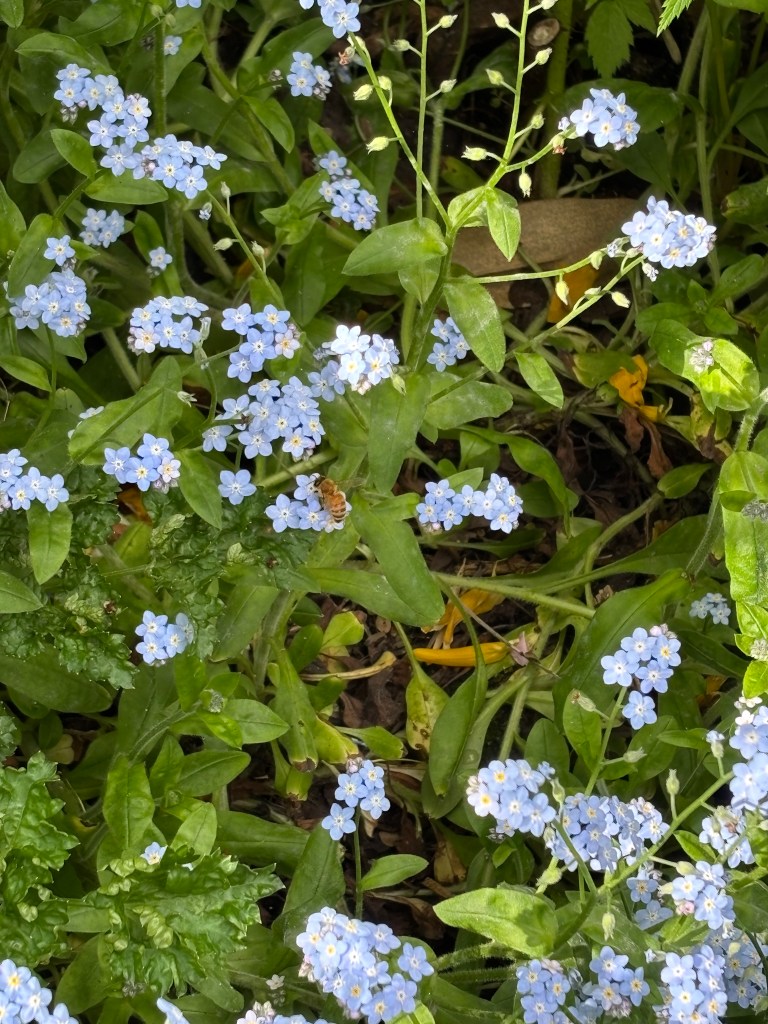
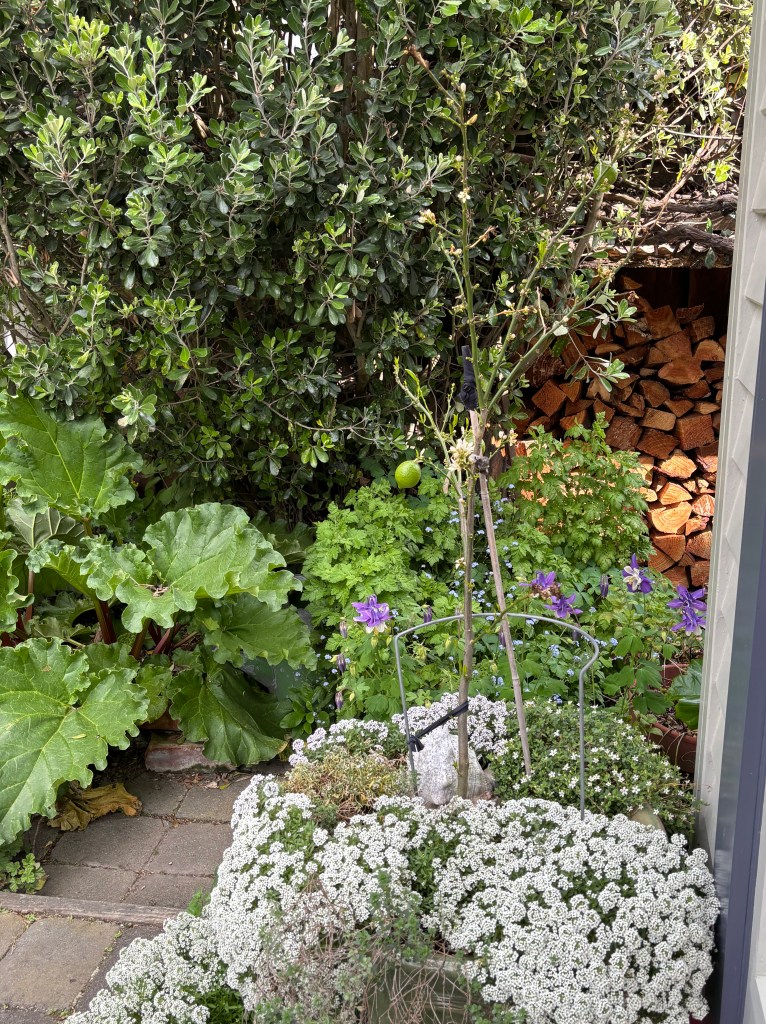
A woman looked over my gate this week and asked, ‘How do you get your flowers to grow?’ I looked with some despair at the cloudy masses of forget-me-nots and couldn’t think of an answer. ‘They just do,’ I said lamely, in the end. Which is true. I didn’t plant the forget-me-nots. They just come up every spring. So do a lot of other things which I inherited when I moved in nearly 40 years ago. ‘What about those,’ she asked, pointing at some aquilegias. I planted aquilegia seeds – probably decades ago – and they continue to come up every year. Often in less than convenient places. Fox gloves come up randomly, as does Solomon’s Seal, feverfew, borage, parsley, lemon balm, wind flowers, marigolds, geums … She told me that she’d tried to grow some daffodils in a pot but they got knocked over by the wind. Gardening’s like that, I reassured her, a roller coaster of success and failure.
Bees like the forget-me-notsAquilegia growing between paving stonesFox glove beginning to flower
While I have planted roses, herbs, fruit trees, vegetables, pansies, sweet peas, geraniums, raspberries, blackcurrants, and so on, many plants are self-sown or grown from cuttings I’ve been given. Others have spread of their own accord. Or contrarily given up the ghost.
Planted, gifted, transplantedGeraniums grown from cuttings left by a neighbour at my gateBanksia I planted, now needs support
Many large trees in the garden are self-sown and are usually indigenous such as several kōwhai, ake ake, pseudopanax, pittosporum and cabbage trees – or were planted by previous owners, such as the beech, karo, a very old hebe and a myrtle. The ake ake has an interesting trunk.
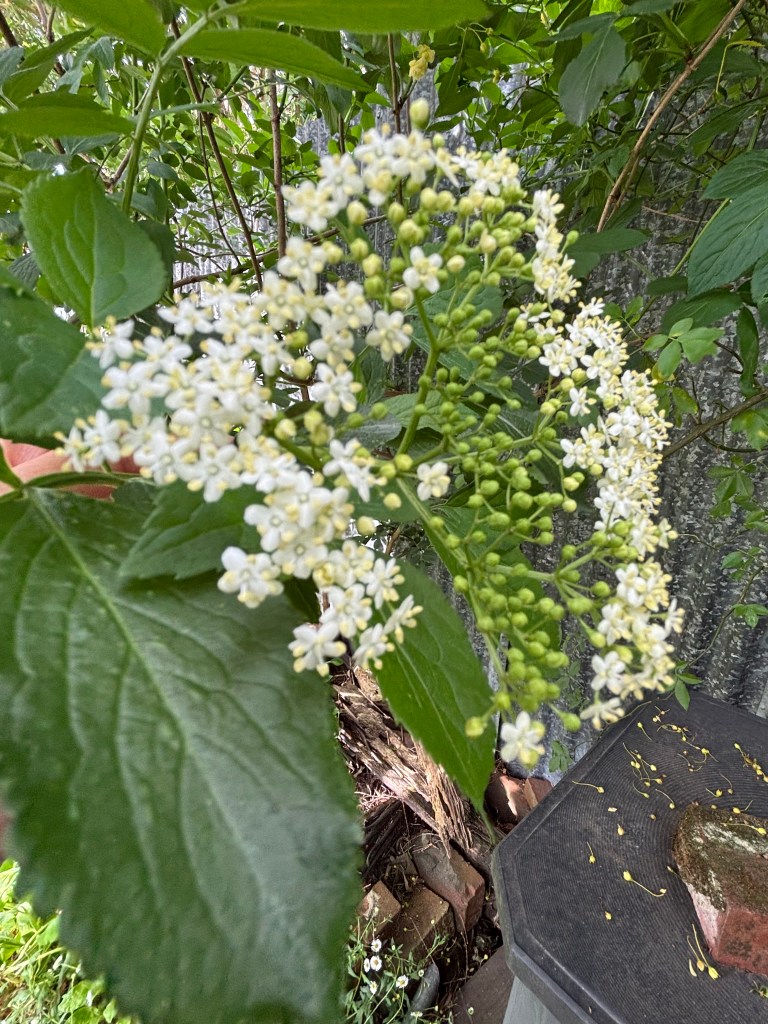
Although not a great fan of succulents, several years ago I bought some cute little ones at a market. Now they are in various parts of the garden, completely hidden by cottage garden plants at the moment except for some in pots. I’m encouraging some self-seeded elder plants to grow so I can make elderflower cordial.
Trunk of ake akeFlowering succulentFirst elder flower
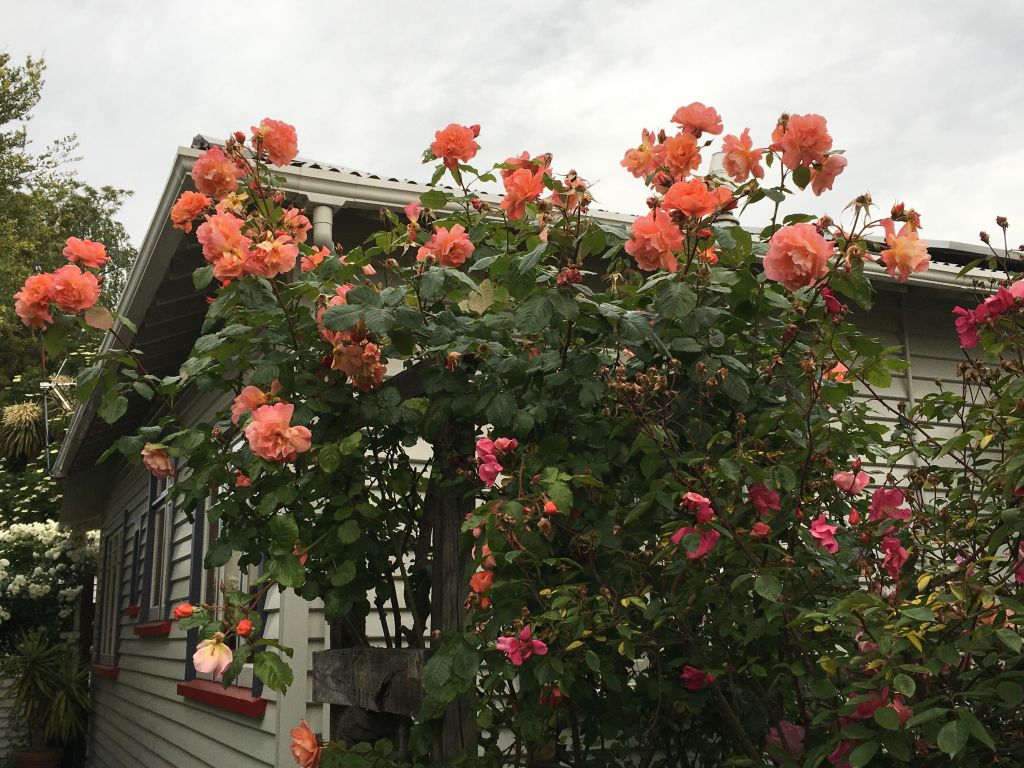
Dips in the gardening roller coaster include plants which do not thrive or suddenly sicken. This has happened recently to a bay tree in a pot which was thriving until a few weeks ago when its leaves began to turn brown. It was badly affected by scale. I trimmed it back and administered what first aid I could. Now it’s just a matter of wait and see. A lime tree in a pot lost all its leaves, but there are new ones appearing, so I’m hoping it will recover. My lemon tree gets sooty mould from time to time, and once a more serious disease from which it has recovered. I had to remove all the affected fruit in the serious case, and pruned the tree in both cases to let air flow through. I’m still mourning a beautiful rose, a Westerland, which died last year.
Ailing bay treeRecovering lime treeRecovered lemon tree
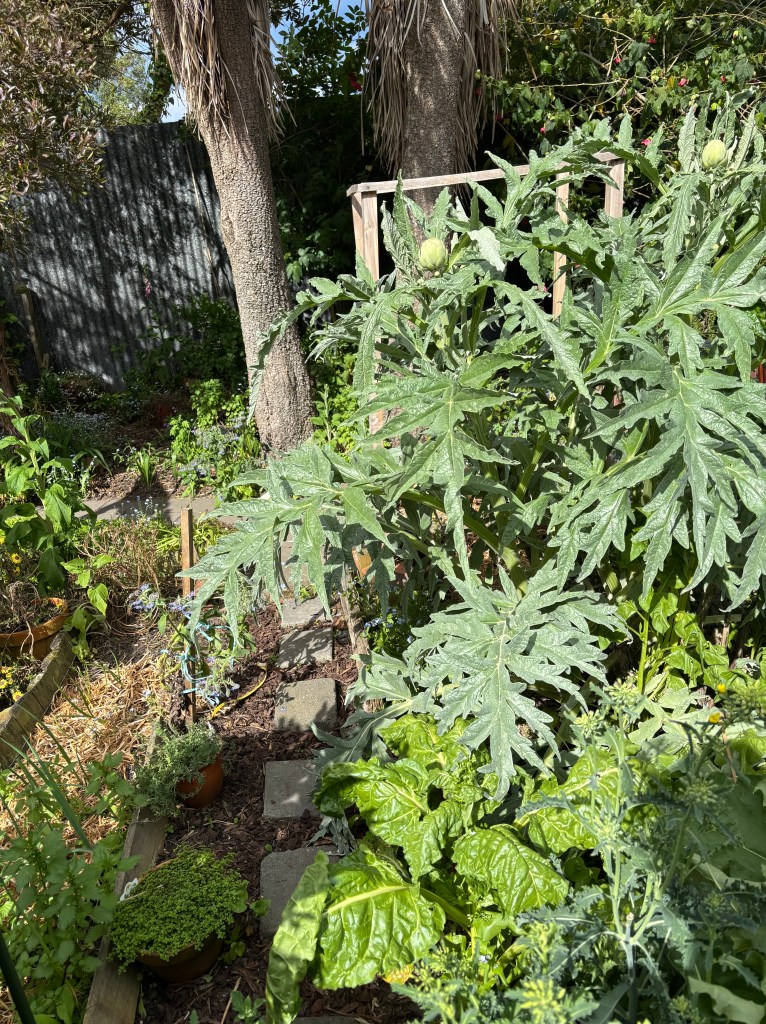
A bit of a softie about what gets to grow, I often can’t bear to pull things out (except convolvulus). Children passing by might enjoy the dandelion clocks on the front berm. This week a gardener on tv was advocating for weeds in the garden. While not exactly a weed (whatever a ‘weed’ is) my artichoke is a bit of a thug in the garden, overshadowing the vegetables and rhubarb, but it is pleasing to look at. Today I noticed the first globes appearing.
I spend a lot of time just looking at the garden. Once the forget-me-nots have finished, other plants will re-emerge to take their place.
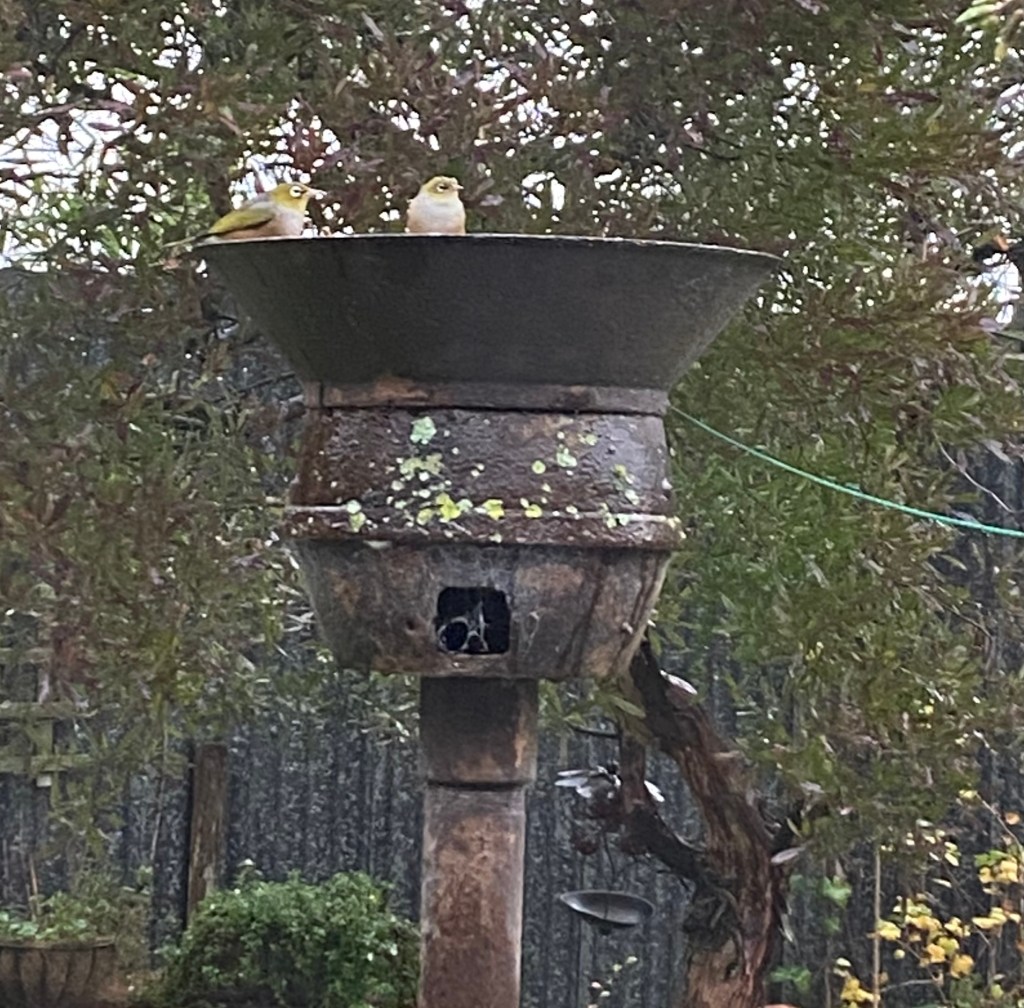
Should you be selective about what forages in your garden? Once you open the gate to wildlife there’s no stopping them. I have a bug house which is smothered in spider webs. Two bird feeders attract lots of waxeyes and a few sparrows. The blackbirds seem to fend for themselves, digging into the leaf litter for snails, worms and insects (and they enjoy the birdbath), and finches occasionally fly in to feed on the seeds of plants such as borage which also attracts bees when flowering. Fantails flit high up in the canopy, catching insects on the wing. Other birds pass overhead: spur-winged plovers, gliding seagulls and sometimes a pair of ducks or a skein of geese. Sometimes I hear a grey warbler and distant magpies.
On the flip side, cats cruise through (discouraged by a water gun if I’m fast enough), Felix brings in a rat now and again, and ants appear with monotonous regularity. Two days ago I was horrified to find thick masses of ants around the guttering downpipes and long lines of them along the eaves and walls of the house. I should have taken photos to freak you out, but I had turned into a rubber-gloved, masked avenger with a loaded spray gun before it occurred to me to record the event. The next day there was little sign of ants – except along the clothes line where a column of them was migrating to a nearby tree, like Mother Courage and her children toiling across the battlefield. It seems I only feel sorry for them when they are in retreat.
There are several natural sources of bird food: apples, berries, aphids, and abutilon, camelia and protea flowers.
Apple treeAbutilon flowers
And there are two bird feeders:
The new bird feeder (on the left) requires sugar water and ‘truffles’. Lately, I’ve been replacing the truffles every day for these voracious (hungry?) waxeyes. So that nothing is wasted, I put the little bits which fall through the wire feeder into the other bird feeder, with the windfall apples. I worry that I should leave a gap before replacing the truffles (a day? half a day?) so that the birds don’t become too dependent on them.
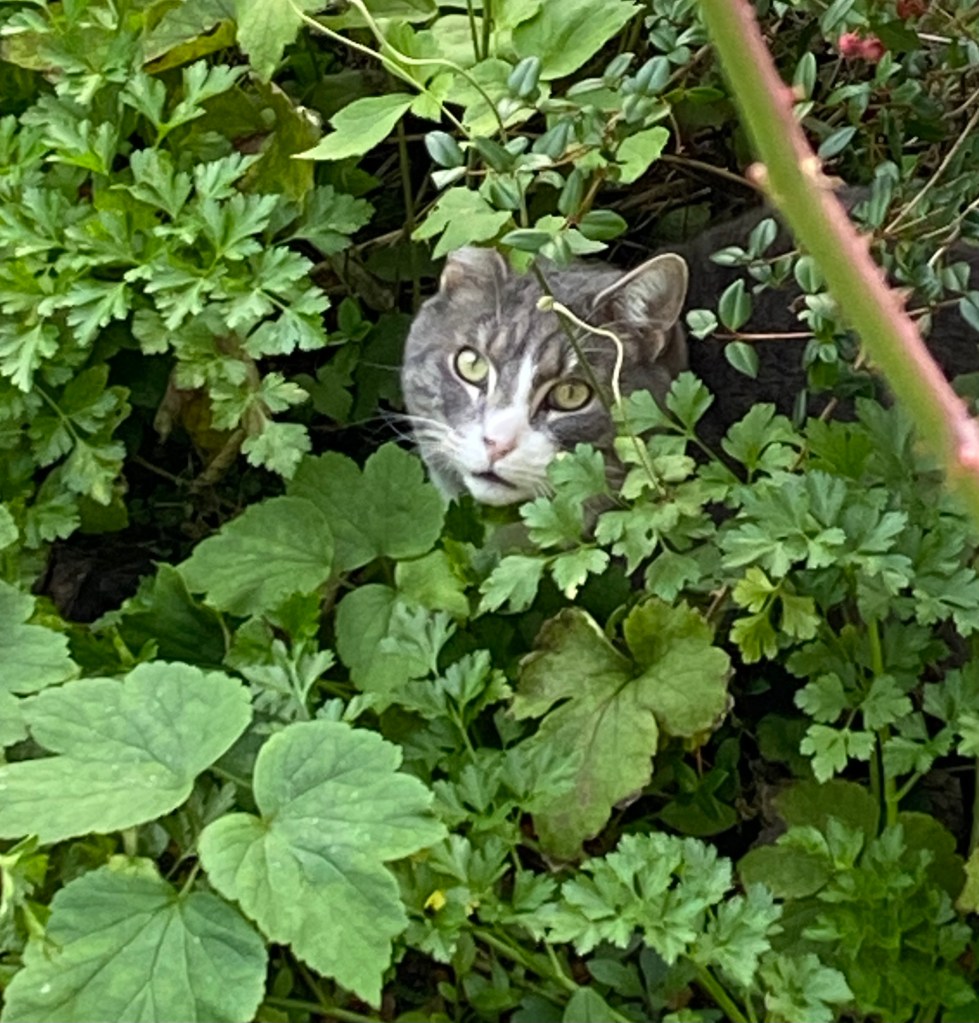
Both bird feeders are cat proof. For Felix, the new bird feeder is cat television. He sits in the parsley under the cranberry bush and watches for hours – even now, in the rain.
A photo taken several days ago. Felix briefly switched his attention to me.
The Sunday sky beyond is about to turn pink with a dramatic sunset and, to the east, a rainbow appeared.
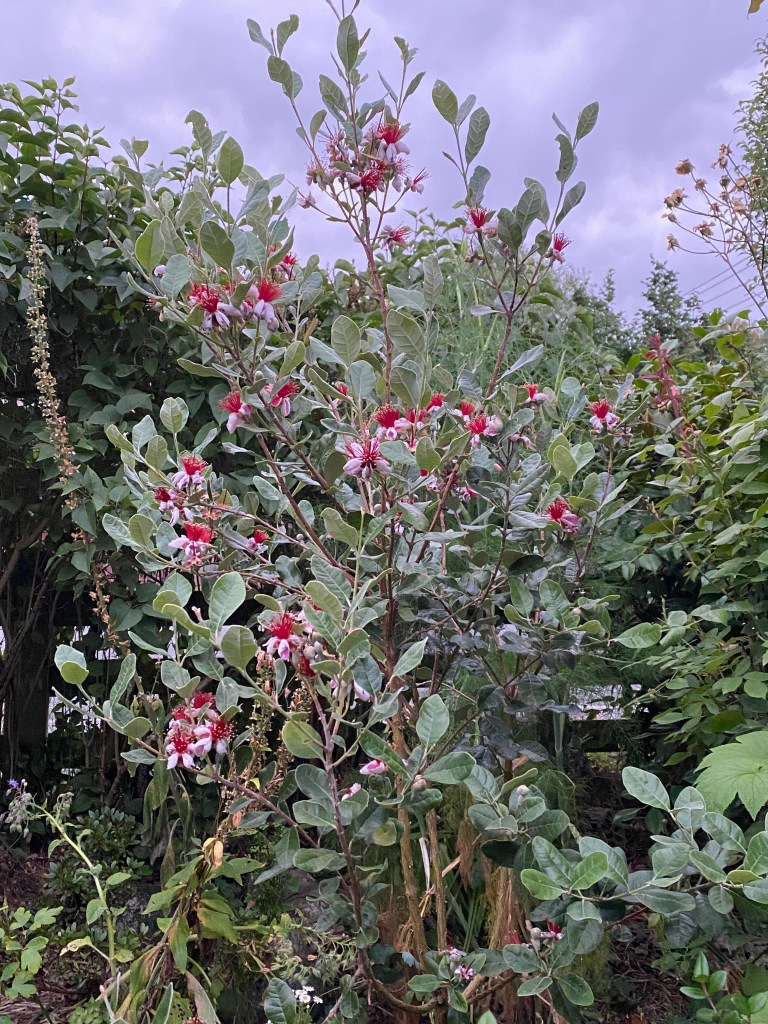
The feijoa tree is covered in flowers this year. As we put the Christmas tree (exotic pine) inside the house on Sunday, we looked out and said, ‘There’s a real one!’* It is native to South America and is of the myrtle species, so related to the pōhutukawa aka the Aotearoa/New Zealand Christmas tree (beautiful pictures and the full story on this link).
I have a New Zealand myrtle in the garden. It is covered with fluffy white flowers at Christmas time, which prompted me to post about it last year (Christmas Trees, 8 Dec 2023 – also A White Christmas 14 Dec 2021). The Southern rata, another myrtle, was in flower when I was in the Botanic Gardens the Sunday before last.
Feijoas are very popular in New Zealand, and Kate Evans has written a book about them.
Here’s a close up of the pretty flowers which make the feijoa a self-decorating Xmas tree.
Myrtle rust is a problem for myrtles, so let’s hope it doesn’t become the grinch for future Christmases.
*My sister and brother-in-law, who gave us the inside Christmas tree also gave us the feijoa tree.
................... for lovers of ice cream. Your free on line magazine for sweet frozen treats. Recipes, inspiration, artisanal ideas for your delectation.












 Anne-O-tations