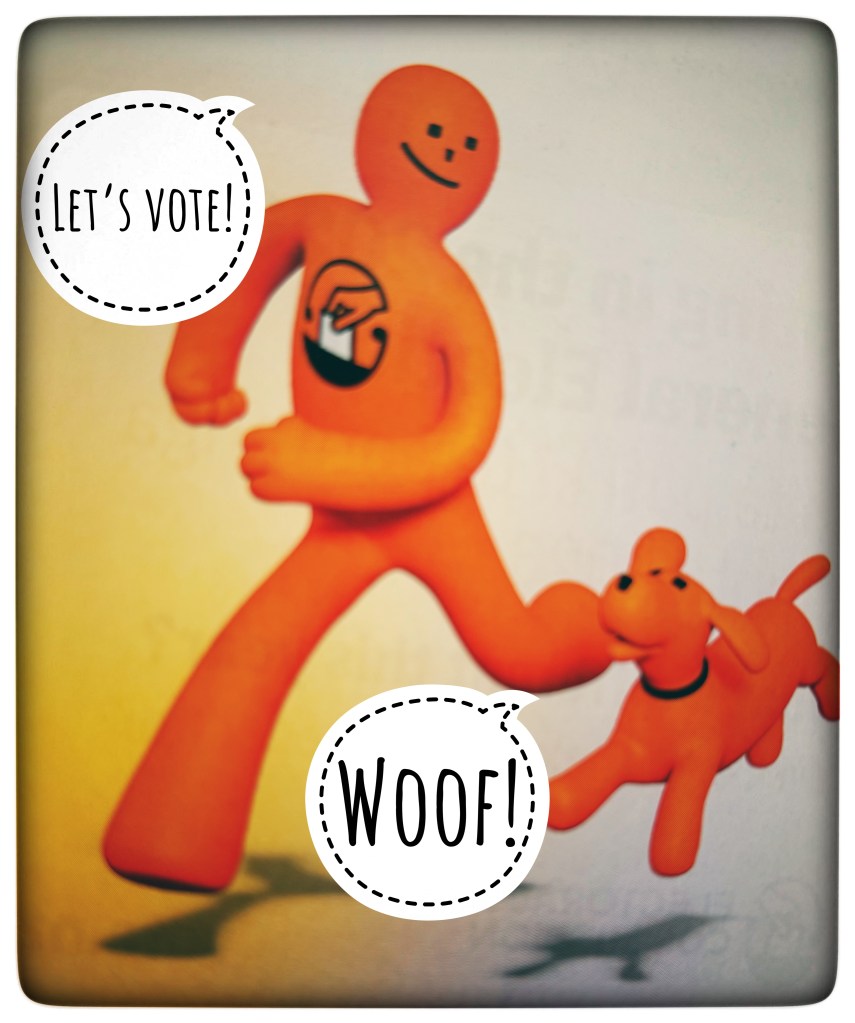
It was a good plan to vote on the first day some voting places were open. It was less busy and we were able to get a mobility park at the door. The polling station we chose was not in our electorate so the official had to hunt out the relevant electoral roll. Otherwise, it was easy – except Mum had forgotten her reading glasses. I was allowed to fill in her voting paper for her which I did carefully, explaining it to her as I went. It was very trusting of the officials; I’m pretty sure I look law-abiding!
I wonder how near-sighted people manage with the voting forms. The lists of parties and candidates are quite close together and small-ish. A magnifying glass would be useful. And what about all the people in rest homes. Do they have to rely on family to take them out to vote?
It was fitting that the polling station we went to is on the same street as Kate Sheppard’s house. After all the effort she and many others put into getting us the vote finally, in 1893 (after a previous unsuccessful petition) it seems important to make sure we do vote. I can imagine her saying, “What do you mean you can’t be bothered to vote? Really? After all we’ve been through? Give me strength!” It wasn’t as easy as today’s digital petitions, that’s for sure. It was a door to door, neighbourhood to neighbourhood, rural district to rural district, involving lots of volunteers. Then the petition was manually pasted together (you can see the table where this was done in Kate Sheppard’s house), rolled up, transported to Parliament, wheeled into the House in a wheelbarrow, and unrolled along the floor. Even then the vote was a close thing. This election is something of a nail-biter too.
At the end of her memoir, Jacinda Ardern imagines giving advice to a young girl who doubts herself.
The things you thought would cripple you will in fact make you stronger, make you better. They will give you a different kind of power, and make you a leader that this world, with all its turmoil, might just need (pp131-132).
It was hard to put this book down (in more ways than one). It answered a lot of questions I had about what it was like being Prime Minister, a sensitive, principled, idealistic and female one particularly. No ghost writer was involved here, but surely a good editor. It is very well written and well structured; parts of it echo and link, particularly character-forming moments from early in her life which serve her well when making hard decisions later. It goes well beside Michelle Duff’s biography, which gives the political and social context more than it gives details about her life.
I looked through my 2020 diary to find mention of Ardern’s government and the covid response and was shocked to find there was very little. And yet it occupied our daily lives and our thinking in all her years in government. My journal did a better job, thankfully, and I had slipped newspaper cuttings into it which are interesting to read now. Something else in my journal caught my eye. In November 2021 I was reading Deborah Levy’s first memoir Things I Don’t Want to Know and had copied down this extract where it occurs to her that like other women she is ‘on the run’.
We were on the run from the lies concealed in the language of politics, from myths about our character and our purpose in life…The way we laugh. At our own desires. The way we mock ourselves. Before anyone else can. The way we are wired to kill. Ourselves. It doesn’t bear thinking about (pp158-9).
I remembered Ardern writing in the memoir that she was ‘on the run’ from one thing to another in her life. She discusses with a friend their shared tendency to ‘run away’ from things. The honesty of her self-evaluation is an admirable aspect of the book. When she decides to leave Helen Clark’s office and go to New York she worries that she could not be sensitive and survive in politics.
Was I running away? Probably. But that was better than staying and facing up to the fact that I couldn’t do something (p122).
In the Acknowledgements, Jacinda Ardern thanks her mother for going through ‘endless journals’ for her. Clearly, the family kept better diaries than I, and it explains the careful details of Ardern’s early years and highlights the collaborative spirit of her family who have supported her and her own family consistently.
It seems like a completely different time we lived through during Ardern’s two terms as Prime Minister – certainly a contrast to the current government. An article I found tucked into my journal describes the change as ‘Retrograd’.
People whose outlay involves enormous houses, multiple properties, private schools and expensive cars will demand tax and rates cuts, while furiously complaining about public services…Mention you’ve waited hours for an ambulance, or that mental health services are stretched to the limit, and they’ll be indignant. They will blame the government. Then they will briskly use the tax cut to transport the family to a holiday in Europe. This is Retrograd, where you take it all for yourself, live your best gated life, enjoy the paradise of your own scorched earth.
-Charlotte Grimshaw, Listener, 26 March 2022
A Different Kind of Power gives me some hope that these days won’t last – before climate change beats us to it.
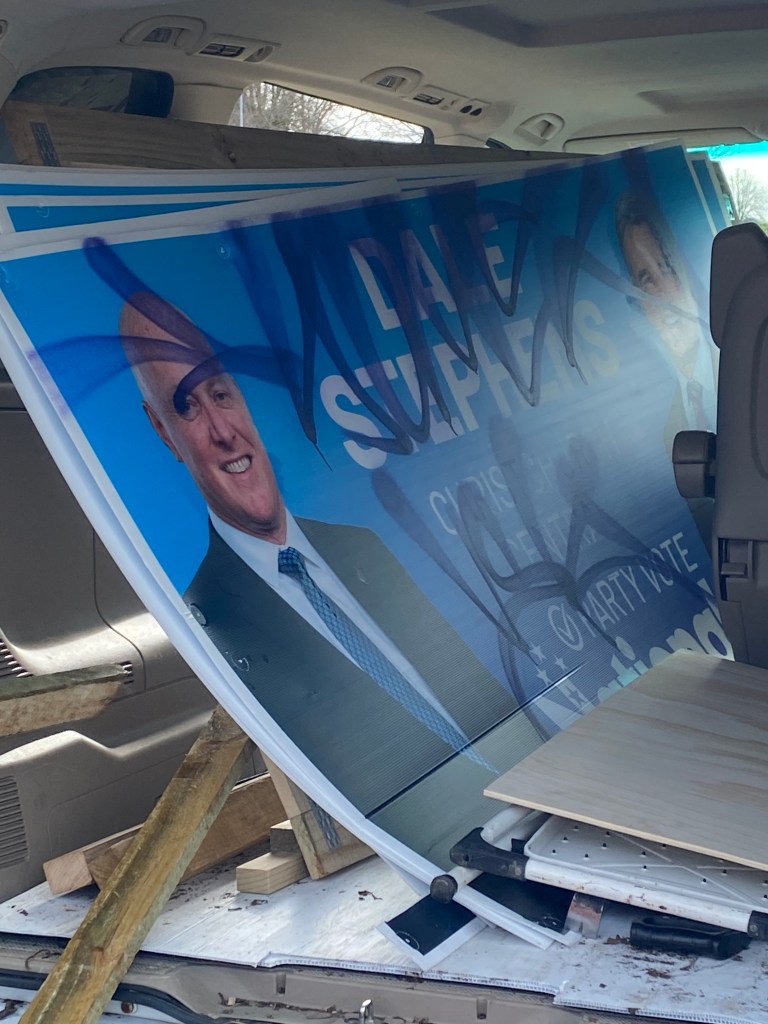
It’s that time in the election cycle when our city is littered with political billboards. Cheesy, fake grins of politicians in suits are pasted up along our city streets. It’s a mystery to me how such blatant insincerity and spin win any votes at all. Inevitably, many billboards are defaced. I saw some being removed and replaced this morning – on a site owned by a property developer.
Someone had gone to a lot of trouble on a billboard next to these. It is beside a busy road and I wonder if they worked in the dead of night, or in daylight with impunity and a Sharpie. I was reminded of Virginia Fallon’s column in The Press this week about the more creative defacing of billboards.
I feel sorry for the people living next door to this field of sprouting billboards, with their river views impeded by the visual pollution. At least they see only the backs of them.
Some parties choose a more modest sign.
The simplicity of this sign seems to fit what ‘being green’ is about – as does the backdrop.
................... for lovers of ice cream. Your free on line magazine for sweet frozen treats. Recipes, inspiration, artisanal ideas for your delectation.