Now I’m seeing evidence of cottages everywhere in my house.
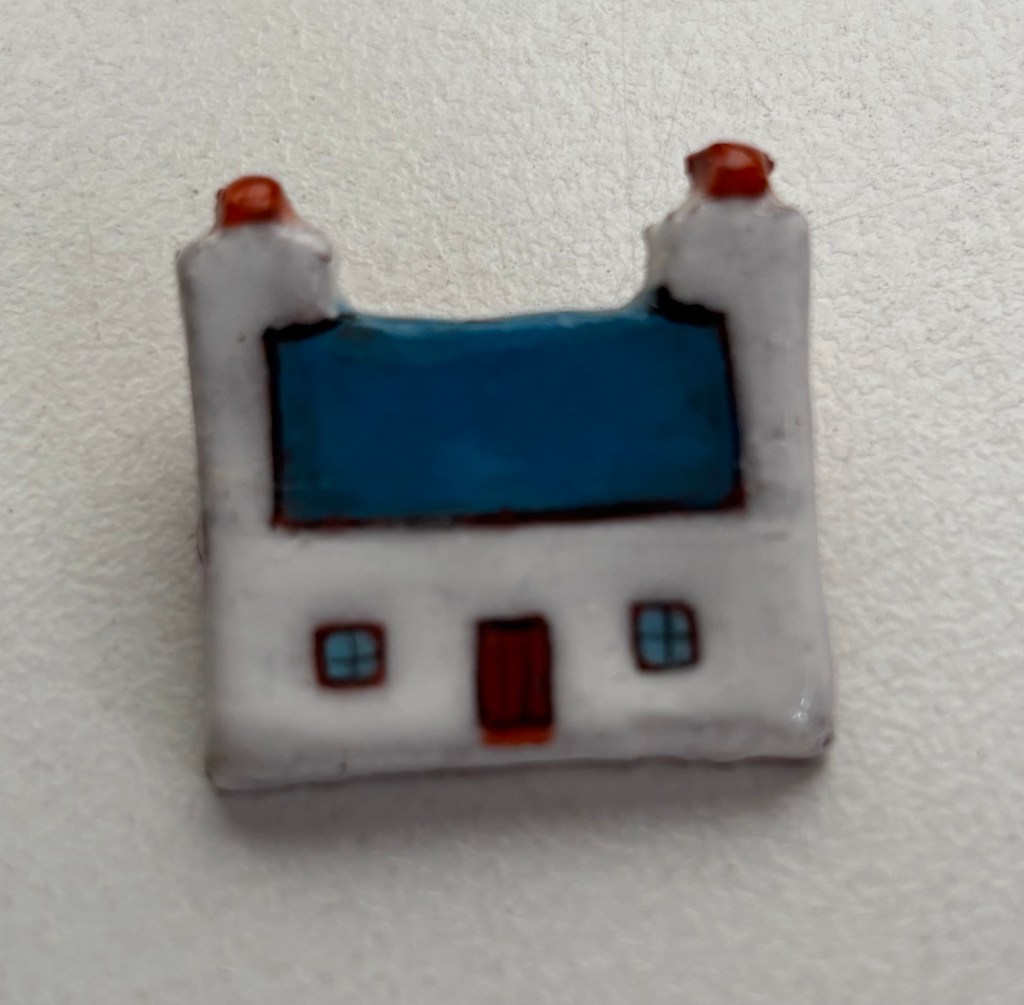
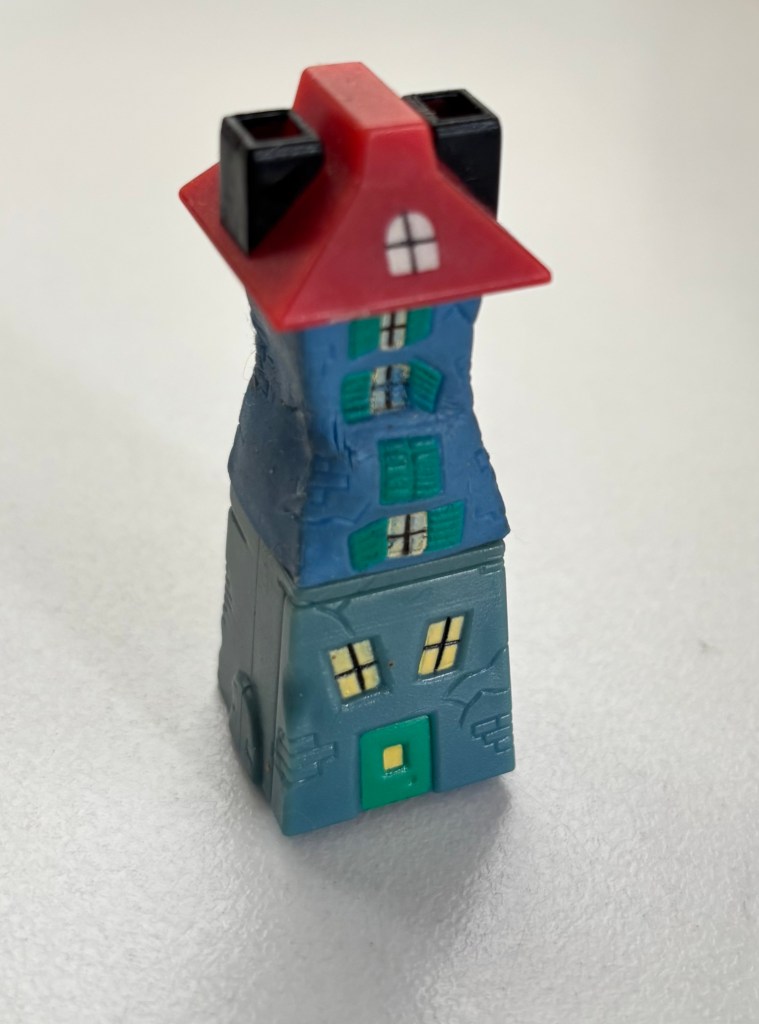
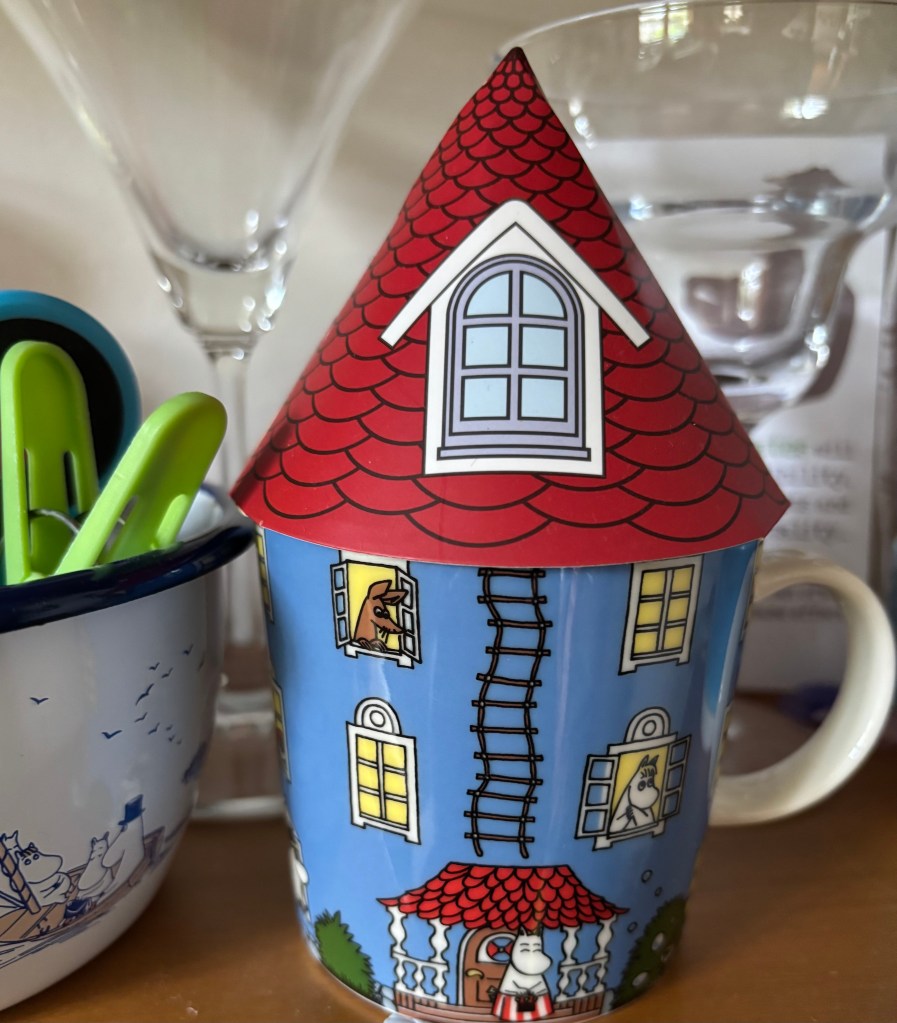
Model miner’s cottage from Central OtagoScottish cottage broochFinnish cottage earringsEnglish mill cottageCottage from Kinder Surprise (when they had good stuff)Soap box cottage (nice soaps inside) from Arts Centre marketCottage on wheels…?Moomin cottage mug
And then there are the many miniatures – a sort of ‘cottage chic’.
Tiny teapots from YorkKitten in basket (gift)Teddy in bath (gift)Tiny bookLittle jug and basin from IrelandLittle watering can lights from Chatsworth
It’s no wonder that my brother said, on Friday, that he hopes he dies before I do so he doesn’t have to clear out my house. That comment prompted me to weed my bookshelves in the weekend and give away two boxes of books. I expect he won’t notice the difference!
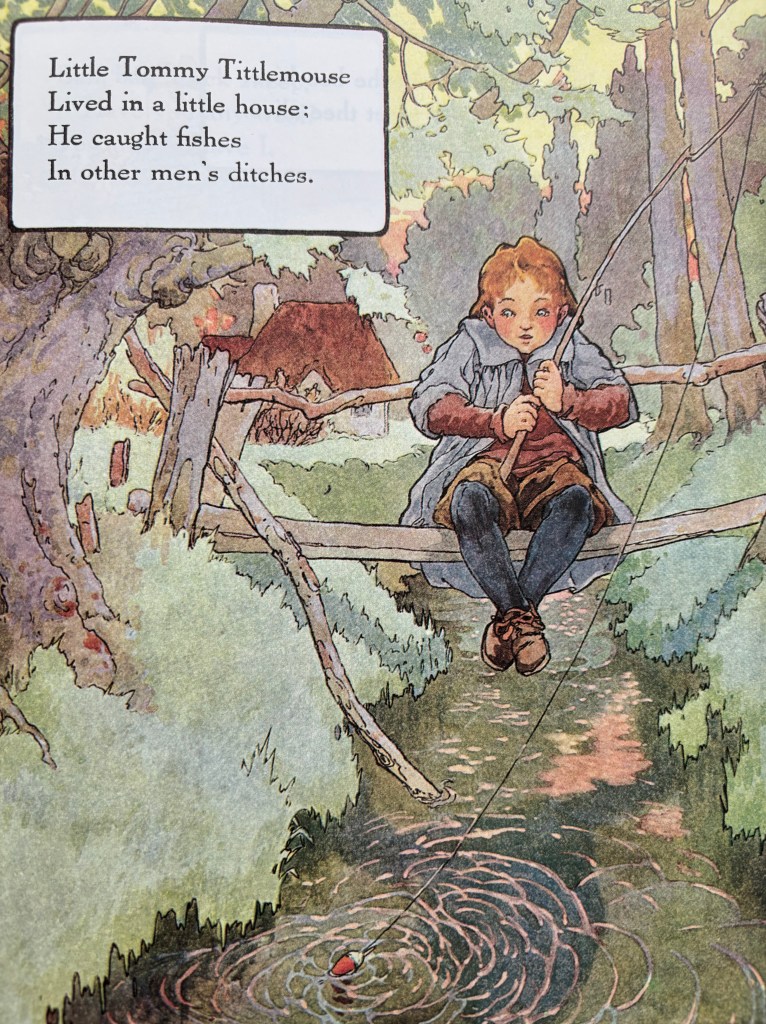
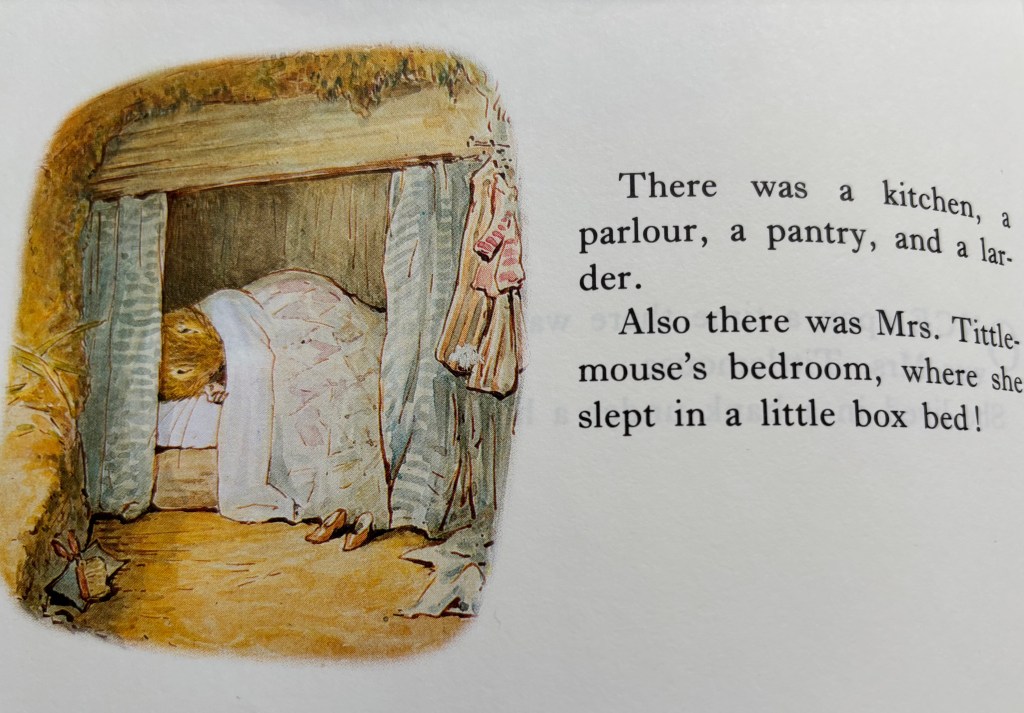
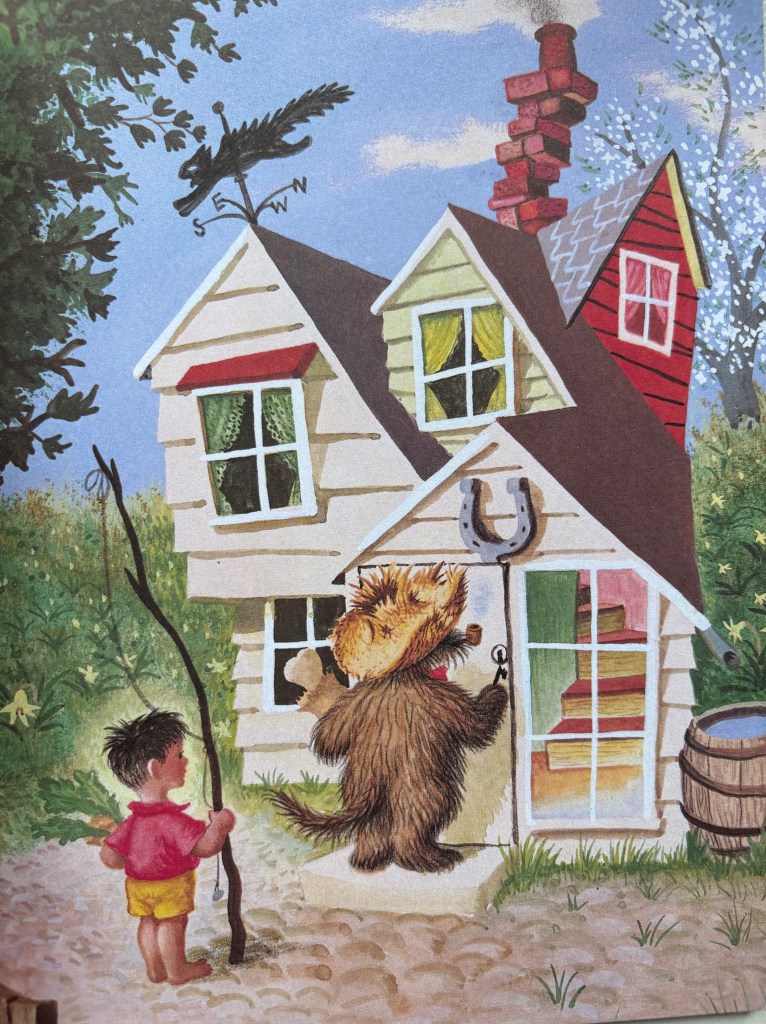
I suspect childhood reading was the source of my fascination with cottages. These pictures are from books I won’t be giving away.
Mother Goose Vollund editionPeter Pan and Wendy and the lost boysBeatrix PotterMister Dog (Little Golden Book). Note the weather vane!Bunyip Bluegum and Uncle Wattleberry’s tree house.
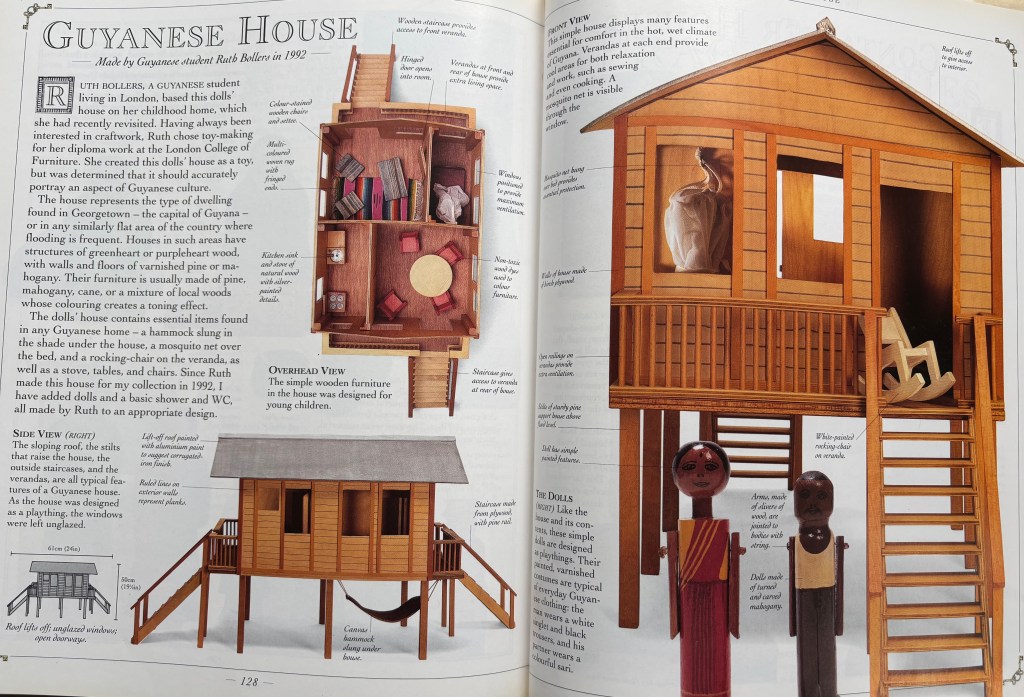
Books with cut-away interiors intrigue me, such as the last photo (above) of a neolithic French rural cottage. As Katherine Mansfield wrote in The Doll’s House: “Why don’t all houses open like that? How much more exciting than peering through the slit of a door into a mean little hall with a hat-stand and two umbrellas!”
My favourite childhood book was Miss Happiness and Miss Flower by Rumer Godden. In it, a Japanese dolls house is built, similar to the one in my copy of The Ultimate Dolls’ House Book by Faith Eaton, along with other interesting cottages, reminding me of the Folk Museum I visited in Korea which replicated the interiors of houses over time.
It’s not only children’s books which feature cottages. There are many books about women (or men, as in The Searcher by Tana French) who retreat to a country cottage to regroup and reshape their lives, with mixed success, such as in Falling by Elizabeth Jane Howard. Miss Marple lives in a cottage in the English village of St Mary Mead. Tove Jansson’s fictional family in The Summer Book live in a cottage on a Finnish island. Other authors have shown the disadvantages of the cottage: Jane Austen in Sense and Sensibility, Claire Fuller in Unsettled Ground. Still, somehow, the romance of the cottage lives on, whether it’s a place of retreat or a place to set out from on adventures.
Everyday we’re either repelled or attracted by what we experience – or somewhere along the continuum from one to the other. Felix is very cute until he brings in a rat. I began this morning’s paper with anticipation only to put it down with distaste. I link these opposing feelings to the kinds of books I’ve been reading. I was a little repelled (that’s NZ-speak for very repelled) by aspects of a book of short stories titled Surplus Women by Michelle Duff. It’s literary fiction, after all the author won the International Institute of Modern Letter’s fiction prize in 2023. The book reminded me of Margaret Atwood’s short stories collected in Bluebeard’s Egg which I puzzled over at university until it clicked that the women were supposed to behave like that and never see the error of their ways – so we wouldn’t make the same mistakes, perhaps? With both authors the writing itself is the most attractive feature.
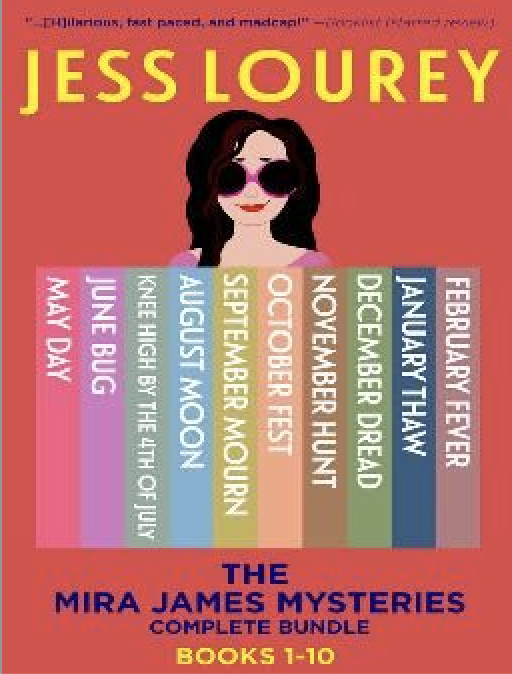
I am never without a book and, ever indiscriminatory (within limits), looked forward to slipping into the more comfortable, but somewhat mis-named, genre of ‘cosy crime’ to give me a break. I decided on May Day by Jess Lourey and embarked on a sometimes attractive sometimes repellent adventure set in the small town of Battle Lake, Otter Tail County, Minnesota (all real places). It’s attractive for the hilarity and social commentary and somewhere on the spectrum to repellent for the food, weird Americanisms (‘a couple moments’ instead of ‘a couple of moments’ is just one example) and quirky characters – reminiscent of Janet Evanovich’s Stephanie Plum series, but engaging for its freshness*. I’m too entertained to be bothered by the sneaking suspicion (i.e. awareness) that the writer knows too well – and manipulates – her reader, but that is perhaps the same for all fiction writers; part of the writer’s craft. Of course, May Day turns out to be the first of a Book by Month series. The first was cheap on Amazon, after which the price of each book quadruples. So I looked it up on the library catalogue and have downloaded all ten books in the series for free and have 14 days to finish them. A fest of alternating attraction and distaste. I’m up to July.
*Both Evanovich and Lourey get a lot of laughs out of the antics of elderly folk – but then, so do I. When I took Mum (aged 96) to have a blood test on Thursday she announced in the waiting room that her stockings were falling down and proceeded to hoist up her neat tweed skirt to make the necessary adjustments. (Luckily, there were only three people in the waiting room, a man intently involved with his phone and two others hastily heading out the door. A courier driver at the counter had his back to us and was taking his time.)
At the end of her memoir, Jacinda Ardern imagines giving advice to a young girl who doubts herself.
The things you thought would cripple you will in fact make you stronger, make you better. They will give you a different kind of power, and make you a leader that this world, with all its turmoil, might just need (pp131-132).
It was hard to put this book down (in more ways than one). It answered a lot of questions I had about what it was like being Prime Minister, a sensitive, principled, idealistic and female one particularly. No ghost writer was involved here, but surely a good editor. It is very well written and well structured; parts of it echo and link, particularly character-forming moments from early in her life which serve her well when making hard decisions later. It goes well beside Michelle Duff’s biography, which gives the political and social context more than it gives details about her life.
I looked through my 2020 diary to find mention of Ardern’s government and the covid response and was shocked to find there was very little. And yet it occupied our daily lives and our thinking in all her years in government. My journal did a better job, thankfully, and I had slipped newspaper cuttings into it which are interesting to read now. Something else in my journal caught my eye. In November 2021 I was reading Deborah Levy’s first memoir Things I Don’t Want to Know and had copied down this extract where it occurs to her that like other women she is ‘on the run’.
We were on the run from the lies concealed in the language of politics, from myths about our character and our purpose in life…The way we laugh. At our own desires. The way we mock ourselves. Before anyone else can. The way we are wired to kill. Ourselves. It doesn’t bear thinking about (pp158-9).
I remembered Ardern writing in the memoir that she was ‘on the run’ from one thing to another in her life. She discusses with a friend their shared tendency to ‘run away’ from things. The honesty of her self-evaluation is an admirable aspect of the book. When she decides to leave Helen Clark’s office and go to New York she worries that she could not be sensitive and survive in politics.
Was I running away? Probably. But that was better than staying and facing up to the fact that I couldn’t do something (p122).
In the Acknowledgements, Jacinda Ardern thanks her mother for going through ‘endless journals’ for her. Clearly, the family kept better diaries than I, and it explains the careful details of Ardern’s early years and highlights the collaborative spirit of her family who have supported her and her own family consistently.
It seems like a completely different time we lived through during Ardern’s two terms as Prime Minister – certainly a contrast to the current government. An article I found tucked into my journal describes the change as ‘Retrograd’.
People whose outlay involves enormous houses, multiple properties, private schools and expensive cars will demand tax and rates cuts, while furiously complaining about public services…Mention you’ve waited hours for an ambulance, or that mental health services are stretched to the limit, and they’ll be indignant. They will blame the government. Then they will briskly use the tax cut to transport the family to a holiday in Europe. This is Retrograd, where you take it all for yourself, live your best gated life, enjoy the paradise of your own scorched earth.
-Charlotte Grimshaw, Listener, 26 March 2022
A Different Kind of Power gives me some hope that these days won’t last – before climate change beats us to it.
Two hot days in a row were all the excuse I needed to sit in a cool spot and read. Consequently, I’ve just finished this brilliant, entertaining and educative book by a 27 year-old historian. I had thought of skimming through it quickly, but it was so engaging that I read every word – sometimes more than once! The author would like to rescue the once famous (infamous?) visual satirists (mainly Gillray, Rowlandson and Cruikshank) from Victorian censorship – Prince Albert burnt many he found in the royal collection. She claims that they were such an influence in their time that they likely changed the course of history. As the cover illustration shows, they caricatured political figures, here showing PM William Pitt and Napoleon Bonaparte carving up the globe – you could substitute them for Trump and Putin.
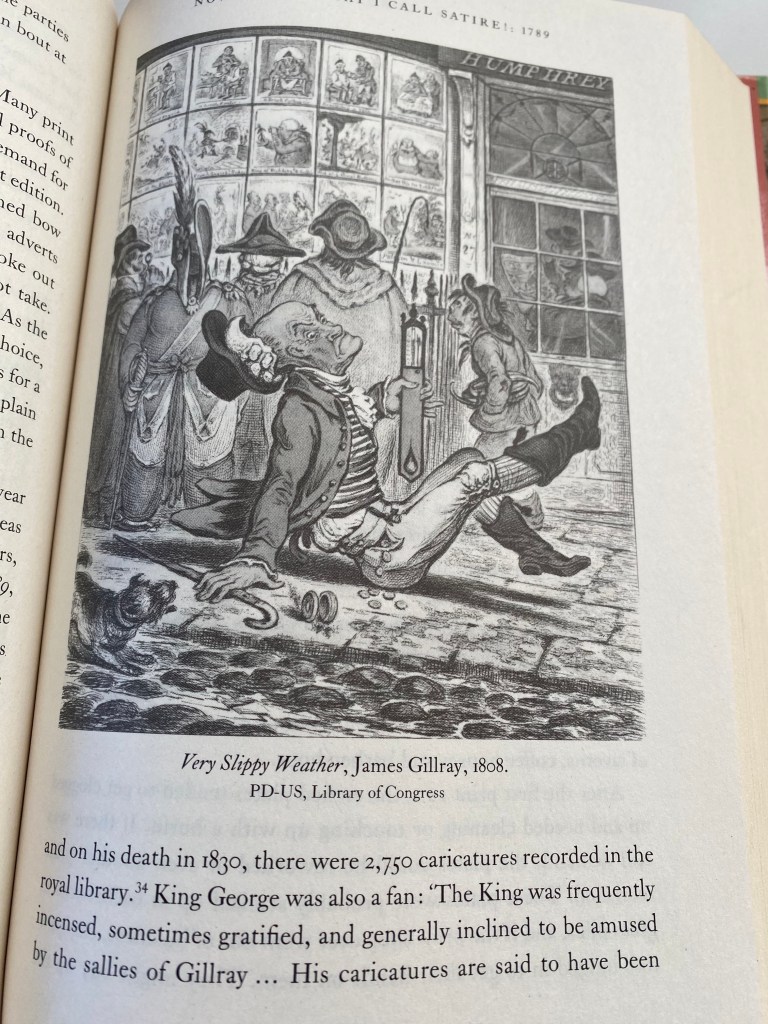
People would crowd to the bow windows of the printmakers (here, the shop of Hannah Humphrey) to see the latest cartoons – often in the hope (or dread) that they might feature in the caricatures themselves – and to buy some to add to their collections.
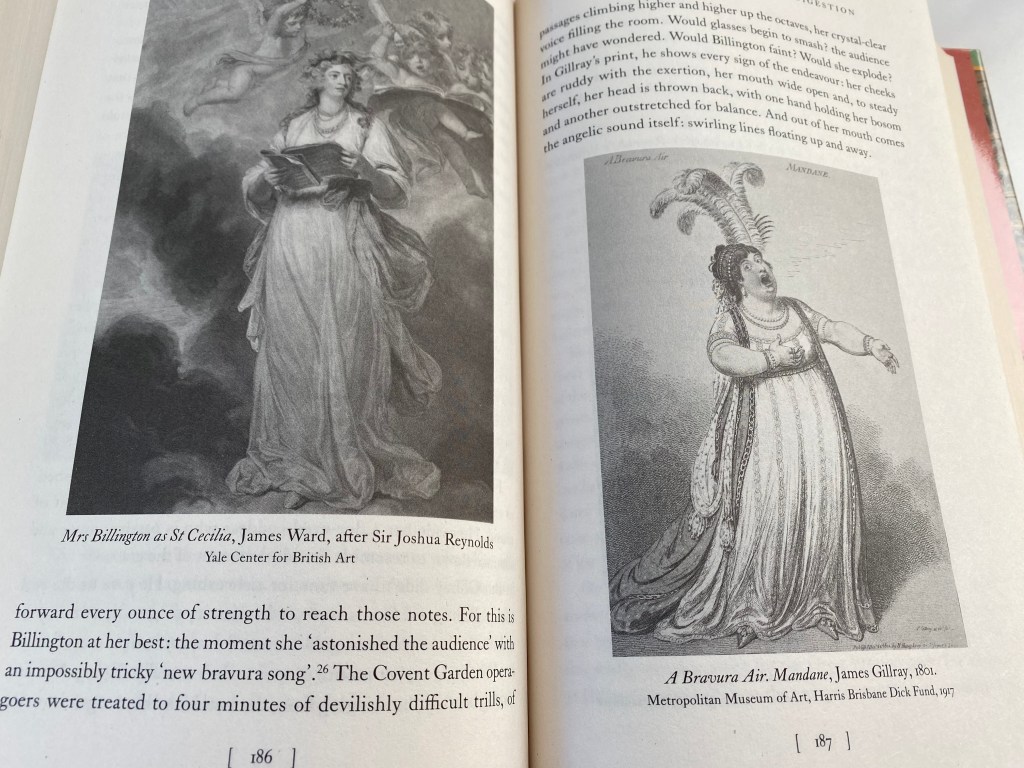
While portraitists and painters may have been held in higher esteem, the satirists were generally formally trained in those skills too. This image shows the contrast between the two forms: one an idealised portrait of a celebrated singer, while the caricaturist brings her down to earth.
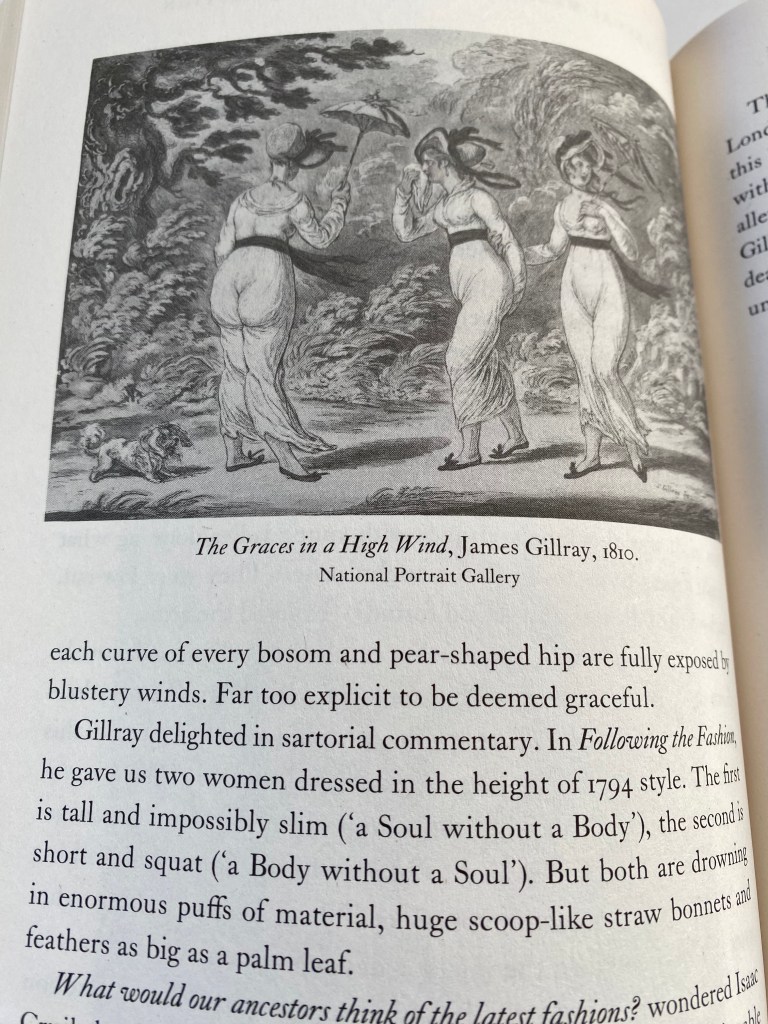
I am amused by this send-up of a fashion trend in muslin dresses better suited to warmer climes than the English weather.
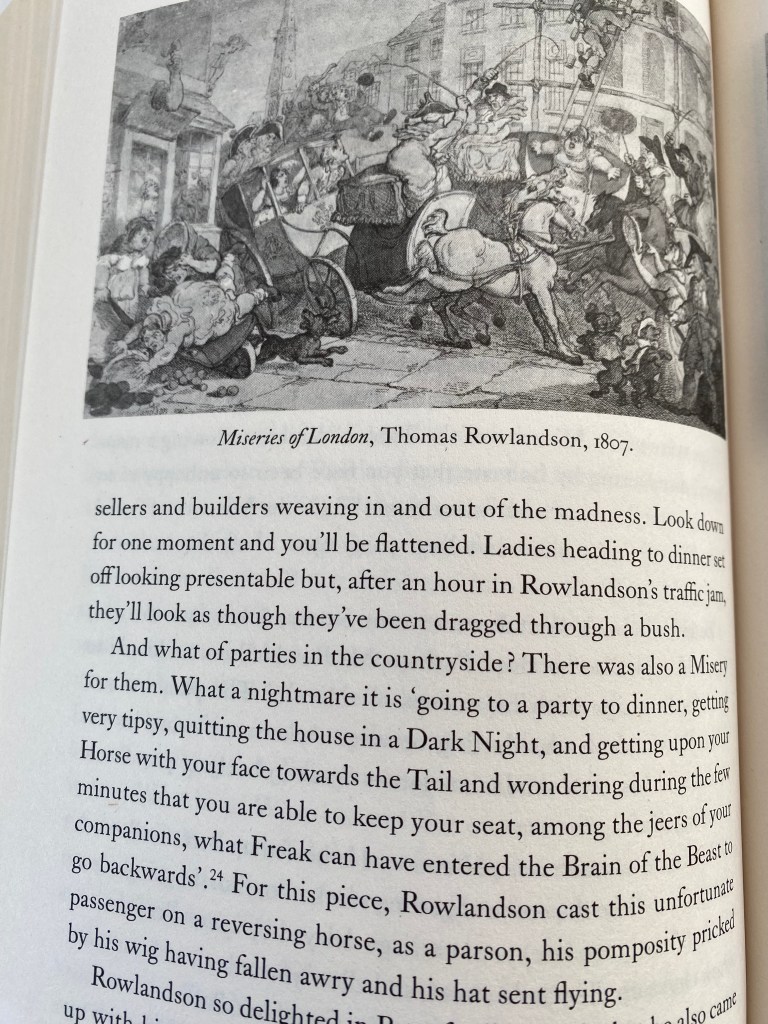
And here’s a Georgian traffic jam in London. I’ve included text again so you can appreciate the author’s very readable writing style.
Many of the caricatures are of brutal scenes, particularly of the French Revolution, which shocked the public and, despite general disapproval of George III and more so of his profligate heir, may have put people off trying the same thing at home.
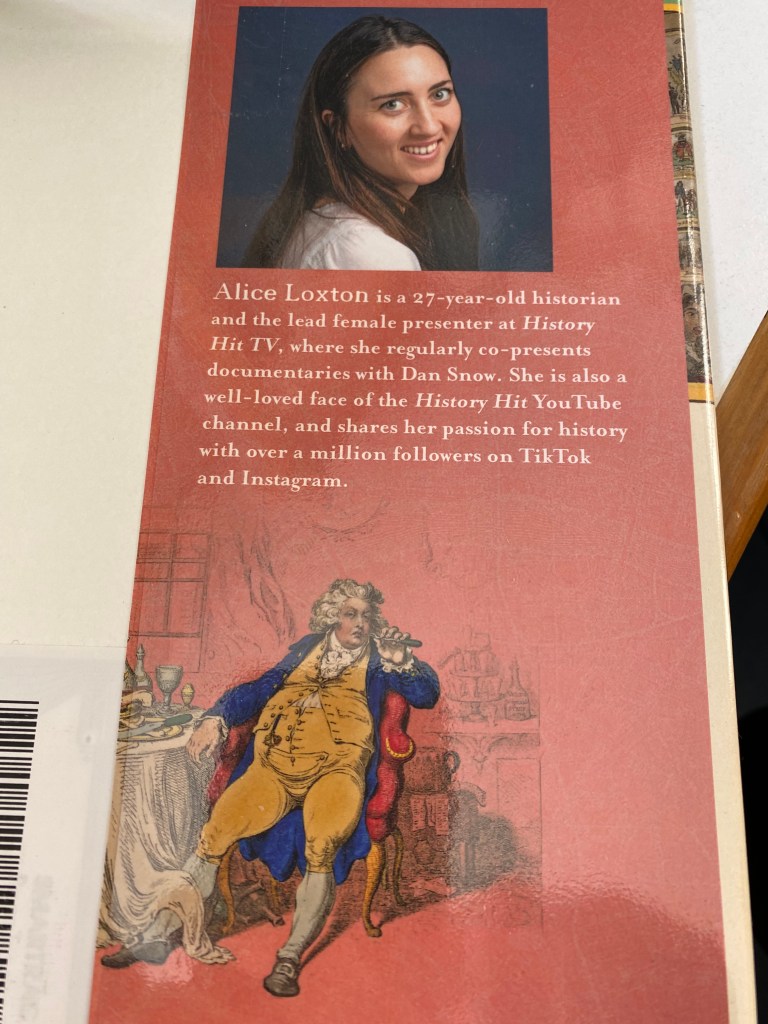
Here’s a bit about the author, with a caricature of the Prince of Wales (later George IV) by Gillray below.
I read The Unlikely Escape of Uriah Heep by H.G. Parry on the Kindle app on my ipad – my favourite bookshop was shut during lockdown – but I would like to have a “real” copy of it to dip into again more easily. I expected the book to be like the Jasper Fforde series which began with The Eyre Affair, in which a literary detective’s work is to put escaped characters back into their books. It is funny and fantastical by warping our known world, but The Unlikely Escape is different, superimposing or layering fiction on our “real” world. You laugh one moment and catch your breath the next.
The quotation above (reminiscent of ‘there’s a kangaroo loose in the top paddock’) comes from the first page when Rob’s brother, Charley, telephones him in the middle of the night from the university English department with a plea for help. Charley has summoned Uriah Heep out of David Copperfield and he does not want to be read back in. To remind you what Uriah is like, I found this audio of Dickens (really?) reading the part where David Copperfield meets Uriah for the first time.
In an interview with Kim Hill, the author said she chose the name Uriah Heep for the title as it is a name likely to be familiar to potential readers of the book. He is not the only character on the loose. There’s Heathcliff (with lethal weaponry), Sherlock Holmes and Dr Frankenstein (each called on for advice), Dorian Gray (expert internet hacker), Scheherazade (continually shelving in the bookshop) and various others.
I was surprised to find that H.G. Parry is a NZ author (but not surprised that she has a PhD in literature) and that the setting of her book is Wellington. To explain why I was surprised, the fictional characters who are on the loose are from Victorian to Regency English literature mainly. There are Dickens characters, and Austen and Wilde characters, as well as a fictional (i.e. made up by H.G. Parry) girl detective, from the twenties or thirties, I think. She’s a bit of a Jacinda Ardern type of character: forthright, moral and pragmatic, carefully negotiating her way around the tricky coalition of characters as she takes the lead. The particular setting is not that relevant really, as the book is about reading and how the characters we read about can inform our own lives. Perhaps, as it is the capital city, there is an implication about how we govern ourselves, settle scores and lead the way… The local references: Maui and Mahy are both internationally known, and this book is for an international market.
The book is a blast, particularly if you have studied literature and literary criticism, but just as much if you are aware of the vagaries of human nature and the different ways in which we can invent and re-invent ourselves, or if you have seen the various interpretations of the classics in tv series and film. As an example, there are five Darcys – each evidence of different ways in which readers have interpreted the character. One looks like Colin Firth. They share a house in a lane off Cuba Street. The lane is only accessible to other fictional characters (a bit like the train platform in the Harry Potter books), but it is under threat and this provides tension and action in the plot. One character is The Implied Reader who has an indistinct face. An Implied Author turns up at one point, and even Charles Dickens.
The plot is held together by a variety of contrasts and conflicts. Mainly, it is the story of two brothers. One is a 26 year old prodigy and academic who can summon fictional characters from books. The other (the first person narrator for much of the book) is a criminal defence lawyer who has almost always looked out for his younger brother. Now, he is called on to confront the family secret while hiding it from his partner, Lydia, and to take his support of his brother to a dangerous level. Uriah Heep becomes significant here as a foil to David Copperfield. I read a Guardian article which said these two characters “are a fork in the road”. Which brings up the question of how fair an author is in creating characters to make a point – Uriah Heep is perhaps justifiably aggrieved! A similar question arises as Charley and a rival summoner fight over which fictional world to impose on the real life city. So it is about academic rivalry as well. Or meeting one’s arch-nemesis. Is it imperative to impose one potentially limiting interpretation or to allow the many manifestations of fictional characters? The book argues for the latter.
The book is about how we read, whether or not we read, how much importance we give to the creative imagination and how powerful it can be in our lives. Margret Mahy’s The Lion in the Meadow is a recurring reference. I remember reading that there were two endings to Mahy’s story, and it is discussed in the book. The writer – and consequently the reader – suffers by repressing the imagination is the point made. And so in the end, as in Mahy’s book, the dragon remained “and nobody minded”. The Unlikely Escape finishes (slight spoiler alert – this book is about far more than the ending) with the once occasional reader, Rob, engrossed in Great Expectations at home by the fire with his brother Charley (reading The Princess Bride) and Sherlock Holmes (reading Agatha Christie) “And for a moment, the space between heartbeats, I felt I could glimpse the world Charley saw. A world of light and shadows, of fact, truth and story, each blurring into one another as sleep and wakefulness blur in the early morning. The moments of our lives unfolding as pages in a book. And everything connected, everyone joined, by an ever-shifting web of language, by words that caught us as prisms caught light and reflected us back at ourselves. ‘We changed again, and yet again,’ I read, ‘and it was now too late and too far to go back, and I went on. And the mists had all solemnly risen now, and the world lay spread before me.'”
I’ve enjoyed the thinking this book has allowed me days after finishing it.
................... for lovers of ice cream. Your free on line magazine for sweet frozen treats. Recipes, inspiration, artisanal ideas for your delectation.















 Anne-O-tations