
What do you mean, ‘Poo-awww, stinky dog! Fetch a peg for my nose’?
Why are you talking funny – is it your adenoids?
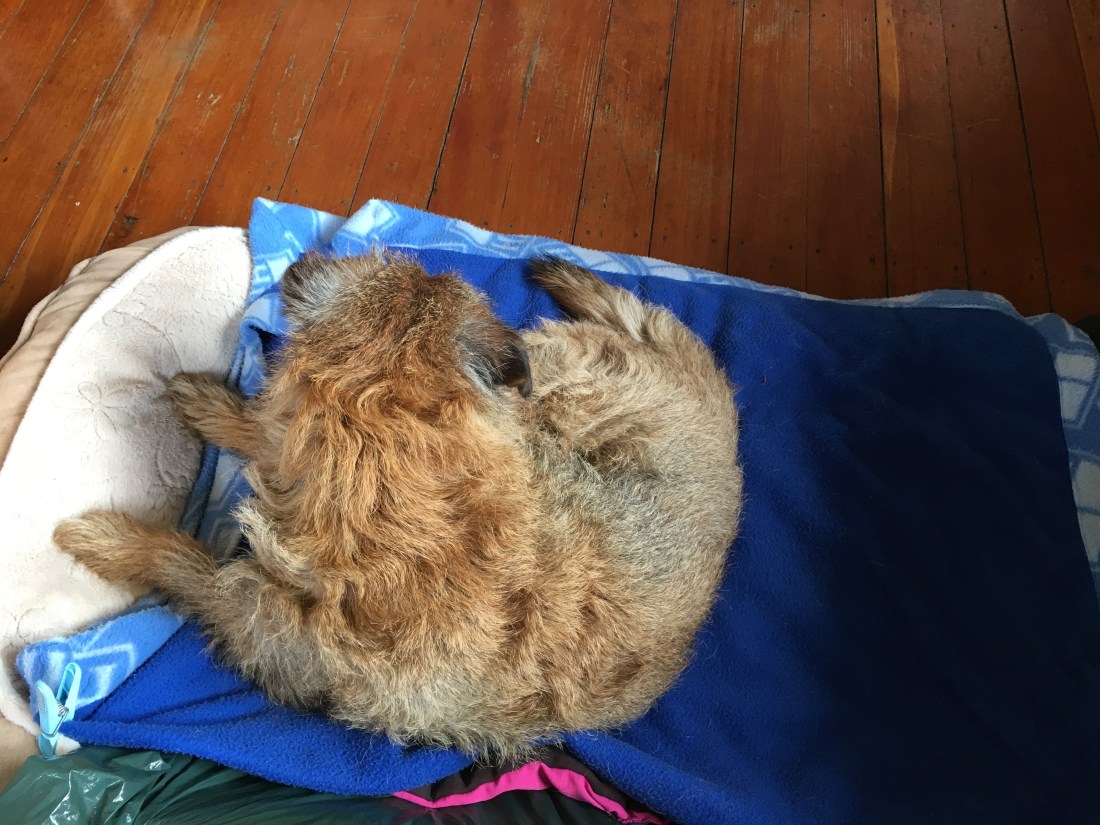
I was asleep!
And who opened the window? Don’t you know my elderly frame can’t handle a draught?

What do you mean, ‘Poo-awww, stinky dog! Fetch a peg for my nose’?
Why are you talking funny – is it your adenoids?
I was asleep!
And who opened the window? Don’t you know my elderly frame can’t handle a draught?
“How do we become human except in the face of adversity?”
Of the 50 or so books I read each year, a few books stand out and remain with me, and I wonder if those are the books which are wide in scope, yet focused in message. Burnt Shadows by Kamila Shamsie is one of these. Shamsie creates links from Hiroshima (hence the burnt shadows) to Pakistan and the United States and the “war against terror” to question our perception of events. Similarly, Happiness by Aminatta Forna is wide in scope ranging from the wolf-hunting in the US in the 1830s through war zones in Africa and the Middle East to fox-hunting in urban London, to focus on modern humanity increasingly ill at ease with itself. This is a clumsy summary; Forna’s writing is not so. The threads of her narrative are drawn together with powerful impact (for me, at least). One such thread, through the character of American scientist Jean Turane who is studying foxes in London, is our relationship with animals both wild and domestic, and there is animal imagery in character descriptions: the eyes (human) which “hunted” in an unguarded moment on waking, the bite on the wrist administered by a woman who, having lost her mind, reverts to instinct. Such animal connections are not new but the way they intersect across the narrative threads gives fresh insights, and the way in which the writing triggers connections in the mind of the reader is what memorable writing does.
Can ‘knowing better’ change ingrained habits? William Golding talked of the “off campus curriculum”; the habits and beliefs we are instilled with before knowledge can take hold. Significantly, the two main characters in Happiness are experts in their fields. Jean’s story is intersected by that of Ghanaian psychiatrist Dr Attila Asare, an expert on Post Traumatic Stress Disorder, a major thread in the book. In London to deliver a key note speech at a conference, he considers the city about him and thinks of those who live “in terror of what they cannot control” as “glass dwellers” who are “terrified of the cloche being lifted. They treated the suffering of others as something exceptional, something that required treatment, when what was exceptional was all this…All of this.” Attila and Jean both “lift the cloche” in their lives (in italicised flashbacks and in the present) and encounter danger and discomfort but are better people for it. Forna batters at that glass throughout the novel, in the ladybirds against Jean’s windows, and the woman behind the window of her house tearing out her hair – whose nervous disorder will be healed by the roof garden Jean constructs for her. It questions how we deal, or fail to deal, with challenges such as human migration, animal migration: foxes in urban areas, the brightly-coloured parakeets in the park (which reminded me that I had seen these in Greenwich), our treatment of the elderly and the grief of our neighbours. People migrate, animals migrate. Both experience hostile reactions. A 13 year old student of mine who knows a lot about ants (just as Jean in the book is an expert on foxes) recently questioned my killing of ants in the house with, “That’s not very nice” and a hard stare. I was reminded of this when, at the end of the novel, Attila admires “the ant bearing a sugar crystal… its tenacity, its superior strength.” I still have ant bait (will this book change that?) but I look at the odd ant on the window sill with more respect. I thought a lot about education during this book. A lot of our unpleasant behaviour can be explained by ignorance and, worse still, not wanting to know, when it is easier to revert to ingrained habits, despite the gains: “All of this”.
“How do we become human except in the face of adversity?”
This rhetorical question in Happiness, felt like both a reconsideration of what happiness is, and a life-changing revelation. It felt familiar: it put into words and into the structure of a novel an idea I think about, such as when young people look at what work they might choose, saying, “No, that’s too hard. I want something easier – with lots of money…” Yet, my experience of challenging work is that out of the unavoidable failures and set-backs comes something beyond value. “Lots of money” may provide a little insurance (I can hear hollow laughter from Christchurch people), but can’t protect us from adversity.
I was led to consider whether we have become more resilient or more fearful, individually and as a community, since the earthquakes and the associated feeling that the whole world is crumbling about our ears. “What doesn’t kill you makes you stronger” is a cliche dismissed at first in the book, but it appears again, and again, so that its truth is reinforced. The book questions “whether the absence of adverse life events creates the ideal conditions for human development”. The effects felt by people since the earthquakes are sometimes described in the health system and the media as PTSD and this “disorder” is a major theme in this novel – as is the media’s response to events. At first I thought the author was being satirical about the modern health system and the general discourse in the media about health issues – and there is humour there – but the truth of it is sobering. Here, Dr Asare considers the burgeoning number of hospital departments:
Affective Disorders Service. Anxiety Service. Chronic Fatigue Service. Challenging Behaviour Service. Conduct Problems Service. Eating Disorders Service. Depersonalisation Disorder Service. Female Hormone Clinic. Mood Disorder Service. Obsessive Compulsive Disorder Unit. Party Drugs Clinic. Psychosexual Service. Self Harm Service.
Later in the chapter, a child observed having a tantrum is described as having “Disruptive mood dysregulation disorder” which seemed funny at the time – but is it true that the term is used by health professionals, and if not now, will it be in the future?
The book’s real force, for me, comes from the journey made by Dr Attila Asare, and the realisation he comes to about his field of study. PTSD is examined in war zones and as “Responses to Adverse Life Events” in civilian life – even “Witnessing Trauma through Social Media”. “How do we become human except in the face of adversity?” is spoken by his character. Happiness becomes a paradox, he concludes. Trauma causes suffering, but not necessarily damage, but it does lead to change. And that change may be happiness – if not as we commonly imagine it. I think Michael Leunig imagines it this way. A memorable cartoon of his lists grief as one of the things which adds meaning to our lives. That connects with me. Grief never goes away. We live with it. It is part of what makes us human. And here the intersecting thread of Jean and the foxes gives us a lesson in resilience. Attila reads Goodbye to All That (an echo of “All of this”?) by Robert Graves in which a soldier, sickened by the life at home, “the insanity of the insulated”, returns to the trenches. “Attila picked up the pen again and traced his thoughts on paper. He wrote: ‘Resilience: Ability to maintain a state of equilibrium in face of adversity.’ He wrote the words: ‘Hope. Humour. Survival. Adaptability. Expectations. Impermanence (acceptance of).’ These he wrote on one side of the paper. On the other side he wrote: ‘Denial. Protectiveness. Control. Environment (creation of perfect).'” We do dig a hole for ourselves, I concluded.
My teenage students often look for “easy” books to respond to, yet the students who choose challenging books (even inadvertently) respond best because their thinking has been expanded. It could be that something in the book triggers a connection in them, that they are ready to hear what it has to say. In adult book group discussions, I have become aware that our responses to the books we read depend on what is going on in our lives at the time or the degree to which the book agrees or disagrees with our beliefs and values, regardless of the author’s perceived intentions. Reader Reception Theory posits that a reader brings meaning to a book – almost regardless of the writer. I am more inclined to respect the writer’s craft in shaping our responses. I had barely started this novel before our book group met last week and now that I have read it, captivated by its scope and crafting, I want to wind back time to give it its due, although everyone “loved it” and “would recommend it to anyone” and significant life events were triggered, particularly around grief. For me, it will become one of the memorable ones.


It occurred to me this morning, as I looked out at my garden, that I feel three-dimensional here.
While travelling, I was not myself in many respects, just a tourist passing through, like the narrator of Apirana Taylor’s short story “The Red Sari”. He sits in gridlocked traffic in the bubble of a taxi, sees a jet rising away from it all above him, thinks of his air-conditioned hotel and feels a sense of relief that he can escape before long.
This is a good time of year to be at home, with time to read thoughtfully and to reflect. Lemon and ginger tea steams beside me on a Portuguese cork-and-tile coaster. From my study window, I can see my own little bluebell wood (growing under a native beech):

If I look to my left, I can see these Iceland poppies:

For the bees I let the borage grow wherever it appears. It sprawls over the lawn so that I have to hold it back with garden forks while I mow (in the evening after the bees have gone). The bees also enjoy the rosemary, the forget-me-nots, the cherry blossom and the hebe:

The apple blossom is my favourite for its beauty. This little tree also produces a great many sturmer apples:

The diversity of exotics and natives is joyful and the garden is full of “volunteers” and rescued plants. My role in this is to let things be and watch to see what develops. No spraying, I weed by hand when necessary, and nurture the surprises like these violas which pop up between the paving stones.

There is constant bird-song. Yesterday, two ducks visited. One waded, up to its knees, in the grass (since mown) while the other peered over the edge of the roof.
They were just passing through, but I would like to think I’m here to stay, at least for a while.
Tomorrow, I will have been home for a week. It has pretty much taken until today to get everything at work ship-shape again. On Monday I looked at the piles of paper I had to deal with and felt that my head might explode. Somehow I had to sort it all out and teach at the same time. If it hadn’t been for wonderful colleagues stepping in in my absence, I wouldn’t have things sorted by now.
As I was setting work for my five classes before I left, I became acutely aware of how complicated the job is. On my return, I was made aware of how things have changed in the job in just a few years. My replacement was not accustomed to using digital technology or to new methods of assessment. So there’s a benefit to taking leave: you value what you do more.
On the other hand, as she swanned into school today with a pile of library books to return under her arm and a nonchalant air, I did envy her freedom.
I’m still not quite used to being at home. Routines have been forgotten, such as how many spoonfuls of rolled oats I put in my plate. This used to be a part of my morning routine which I didn’t have to think about. An advantage of being away for nearly eight weeks: you forget how you did things and can re-think and change. It’s refreshing. Except that I forgot to take morning tea to the beach on Sunday. Morning tea is important on the beach, when you choose a good log and sit down to chat and share treats. My understanding companion still shared carrot cake with me.
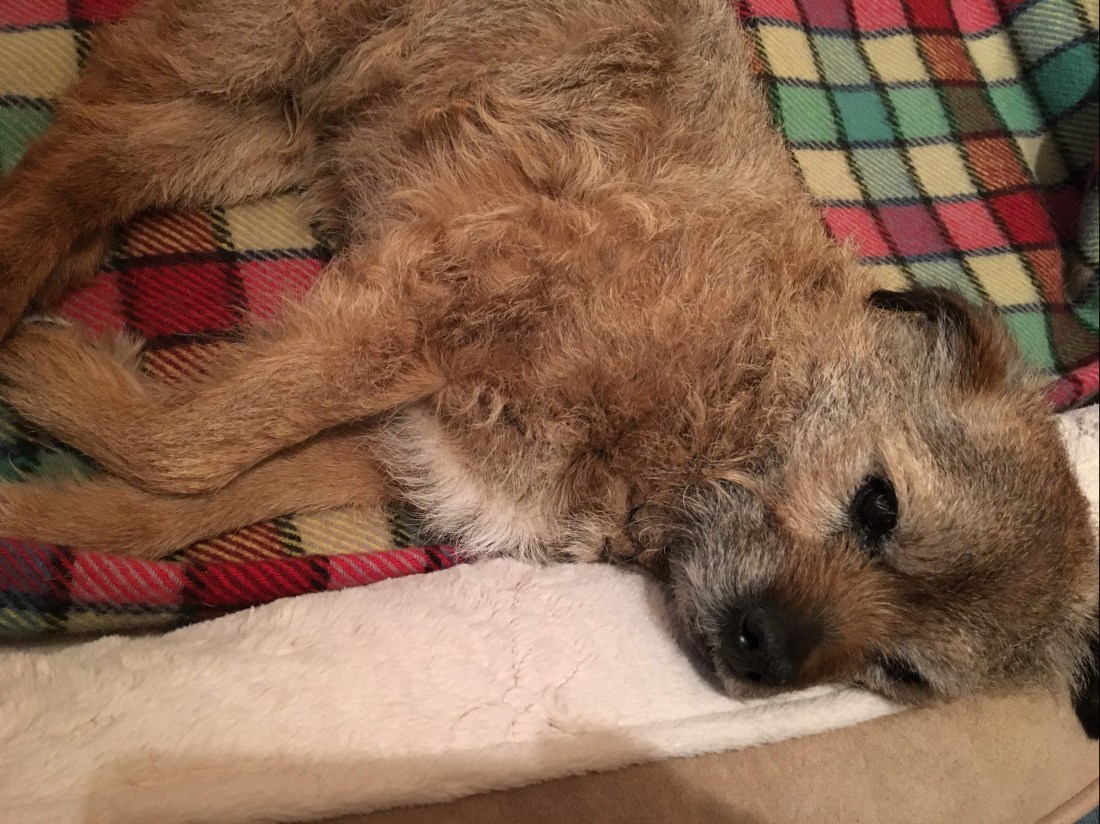
There are sobering things, such as listening to the news and little of it is encouraging. I have to switch to the concert programme. Or suddenly coming to on the way home from work to find I’d fallen asleep and crossed the centre line. Getting up in the dark to get ready for work. Steeling yourself for the day ahead. Cleaning up after an elderly dog. But isn’t he lovely:
There are wonderful things: the sparkly sea on a sunny Sunday, the warm sun on a winter’s day, bird song, fantails flitting about on air waves, the nip of frost in the morning, the stars so clear and so close, winter sweet’s fragrance, the red rhododendron beginning to flower. Mum’s lasagne! I’m not finding it cold; I’ve been told the worst of winter is probably over. Perhaps I’ve soaked up heat from Europe and still have stores of warmth.
My lovely and loving family make coming home warming.
My last day was busy, revisiting favourite places and getting lost and finding new things, as usual.
St Chapelle was unscheduled, but was lovely to revisit.

The Pompidou Centre has changed, but was great. In 1981 I photographed the buildings opposite because they reminded me of a print I had at home. The roofs are still interesting, such as the double former windows on a high grey roof, and the nets slung between dormers in the foreground.

I approached Ile St Louis from the Rive Droit, and discovered Les Plages which I had heard about. The riverside has been set up like a beach resort for the summer. Children are playing football inside that structure.
Ile St Louis has charming streets and shops and cafes, such as this tea shop where I had apricot juice and homemade orange cake.
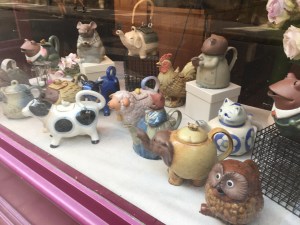
This archway holds three floors above it.
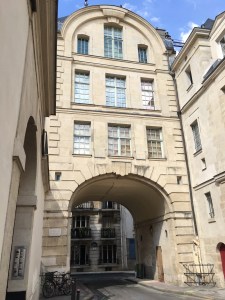
There was a mechanic’s garage in Art Deco style, but full of modern cars. I saw a garage earlier which was just for repairing motorcycles. There are a lot of motorcycles about and I like to look for the ones with two wheels at the front.
St Louis Church is on Ile St Louis, as you might expect. It has a grand array of organ pipes and a modern statue of Pope John Paul in the Chapel of Compassion – but just a photo of Mother Teresa.

Then more shops, such as one with popular French characters:

The dog reminds me of Pommes Frites, the police bloodhound in Michael Bond’s Monsieur Pamplemousse series.
I walked across the bridge to the garden behind Notre Dame where there was a statue of the same pope as before, but also these gentlemen, one recumbent in the vege patch. I’m tempted to say, “recumbent in the cucumbers”.

And here’s the building itself:

Then it was a last look at the pétanque players in the Jardin du Luxembourg.

And a last meal at Bistro des Campagnes – with a glass of Muscadet.
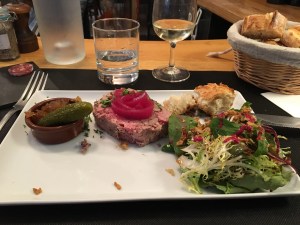
Au Revoir, Paris!
Fittingly, predictive text wanted me to say, “Au Renoir”!
As the Pompidou didn’t open until 11am I had time to revisit St Chapelle on the way. Astonishing stained glass and detailed craftsmanship impressed as before.

There is a carving of a woman with distaff and spindle in almost the same pose as the woman spinning in the tapestry in the Cluny.

The Pompidou has extensive art collections. Here are some which caught my eye.
A Matisse.
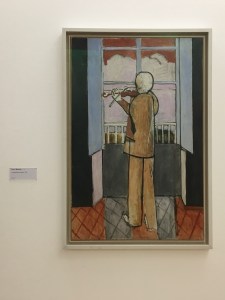
A woman in a Swanndri!

A Picasso sculpture: Young Girl on a Swing. I liked the weighting of this, particularly the clumpy feet.

This is called “Table” but there is more to it than furniture.

This is 3D: a deconstructed piano.

The exhibitions are organised by time periods. You drift from room to room with glimpses into other spaces or to courtyards with sculptures and water and over the rooftops of Paris.
The contemporary art was extensive and challenging. I was pleased I hung in for the top gallery of furniture, art and objects from art nouveau to about the 60s.
This was made for a house in 1911.

A blue car with a crank handle, and leather straps securing the bonnet.

Book covers – Art Deco, perhaps.

A wooden carving, distinctly phallic, and very French in the eccentric, cartoon-like figures and expressions.
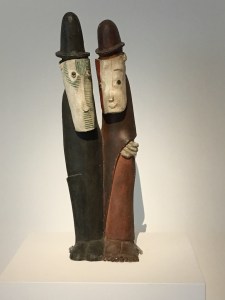
Furniture with a view.

And posters.

I walked 17kms today and I imagine much of that was inside this massive complex.
It doesn’t have the colourful exterior with colour-coded pipes that I remember when I visited in 1981. It’s been toned down. Not in content and scope, however.
A plan to visit the Musee Carnavalet was cancelled when I visited the website and found the museum is closed for renovations. However, you can do a virtual visit, which I will save until I’m home and able to use a screen larger than that of my phone.
Instead, it was a quiet day. An exhibition of photographs in the Jardin du Luxembourg impressed me.

As with the tapestries, I looked at the each photo as the photographer might have done. What was he seeing? What did it say? What does it say to me? With these two photos my experience of Paris helped me to consider what it is like to live here surrounded by massive walls of stone and history. How does that affect our relationship to the environment and how is our identity changed by what has gone before?

The first photo is composed of a wall with a slice of sky visible. The second, dominated by massive columns, shows a metal chair diminished by distance and a partly obscured person. A window is shadowed on a wall.
The young photographer spoke enthusiastically to me about photographing in Africa and South Korea and how those places have altered his perceptions of the world and his/our place in it. Spiritual insights were part of these transforming experiences. He liked how spiritual life was linked to the natural environment and open and visible in these countries, not shut in by stone walls as it is here as if to exclude.
Back to the mundane: I sat in the garden reading and eating a cinnamon cream filled eclair – beautifully wrapped – from my favourite artisan boulangerie, from which I have bought only savoury breads and quiches, until now. I wondered what the joggers made of my choice as they wobbled past.
A flat white – the first I’ve had while away – was available at a little Salon de Cafe nearby.
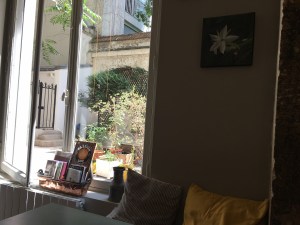
Then I retreated to read in the comfort of my first floor room where, with the window open, I could hear chatter from the street below and see people going by, parents with children, a few cars and scooters; everyday life for the people who live here.

These living streets are what our city council would like, to bring the inner city of Christchurch to life. Businesses on the ground floor and living above. These apartments are on five floors with dormers making an additional sixth floor. And there’s that slice of sky.

I was disconcerted by news of a 4.1 tremor at home. What would that sort of event do to this street?
How will I adjust to going home?
Increasingly, my lack of conversational French is frustrating and it will be a relief to talk freely again as I was able to do with the photographer this morning who, thankfully, spoke English. A conversation on that level is not possible otherwise.
I’ve printed my boarding passes.
One day left in Paris.
A boat trip from Quai d’Orsay to La Villette was the schedule for today – nearly scuppered by taking a gauche instead of a droit, but I made it with five minutes to spare.
We travelled along the Seine with the usual sights. That green mass on top of a building in the centre is someone’s very ambitious roof garden, Italian cypresses and all.

The first lock took us up to the level of the St Martin Canal. At the marina at this point a number of smart motor boats had people on the deck working on laptops. Are they on holiday, or working from home? There was a houseboat with a turf roof, which brought back memories of Scandinavia.
There were nine locks so the trip was leisurely and picturesque. Am I becoming so acclimatised that I find even the graffiti interesting?
We went through a very long tunnel with holes in the roof letting in light and trailing plants and letting out the boat’s exhaust fumes.
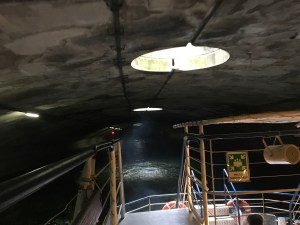
Then we were back into the light, with more locks and folding bridges for vehicles, and overhead pedestrian bridges. Here you can see the vehicle bridge moving back into place after we had passed through.

You may recognise this Canal from the delightful French movie “Amelie”.
This lock house features graffiti congratulating “Les Bleus” on their World Cup final win.

Here, a colourful blanket shelters some homeless people:

At La Villette the canal widens into a basin with marinas, swimming pools, the entrance to the St Denis Canal, restaurants, cultural complexes, a theatre on a barge and a bookshop barge.

I walked through the old and ethnically diverse area nearby to Parc des Buttes Chaumont. Inside the entrance, I identified silver beet looking delectable and glamorous in a flower bed.
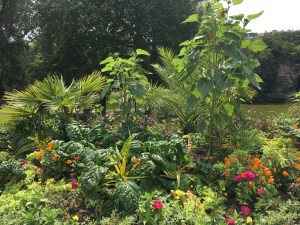
I sat in the shade and ate a smoked salmon wrap I’d bought in a Monoprix on the way. I shared a bit (big mistake) with a very cute sandy version of Hairy Maclary. Its owner had to carry it away. This was my view:

The park reflects the character of the time it was established, La Belle Epoque (late 19th to early 20th centuries) with a folly, rustic bridges, stone arches, grottoes, a lake and waterfalls. The trees are old and huge. Here is a painting group:

There was a grey heron on the lake, and ducklings. A turtle on a rock didn’t move so I suspect it was either pining for the tropics or glued there.
The streets nearby are stacked with Belle Époque apartment buildings with grand views of the park. Higher up the hill, I could look out over a vineyard to Montmartre.
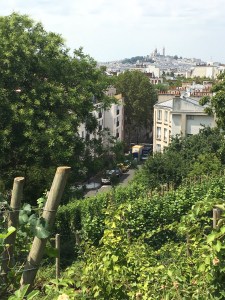
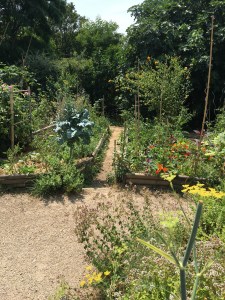
A community garden is next door to the vineyard.
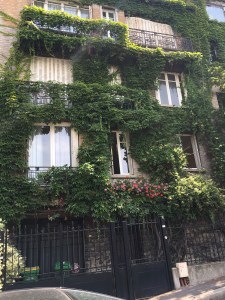
Happy sounds of a busy household drifted from the open windows of the ivy-covered house opposite.
I headed downhill via a little side street of steps, named for a violinist, back to St Martin Canal for a refreshing limoncello in a cafe with books:

and a bookshop with a captivating collection of pop-up books (and air conditioning).

There was a boat on the canal doing the return trip, and I retraced the tunnel part – over ground this time – through the park running the length of it to the Place de la Bastille. It features play and fitness equipment, table tennis tables, a band rotunda and pétanque among the gardens, fountains (enjoyed by pigeons and dogs, and a man washing a bike) and park benches – and the homeless. This is the top side of one of the holes we passed under on the canal.

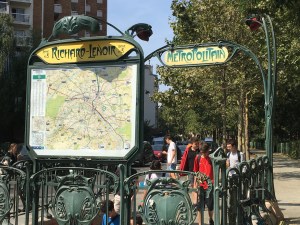
Along the park were metro stations with the art nouveau signs:
From the end of this long park, I looked for the Viaduct des Artes which, like the High Line in New York, is a garden on a disused viaduct.
It goes for miles. You can walk all the way to the Bois des Vincennes. There are lovely gardens with roses, arches and art.
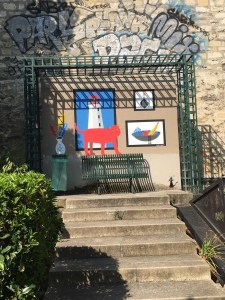
How do they grow such big trees up here?

This sign helps to explain how the gardens are cared for:

Great views down to the streets and apartments.

If you look closely, you might see a cat painted on the wall:

The heat was intense, so I resorted to the metro before I melted.
At the lovely Jardin du Luxembourg on my way home, there was another surprise in a flower bed. Red chard this time:

I had walked 15km according to my health app. It was into the shower for me and all the clothes I had been wearing went into the sink!
Saint Sulpice’s organist, Daniel Roth, popped his head over the edge of the organ loft to take three bows for his appreciative audience. I didn’t recognise the pieces he played but the sound filling this cavernous space was magnificent and meditative at once.

This frame of mind was perfect for contemplating the tapestries at the Cluny Museum. I was grateful for the thoughtful guide we’d had at Angers when we considered the messages in the revelation tapestries there.
At the Cluny, this tapestry is in the Treasures section. I photographed part of it because of the dog on the woman’s lap and the kitten playing with the spindle of wool.

What could the weaving represent? Is a letter being read? What is the symbolism behind the particular animals, birds, plants and fruit? It’s a puzzle.
The Lady and the Unicorn tapestries in six panels, five representing the five senses, are the most intriguing. The woman in each one is the same. Was she real or is she allegorical? A lion and a unicorn appear as prominently in each, as does a lady in waiting.
As with the Monet panels in L’Orangerie, these six huge tapestries are hung in a large space with benches in the centre so you can sit and look closely. The room was dimly lit and no flash photography allowed, so I didn’t risk a photo.
An ante room displayed illuminated books about unicorns, so you could consider their meanings.
There was also a room with modern representations, including a black and white unicorn floor rug with massive hooves attached – and head and horn.
I bought a book about the tapestries to discover more about them. They were rescued just in time, and more may have been lost, even cut up and used for cart blankets and floor rugs.
Out into the sunshine again, and Gibert Joseph bookshop on Boulevard St Michel was giving away Panama hats with its summer reading.

It was time for refreshments in the Jardin du Luxembourg.

Ulverstone Victoria High School (Cumbria) Swing Band entertained nearby.

It was a beautiful day to be in my favourite place in Paris.

Meanwhile, at the end of my street, crowds were gathering at bars to watch the World Cup final.

It’s all happening this weekend with 14 Juillet today and the Football World Cup final tomorrow.
First was the military parade this morning which featured everyone in France who wears a uniform it seemed, from regions all around the republic. All very proud and looking great.
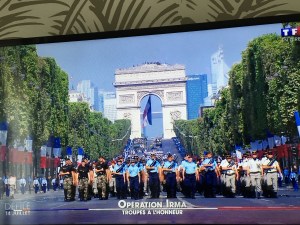
By now, you’ll have worked out that I watched the parade on live television. Really! Travel is wasted on some people.
But look at the views I had!

There were even cameras on the under carriage of aircraft in the fly-past. And there were dignitaries looking dignified, despite the wallpaper – it’s not that bad in reality; much paler.

The sub titles were useful too. These mountain soldiers are wearing camouflage. Like the Norwegian ski patrols all dressed in white, who swept down on invaders and took them by surprise.

The next group were the ones I was waiting for, but I didn’t know they carried axes, or wore leather aprons, for that matter. It seems that there is more than one foreign legion. These ones aren’t the desert legionnaires, obviously. More like forest ones, bearded woodcutters, rescuing Little Red Riding Hood and Grandmother from the wolf.


Here comes the cavalry, playing musical instruments as they ride, which can’t be easy.

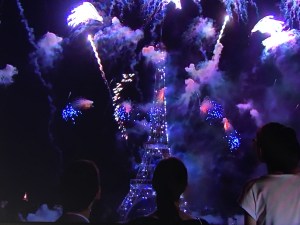
In the evening, there was Le Concert de Paris, followed by fireworks, at the Eiffel Tower.
Pictures failing to upload here.
You guessed it: live television again. I’ve watched previous Concerts de Paris on the Arts channel at home!
Excuses: there were thousands of people, the performers would be little dots in the distance despite the big screens, it was 28 degrees, many metro stations were closed, it was going to be late and dark.
The fireworks were combined with elements of son et lumiere and aerialist acrobatics.
................... for lovers of ice cream. Your free on line magazine for sweet frozen treats. Recipes, inspiration, artisanal ideas for your delectation.
196 countries, countless stories...
a poetry page with reviews, interviews and other things
Rachel McAlpine writes, blogs, draws and podcasts here
see the dappled digital poem in its natural habitat
Contemplations from quakey quirky Christchurch
News, Tips & Website Tutorials

