Design

We’ve become accustomed to appreciating street art, and architectural design, in Christchurch in the last few years. Here are some which have caught my eye in the last week.

I’d been hoping to find this statue in Oslo which is a replica of the one on Wall Street defiantly facing the bull.

Other street statues are mostly famous men, as in this example, but with a difference which leaves you to imagine (or google) what the grouping implies.

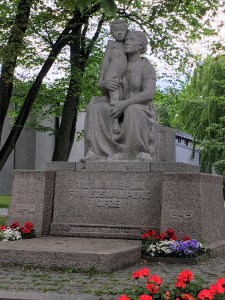
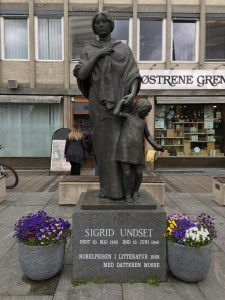
I am on the lookout for statues of women. This one in Lillehammer of a woman who won the Nobel for Literature was a surprise.
The Oslo Historical Museum has some stunning art nouveau features.

At the Art Gallery an exhibition by Norwegian designer Gerhard Munthe included illustrations and tapestries of scenes from Norse mythology, and pottery, furniture and interior design.

And, just for you, Mum, this Monet of a Norwegian mountain. He’s got it just right!

There was a room where you could use this Vigeland sculpture of mother and child as a drawing model.

We went to his sculpture park which has the circle of life as its theme in the layout, paving (a maze or labyrinth), statues and wrought iron. The school children there were a reminder of that theme too, not to mention the old codger on the right who is from Christchurch and was in our group.

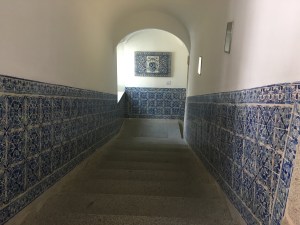
I have been expecting to see some quirky designs in Portugal and have not been disappointed. I knew to expect tiles:
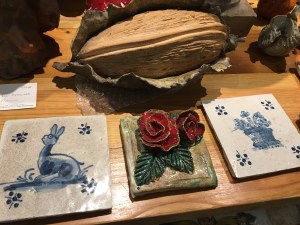
The ceramics I’ve seen have gone beyond that simple beauty. An eggplant dish, anyone?

These ones in Lisbon, remind me of Carlton Ware, if more extreme.

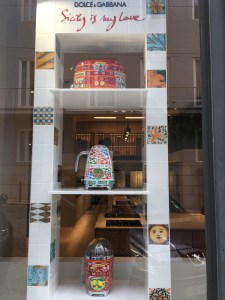
Wouldn’t it be great to have appliances like these?
Here are some ceramics which caught my eye in Évora:

Put on your sunglasses for this one:

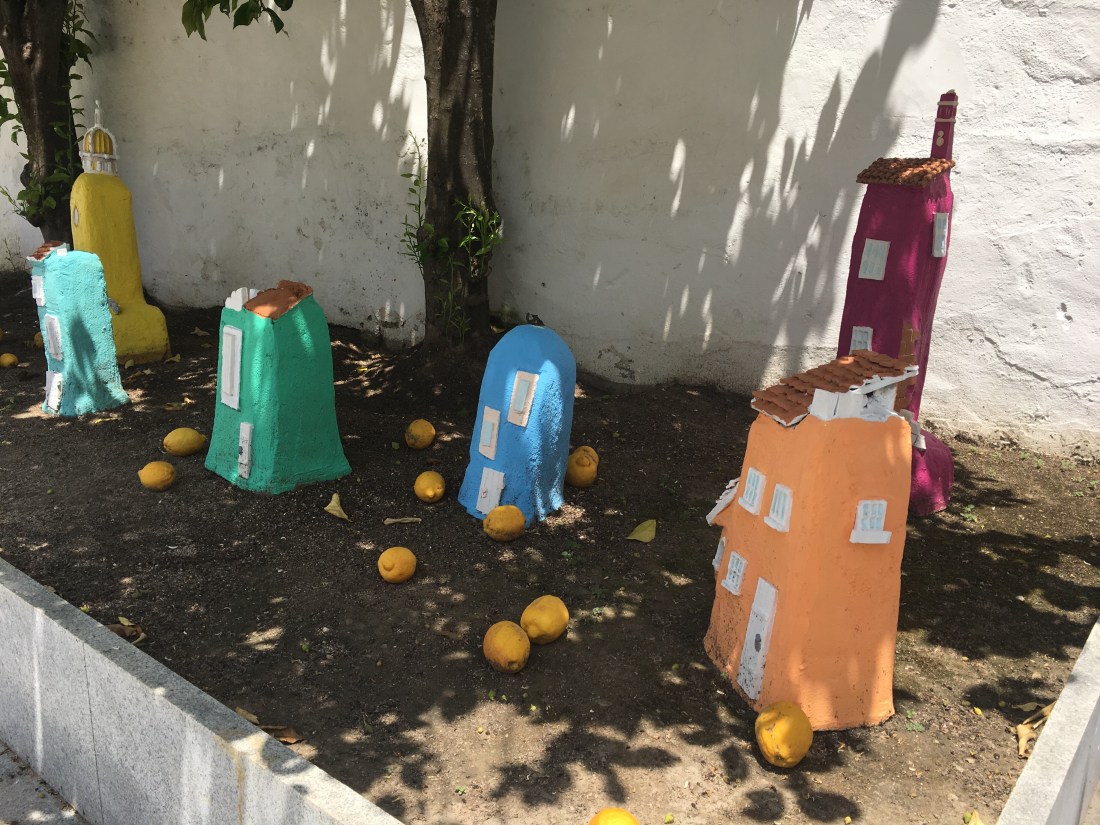
Under two tall lemon trees, with huge lemons on the ground all around them, were these little ceramic houses:
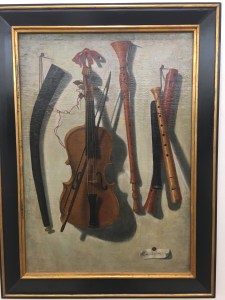
I once photographed a beautiful trompe l’oeil painting in the Louvre, and today, in the Museu Évora, I saw this:
This painting of The Last Supper uses much more plausible or real characters than most such paintings which I suspect have been commissioned to reflect the faces of the patron and his cohort as disciples of Christ.

The emotions captured by this sculptor are all too real:

And then there’s garden design. It’s nice to be surprised by something different as in Diana’s (the huntress) Garden in Évora. More flower meadow (despite the border) than rigidly planted flower bed.
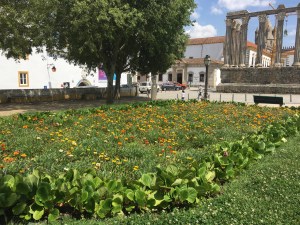
The Roman Temple is in the background. It was uncovered from the various buildings which had been constructed around it.

In repose, enjoying the shade from the 30 degree heat, was this friendly old chap:
Underfoot, the streets in Lisbon have tiled cobblestones – almost fine enough to be tesserae. Here, in Évora, it’s back to basics with stone. Nice.

Ships

Norwegians are amazing. I know, it’s a generalisation, but I’m impressed by their care for the environment, their farming practices, their roadworks and tunnels, their efficiency – doing things thoroughly – and their general nice-ness. They are also tough to survive in the harsh winters. I know that Norway is oil-rich, farming is subsidised, and that it is not a part of the EU, but even so…

Today, the generalisation was made even plainer by visiting two ship museums. First was the Viking Ship Museum which has two original Viking ships recovered from burial mounds.

This vessel had two women buried in it, so they were highly thought of to get such respect paid to them after death. The ship is too big to get in one photo.

It has taken huge amounts of patience, skill and knowledge to piece these ancient ships back together, and they are carefully monitored.

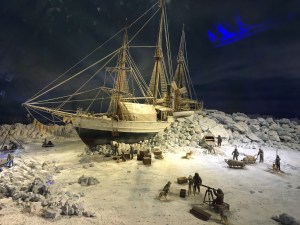
Then, at the Fram Museum, I stepped on board two real ships. The Fram was built to withstand polar ice and fitted out to the last detail by Amundsen. We know him as that Norwegian who pipped Scott at the post. This exhibition shows why. The expedition on the Fram was meticulously equipped, not only to withstand polar ice, but to ensure both the physical and psychological well-being of the people on board. The Norwegians had close knowledge of survival in snow and ice, knew dog-sledding and Nordic skiing and used survival techniques learned from the Inuit.

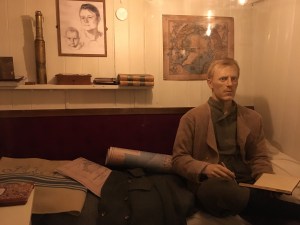
The photo above is a model, but these next ones are inside the actual ship (note the piano).

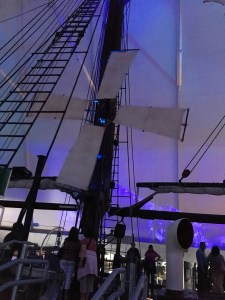
There are tidy compartments for everything. There was even a windmill to generate electricity.

These were two amazing museums to visit, particularly the Fram for its interactive exhibits.

Well done, Norway!

Trolls’ Road

At Geiranger, we went out on the fjord in late afternoon sunshine. This is a freshwater fjord as it extends 150 kilometres inland and is fed by snow melting and the subsequent mountain streams and waterfalls, such as this one. Note the blue ice-melt in the water.

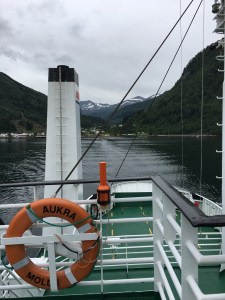
The fjord is deep enough for cruise ships to negotiate.

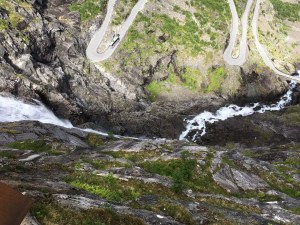
The next morning we took the so-called Trolls’ Road which gives wonderful views, if you can handle the many hairpin bends and the vertigo!

You can cross the fjord by ferry to explore further – the even steeper “Trolls’ Ladder”.

There were many motorbike groups out in very flash bikes, some with sidecars.

I saw one tough rider in full leather gear shakily reaching for the rail of the viewing platform. It doesn’t help that you can see the drop below through the metal grid you are standing on!

Looking over the edge:

On of our group said you can see how the idea of trolls came about when you look at the gigantic mossy rocks (and maybe squint a bit).

Can you see it?

Plants in Scandinavia

Plants have caught my eye in many places. In the cities, such as Copenhagen, plant shops spill out onto the pavement.

People find places for them, such as in pots on apartment balconies or in courtyards.

These tiny tomatoes are perfect for a balcony.

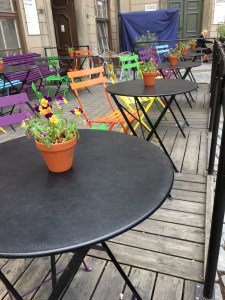
On this Stockholm cafe’s tables, the violas match the chairs.

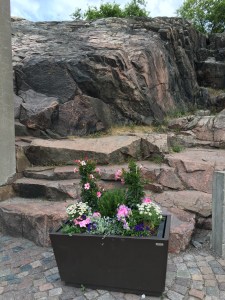
Pots are everywhere on streets in Finland too, such as here in Helsinki .

Wildflowers are everywhere in the Finnish countryside:

They grow on turf roofs too.

These alpine plants were at Alta, Norway:

This one, someone said, is cotton grass:

On a street corner in Trondheim, I spotted these colourful flowers, with matching cushions:
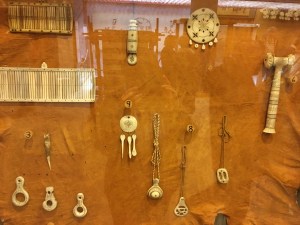
There’s an app for identifying plants, but it might diminish the wonder and strange-yet-familiar appreciation I have for each little gem, such as these mosses and tiny flowers at Geiranger Fjord, Norway.

Old and new

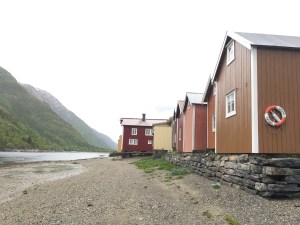
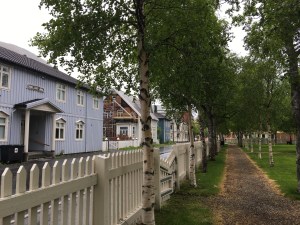
Very few towns in Norway are very old, due to the devastation caused during the Second World War. There are some charming older areas, however, with mainly wooden buildings. My early morning walk in Mosjoen brought up memories of Arrowtown.

Farms and villages we passed on the road south looked traditional with a white farmhouse and red barns, only a few sheep or the red Norwegian cattle, and fields on a thankfully smaller scale than ours.

There is a strong sense that Norwegians live in the natural environment rather than clear-felling and replanting it to assert some kind of dominance. Perhaps it is because the climate is harsh and there’s no ignoring metres of snow on your house and months of darkness.

Norway is rich in oil, which means agriculture doesn’t have the same place as it does in our economy. Here’s an oil rig being constructed.

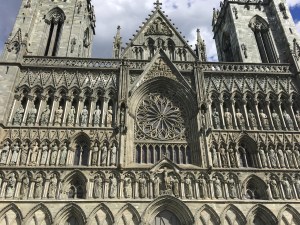
Trondheim has an old cathedral built on King Olaf’s grave, but much of it is recently reconstructed, such as the figures on the facade.

And, always, there is a memorial of war.

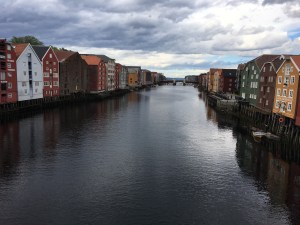
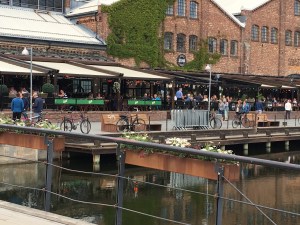
There is a lovely old town along the Nidelva River in Trondheim, buzzing with student life and a bit of Friday evening pre-weekend excitement.

I climbed the hill to Kristiansten Fortress and was rewarded by a women’s choir singing, and the view.

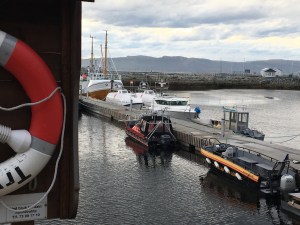
I spotted a classic boat and a modern catamaran moored at Trondheimsfjord waterfront. Old and new.

Fjords

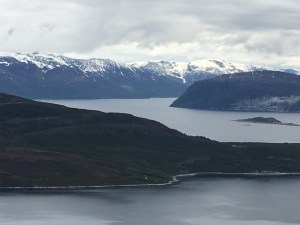
We are travelling down the west coast of Norway through fjord after fjord after fjord after…

We cross from one peninsula or island to another through tunnels or over suspension bridges.

Having a front seat in the bus today was a bonus.

There are lots of roadworks. Here, a helicopter lifts a small vehicle at a tunnel-building site:
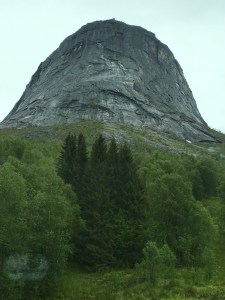
These massive rock mountains are awe-inspiring. I get the feeling that the glacial action which produced them was much earlier than that in New Zealand. My Sixth Form Geography is proving useful.

There are streams and waterfalls around every corner in the road, and charming fishing and farming villages (with sheep!). This is Narvik, which we approached by an alpine train from the Swedish side of the border.

The photo above was taken at 3am. It doesn’t get dark at night.

Here’s our group queuing for the loo before driving our bus onto the Tysfjord ferry.

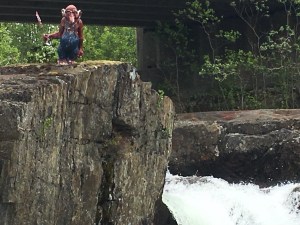
The shapes of the mountains make you think of trolls and, sure enough, here’s one at the waterfall which powers a small hydropower station.

It is quieter where the water flows into the fjord.

This is my favourite scene today:

We ended the day by crossing back over the Arctic Circle.

The Sami people of Lapland

North of the Arctic Circle the presence of the Sami is particularly felt. Their lives as nomadic reindeer herders is not so much evident, but the reindeer are – and where they are, there are reindeer farmers, such as this man at the reindeer farm we visited.

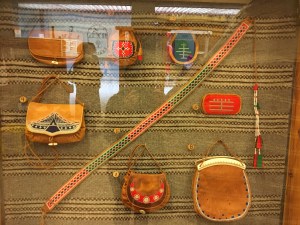
This image is from the Karasjok Sami Museum.

Once we were on Mageroya Island, reached by a series of tunnels, reindeer were often seen grazing on the low-growing alpine vegetation. There were many with calves at foot. I didn’t manage a photo, as the little brown ones were well camouflaged, and I was too busy looking at them all.

On our way to North Cape, we stopped at the Sami Museum in Karasjok. This town is the Sami centre, the place of their parliament, even though they spread across borders from Russia, through Finland, Sweden and Norway.

Our guide was a Sami woman.

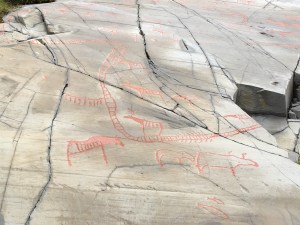
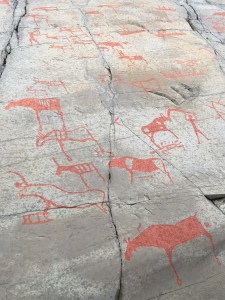
Today in Alta, we visited the UNESCO World Heritage rock carvings site. Although it is not proven that it was early Sami who did these carvings, the reindeer herding images are a visual link for us as visitors. The reindeer fences, which we have seen, are an example of this link.

Teepees are scattered about the landscape throughout Northern Finland and Norway, often modern representations.

This later one is the headquarters of the people who make the famous ice hotel each year.

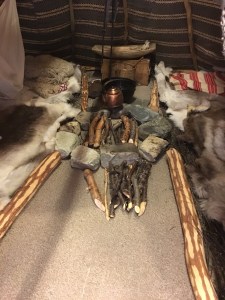
Again, here the Sami reindeer lifestyle is represented, if in an around-the-campfire way. Sami were more likely to be keeping warm around the fire inside the teepee.

Puffins!

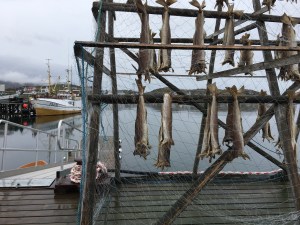
We set off in fine drizzle on a calm sea in Ola’s sturdy boat. Cod was drying on racks on the wharf.

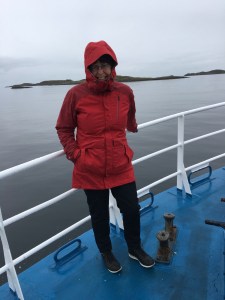
I was well-prepared with layers of merino, Macpac parka and waterproof shoes. While others remained in the cabin (it was freezing) nothing was budging me from the prow; I was getting the most out of the experience!

My camera phone proved unequal to the task: hard to use with cold hands and wet gloves, and suddenly out of charge. I did get this though:

How cool is that?! The puffins are smaller than I expected, but I was delighted to hear that there are half a million breeding pairs on these off-shore islands and the numbers have remained steady in recent years. The green cliff face where they have their burrows looks like the Hilton for puffins.

I also learnt about the razorbills and saw cormorants, guillemots, gannets, herring gulls, magnificent white-tailed eagles (one caught a puffin), kittiwakes and grey seals.

Not having the camera as a distraction was great; I could really look.

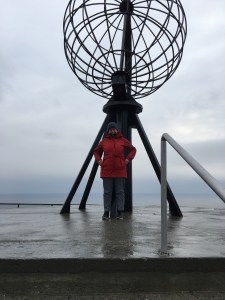
We went out to North Cape later that night where I found this useful information:

And here I am standing on the northern tip of Europe and feeling on top of the world!

Wildlife and forests

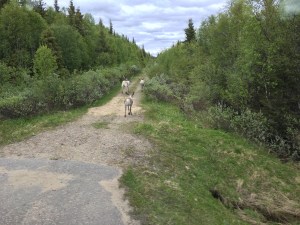
There are signs along the highway warning of moose crossing. We saw moose in a sanctuary but not in the wild. Today, however, we had to stop twice for reindeer crossing the road.

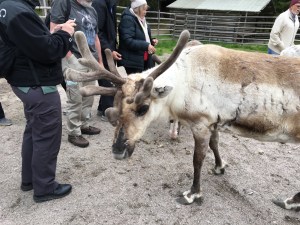
We visited a reindeer farm for a closer look.

The reindeer all belong to someone and are ear marked, but wander freely through the forest – no fences, no trespass orders – and keeping track of your reindeer is even achieved with GPS these days. I’m not sure how land ownership works here, but anyone is entitled to pick berries anywhere in the forest and everyone has access to beaches and riversides. There is forest everywhere you look, except in the towns, although they are built alongside lakes and rivers which are lined with trees. This is Kuopio from the tower.

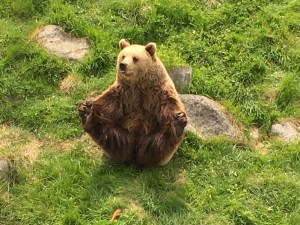
Many wild life are endangered, and we saw these rescued animals in Ranua Wildlife Sanctuary.

This impressive moose is in the wonderful Arktikum Museum in Rovaniemi.

Toys, trolls and dolls

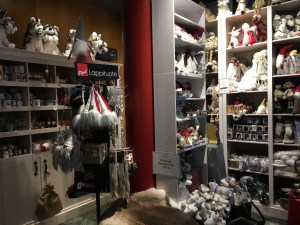
There are the odd gems amongst the souvenir tat. Once you brace yourself for the cliches, stereotypes and anthropomorphism you can get some simple enjoyment from some of the merchandise.

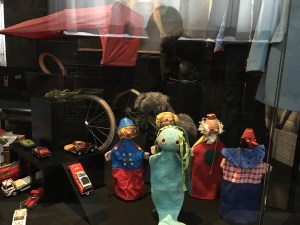
These were some of the crown prince of Denmark’s toys in an exhibition for his 50th birthday.

These made me smile:

High cute factor applied to violent history – and rolling pins?!! Really?

Children’s literature gets lots of attention:

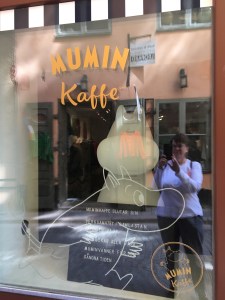
There are Moomins (recently a personal favourite) everywhere. There are even Mumin cafes. (Altered spelling for copyright reasons, perhaps?)

At the Vasa Galleon Museum, a cut-away model showed life on board in miniature.

And the anthropomorphic lynx – on the end of our beds at the hotel in Helsinki. (Gave some of us a bit of a start at first glance.)

The Hotel Santa Claus was full of it – even elves popping out of the bar ceiling.

Or on hallway walls, such as this elf on a watering can.

Sometimes it’s a little overwhelming.

Sometimes it’s charming and magical.