Tove Jansson

I have just finished reading Tove Jansson: Life, Art, Words by Boel Westin.

Tove Jansson in her studio in Helsinki

The book is a lengthy, layered work which builds up a comprehensive picture of Tove Jansson and her work. The detail and academic depth of analysis by Westin adds to the pleasure of reading this biography. It reveals how Jansson’s work is intensely personal but shaped by a clear artistic drive and painstaking skill. Jansson’s motivation to work and love is evident in her work and her life despite enormous challenges, particularly living through the war in Helsinki (when she was brave enough to send up both Hitler and Stalin in her cartoons).

Throughout her life, island summers gave her the space she needed and reminded me of the little island houses I saw when in Finland last year, and brought back detail from The Summer Book by Tove Jansson which I read while I was there.

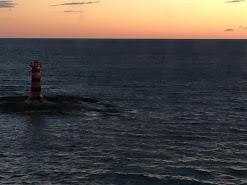
The illustrations of the sea in the Moomin books are like my sea views from the overnight ferry to Helsinki. The sun never quite set all night.

The colour plates in the biography added more fascinating detail, as did the illustrations throughout. I watched a BBC documentary about Jansson after I’d finished the book and was pleased to find that Boel Westin (she is Professor of Literature at Stockholm University) was a commentator throughout. There was also archival footage, particularly of the island, but also of Jansson’s mother and niece who, it turns out, were the two main characters in The Summer Book.

The Moomin machine keeps turning out more cartoons and films, but the original work is the real thing. 
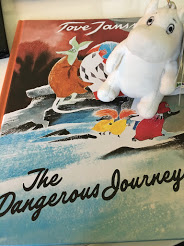
Jansson’s art work was a revelation – not just in the Moomin books and comic strips, but the murals, self-portraits, seascapes and illustrations.

She kept working right into her eighties – mainly on her writing in her later years. She wrote novels and short stories which I am looking forward to reading. I have this collection of short stories ready to go. Great title.

Pavlova Postscript

While nations not far from us contend with fires, floods and, no doubt, famine, we continue the pavlova conversation.

It turned out that the last of Mum’s pavlovas survived the breakfast ravages for a left-over evening meal on Boxing Day. Talk turned to the pavlova bake off, and it was suggested that Mum’s two collapsed pavlovas had been photographed from an unflattering angle (see previous post).

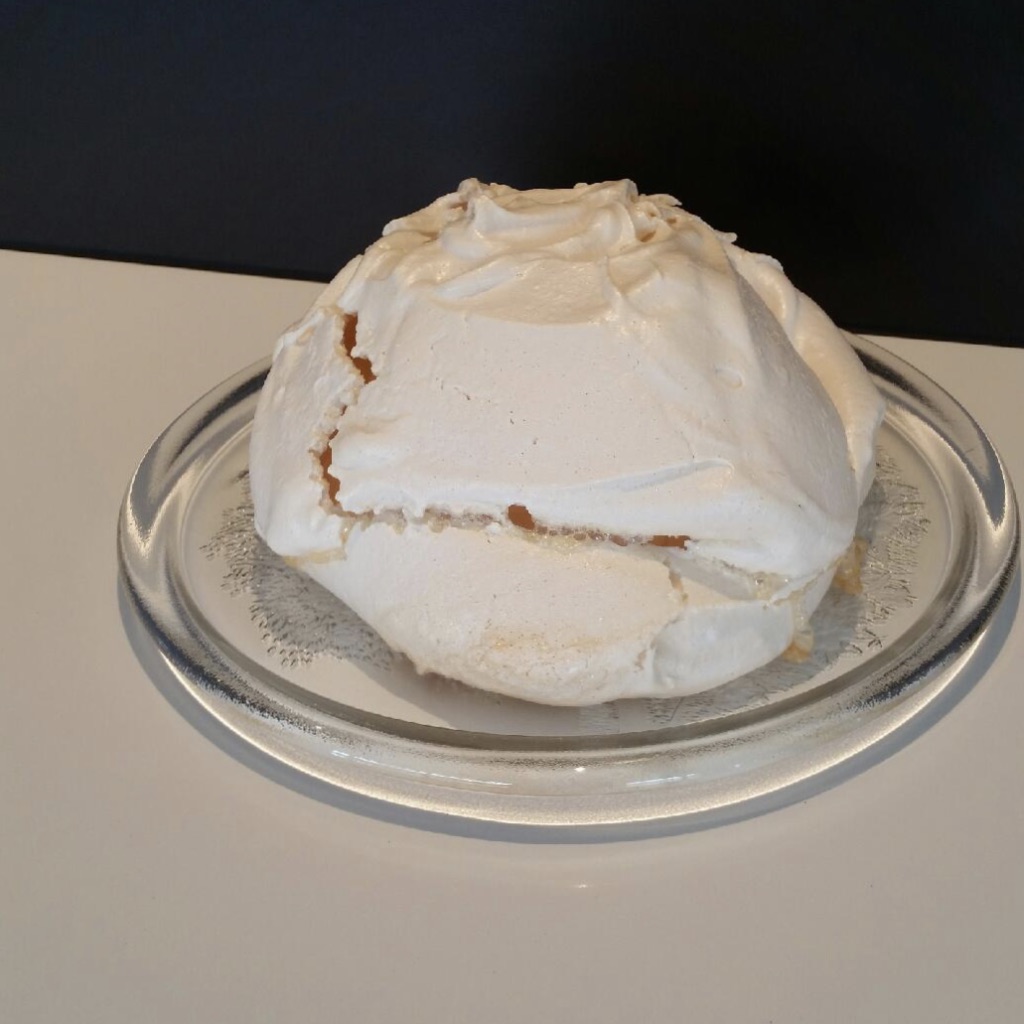
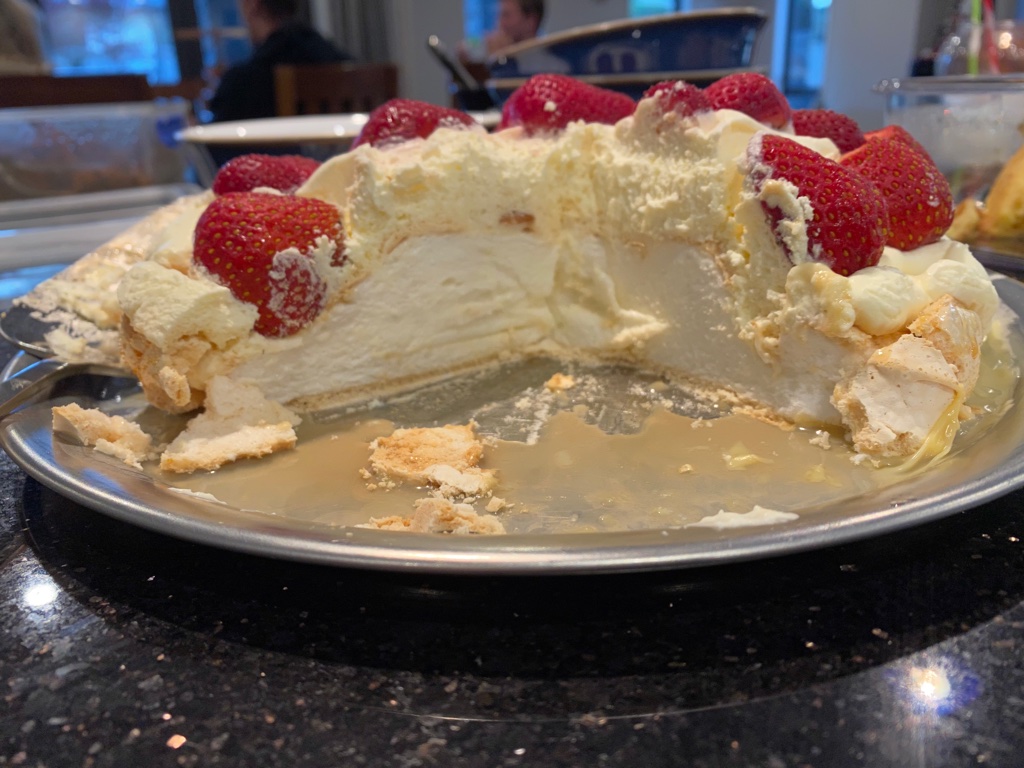
So, here is the final image on the subject, with an eye-level cross section of Mum’s pavlova.

It was still delicious two days after baking and one day after applying the toppings.

Both pavlovas pass the all-important taste (caramel, cream and fruity tang) and tactile (soft and crunchy) test and Mum’s legacy will continue to delight from generation to generation at every special occasion.

Pavlova Bake Off

My younger brother thinks he may have proved himself a worthy apprentice to Mum in pavlova making. He sent me this photo of the freshly-baked base:

I compared it to the two pavlovas Mum had just made:

My sister reckons it’s all down to how slowly you add the sugar. One tablespoon at a time, with a minute between each addition, seems to work. Other theories are that the eggs must be room temperature and there must be no trace of yolk in the separated egg whites.

The problem with a “high” pavlova (as opposed to Mum’s “flatties”) is getting the cream and strawberries to stay on the top. After a couple of “avalanches” the top was finished. This picture shows my brother’s finished pavlova and another of Mum’s specialties, Christmas pudding, which my brother also cooked to perfection. The recipe is our favourite: the Overnight Pudding in the old Edmond’s Cookery Book.

My brother’s pavlova also passed the taste test with its pillowy centre and crisp edge.

Mum’s were equally deliciously, and the last one is probably being polished off for Boxing Day breakfast by my nephews as I write!

Pavlovas by Grandma

Mum’s pavlovas are world-famous in our family. Her grandchildren love them, as we did as children (and still do…)

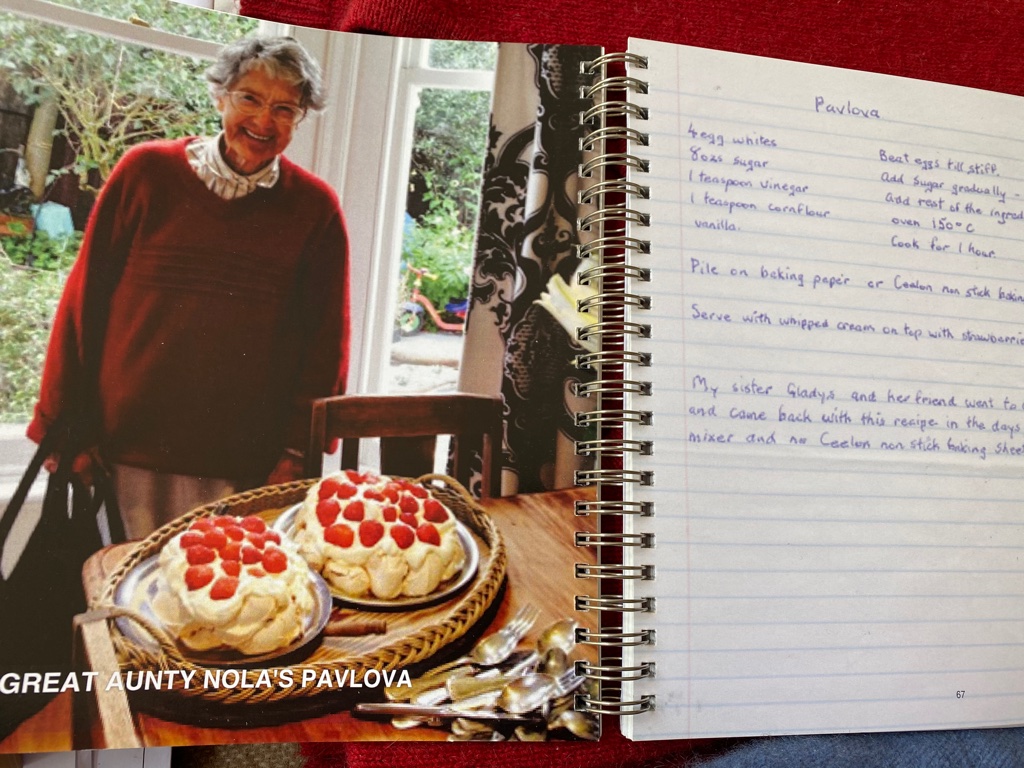
In 2013, Mum’s great-niece, Emma, made a book of family recipes. Here is the photo Emma used and Mum’s handwritten recipe.

Below the recipe, Mum recalls that her sister, Gladys, brought the recipe home to Invercargill after a holiday with a friend’s aunt in Akaroa. In those days, the pavlova was cooked in a coal range – and there was no Kenwood mixer or non-stick baking sheets.

Today, it was amusing to photograph the Christmas pavlovas cooking, as I couldn’t avoid the reflection of us on the oven door peering into the oven.

The Women’s Institute tea towel is most appropriate. What could be more inspiring than Mum’s pavlovas?

Small Delights

A week retired, and what have I done? I’ve been delighting in small details. Here are some of them.

After about four hours’ steadily-paced work, a neatly stacked wood pile.

Welcome rain, and a freshly washed garden seen from inside a warm house.
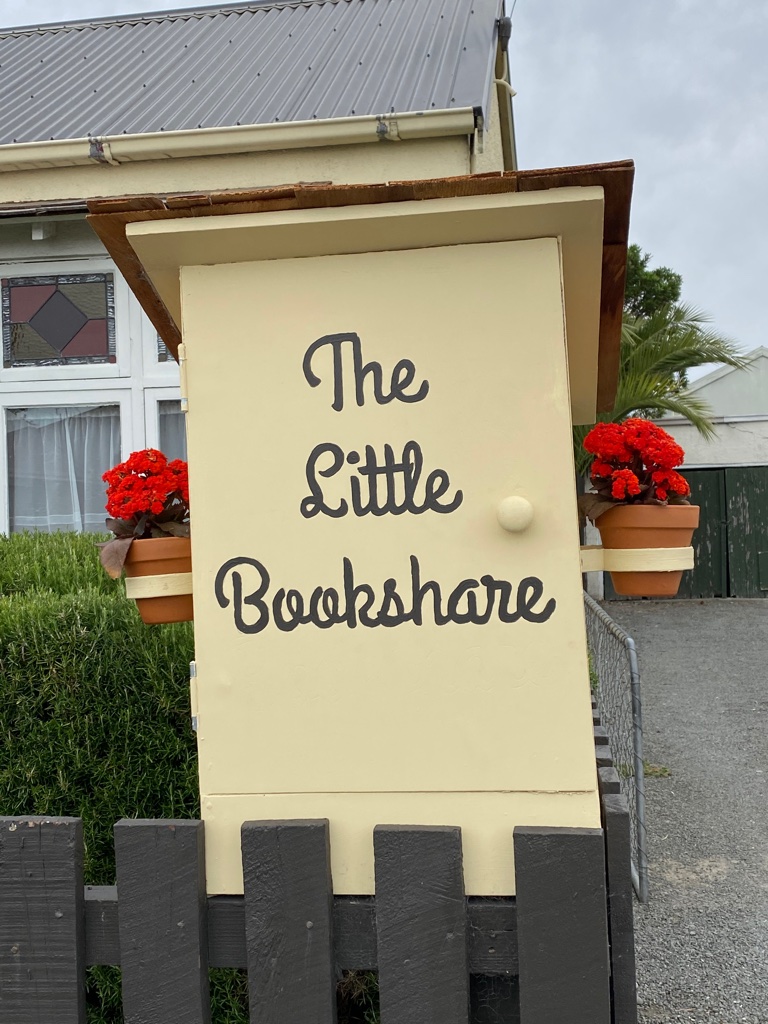
On a nearby street, this little delight – with flower pots! Someone loves books.
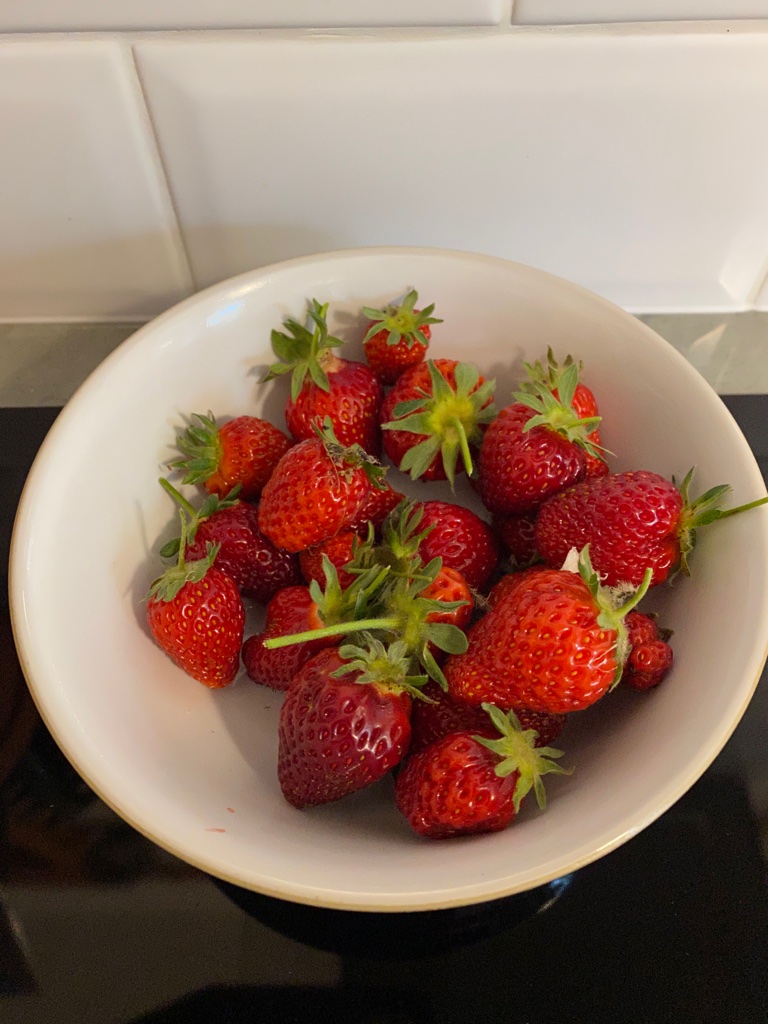
Back at home, a freshly-picked bowl of strawberries:

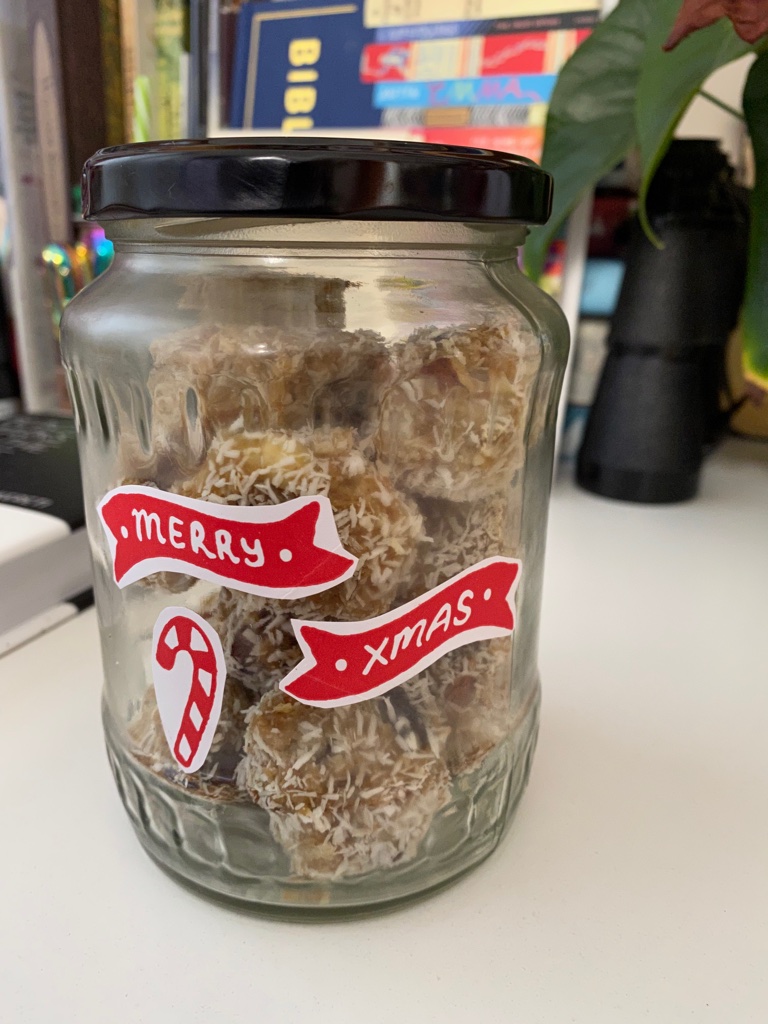
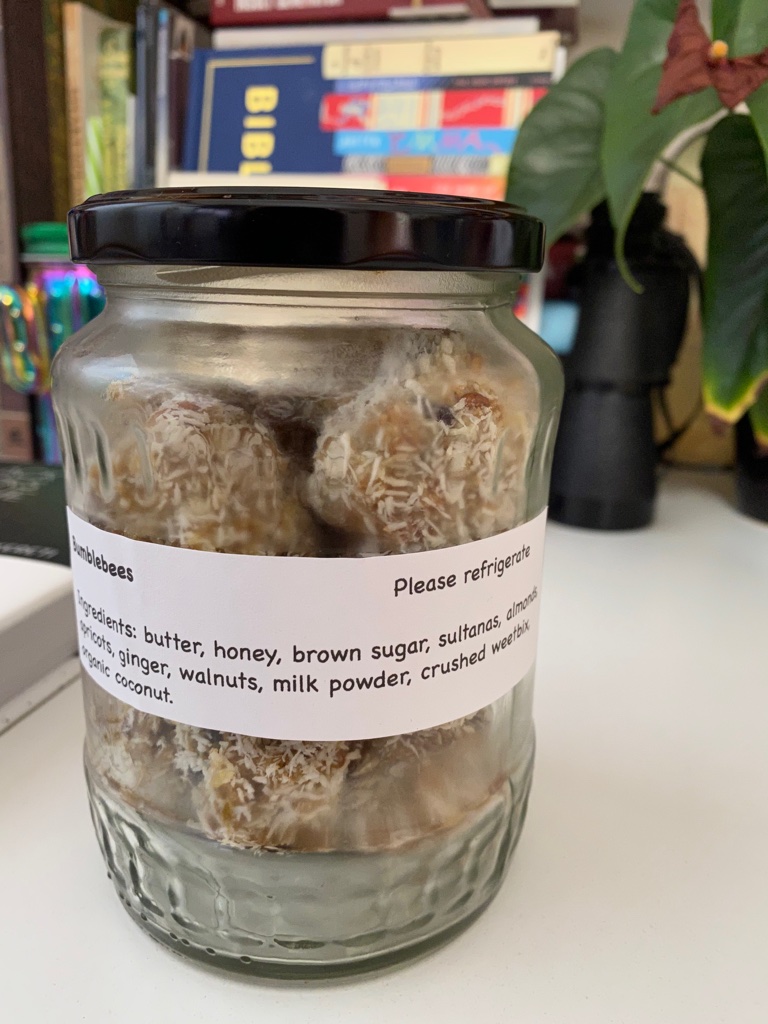
Making home-made Christmas gifts to delight someone else:

With time for the details: decoration and labels.

Out and about on a sunny day, strolling through a street market:

Eating whitebait fritter sandwiches while enjoying a ukulele street band.

Being delighted by opportunist wild flowers as we go to pay tribute to an old friend.

Taking selfies and delighting that we don’t quite get it right!

Admiring fabulous street art.

Being delighted again that readers just want to share!

And bringing home a locally made delight:

An excess of delightfulness – and these are a small sample. Is this what retirement is all about?

Retro Charm

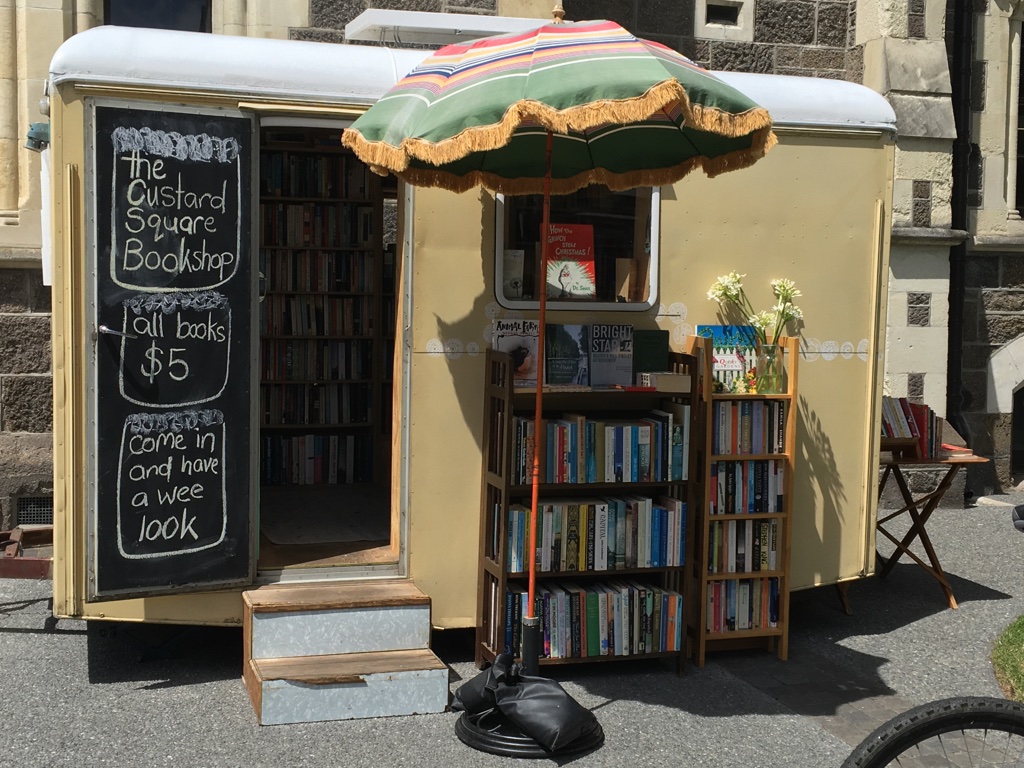
This tiny bookshop is mimicking a large custard square and parked at the Arts Centre. The books are interesting and familiar titles. The shelves outside have Christmas-themed books suitable for gifts. They are protected from the sun by a similarly retro sun-umbrella, complete with fringe.

The Custard Square Bookshop

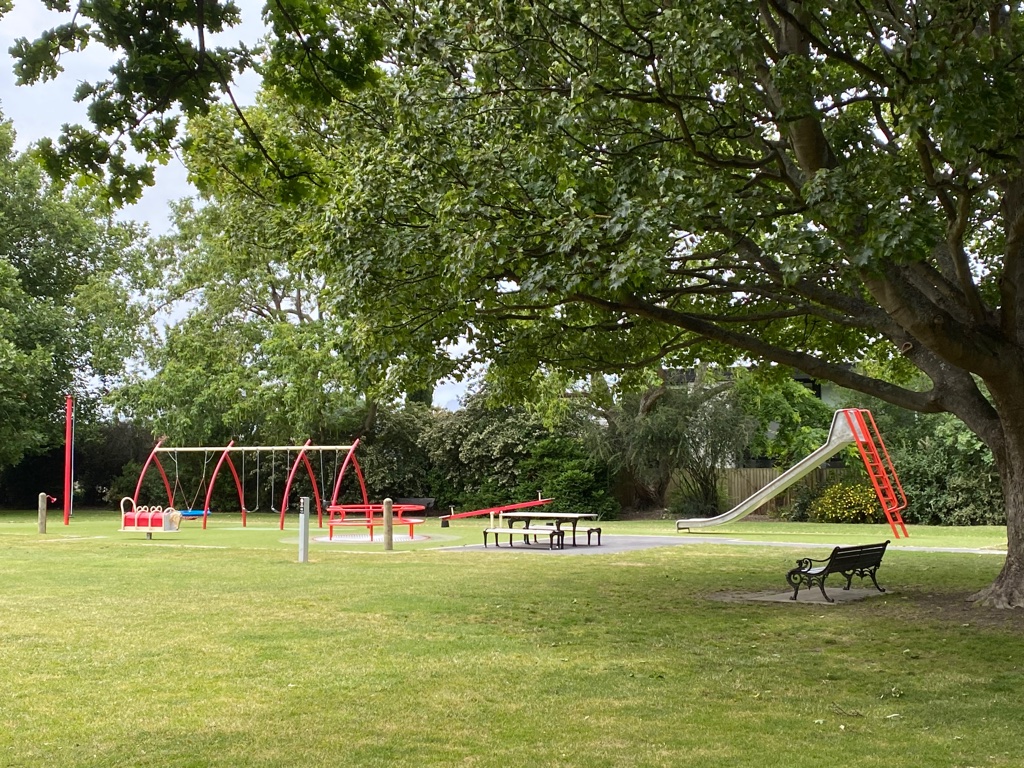
The following day, while walking home through my local park, I stopped to take a photo of the new playground. While it is new, it has been designed with a retro look to fit with the traditional style of the park which features a cast-iron bollard-and-chain fence and a parterre-style rose-garden – and these lovely spreading trees for shade.

Abberley Park

Fun Finish

There was lots of laughter as the costumes of each department were revealed on the last day. There were hippies, Mexicans (one genuine), a sports team featuring the periodic table (guess which department that was!), cats, Little Misses, Where’s Wallies, and “We love Annies” – a surprise from my department who told me to just dress as I liked.

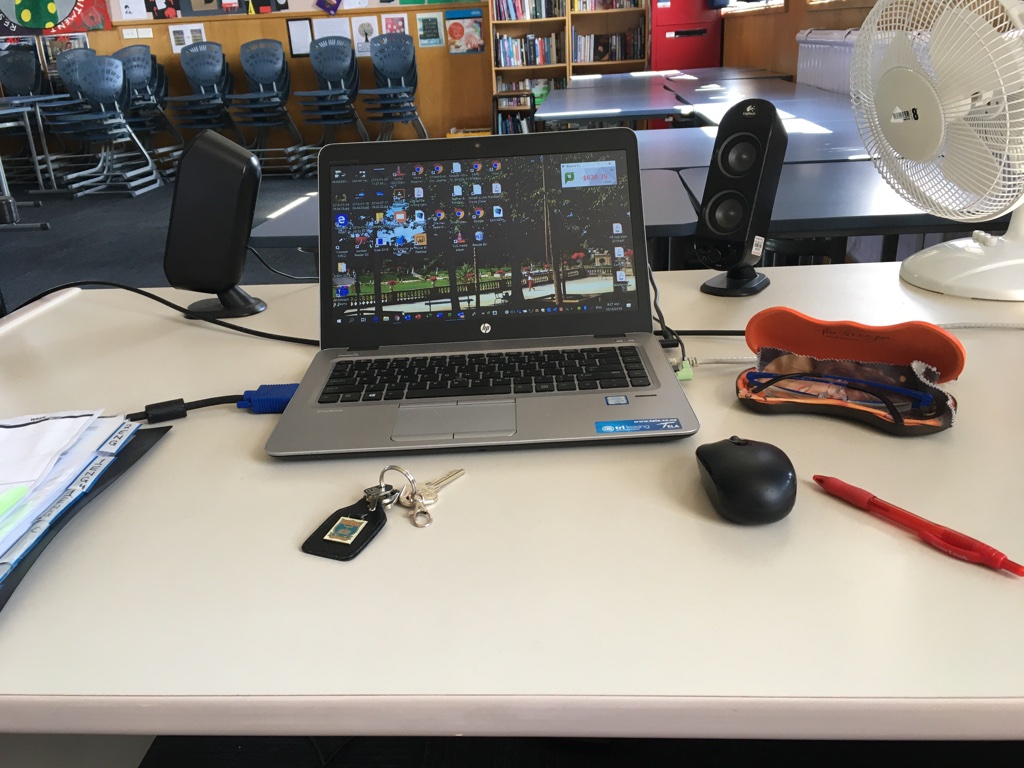
I took one last photo of my laptop and keys before turning them in.

My plan book and red pen were significant objects in my photo!

With farewell speech and final prize giving over, it was lovely to relax and have fun on this last day. There were carols and dances, games, food and drink at a gorgeous vineyard.

Carol singers warming up

What an amazing, creative bunch of people to have fun with.

A well-rehearsed routine – a tribute to our dance teacher who is returning to Canada

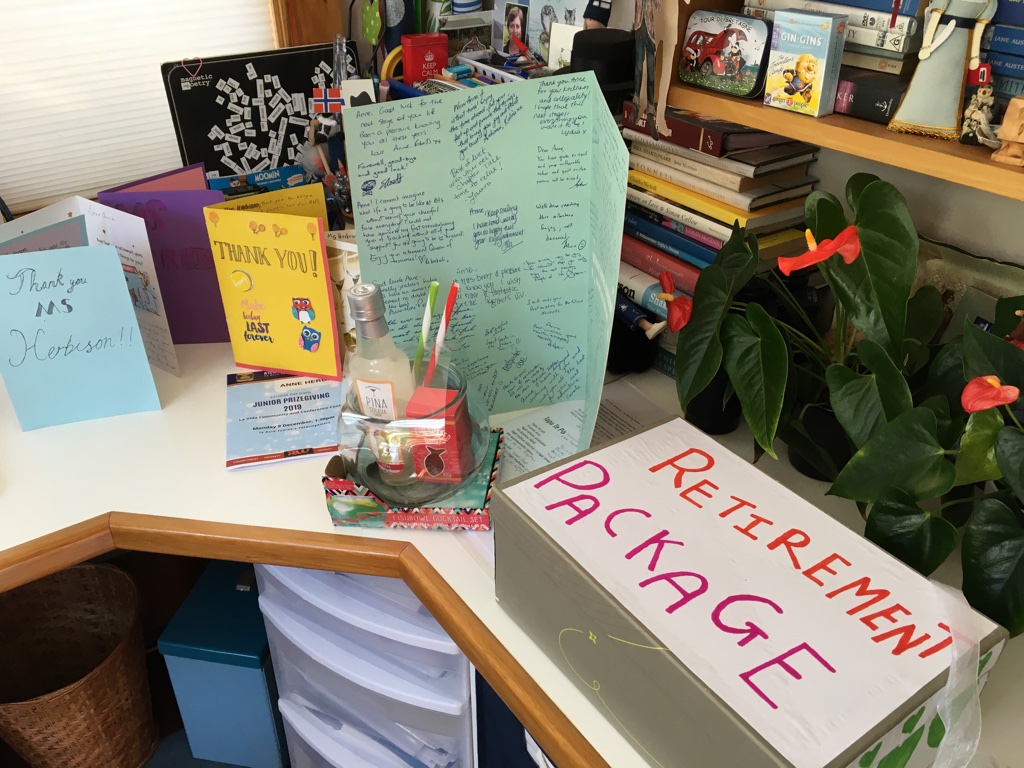
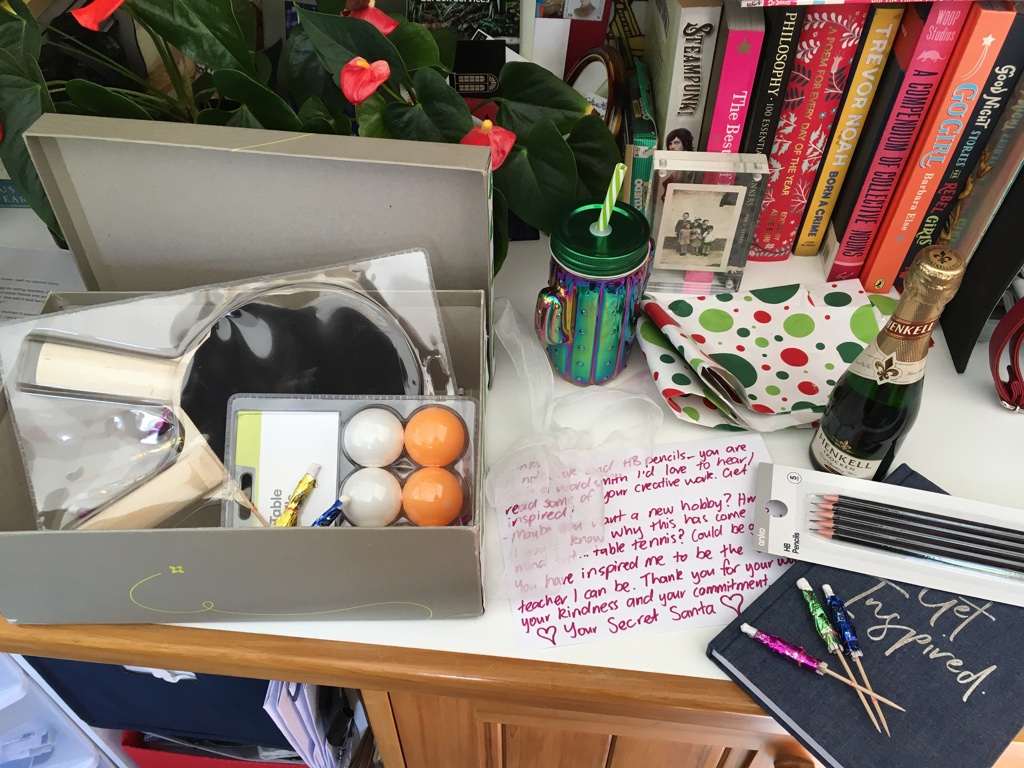
Then there was the fun of Secret Santa gifts.

Captain of the Good Ship English Dept

My Secret Santa revealed her identity to me (after a few wines). She put heaps of effort into this and gave me yet another happy-sad moment!

It was doubly special because she is a former student!

A fabulous finish.

Photo-bombed by Wally!

Making room

In October 2016, the front of my classroom looked like this:

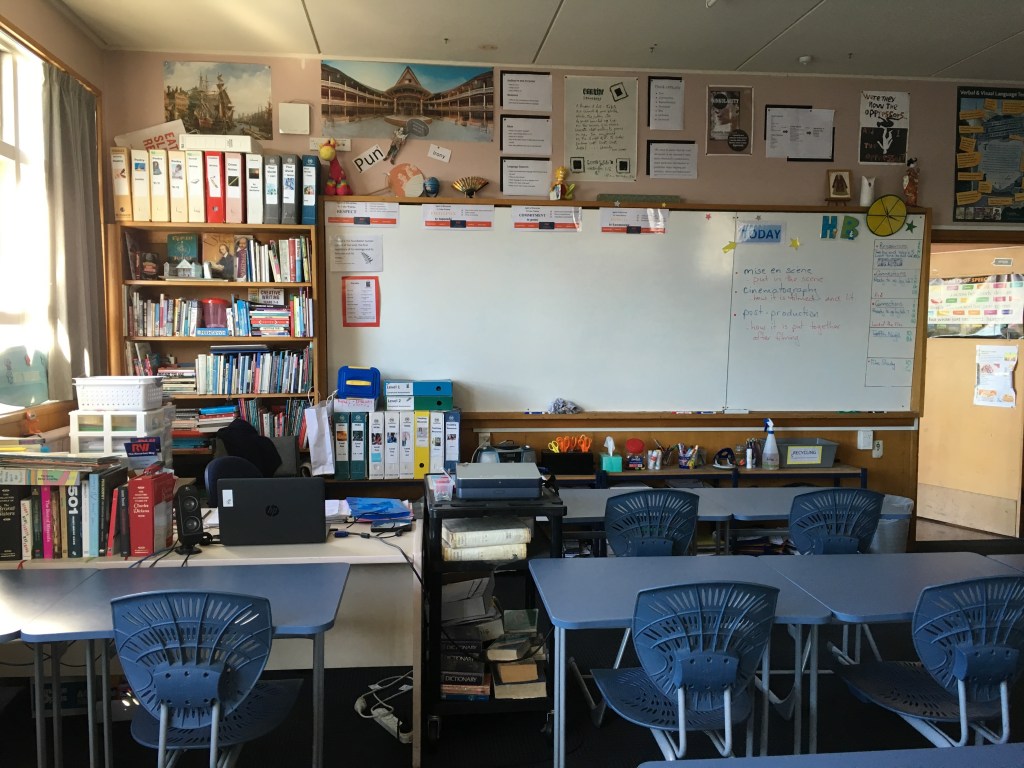
Today, in November 2019, nearly all cleared out before I retire (17 school days to go), this is how it looks:

Places have been found for my resources – often the recycling bin – but others have been saved, at least for now. Some books have been shelved with our teacher resources, others have been brought home as references for my continued learning. Resources I have created which remain current have been filed digitally on our shared drive or in hard copies.

The time is right to make room for the next teacher. Both of us will be making a fresh start.

The view from my home office window

Bits and pieces

There is something appealing about a jar full of bits and pieces. This one sits on the garage window sill. When I find something small and interesting, it goes in the jar for the day when it might be useful for something or other. The lightbulb serves as a lid.

Also on the garage window sill are these three pieces of crockery found in the garden. There’s a sailor wearing a three-cornered hat, playing the hornpipe, a woman outside a cottage, and a pennant design. Does anyone know anything about this porcelain?

Old secateurs make a crooked line-up. Hanging to the side of the door below the weed hooks, those iron claws are an old pair of crampons from Emei Shan, China, on which my companions and I slid on ice as we attempted to climb the mountain (unsuccessfully – the crampons wouldn’t stay on). The mosaic below is made of bits and pieces of tile.

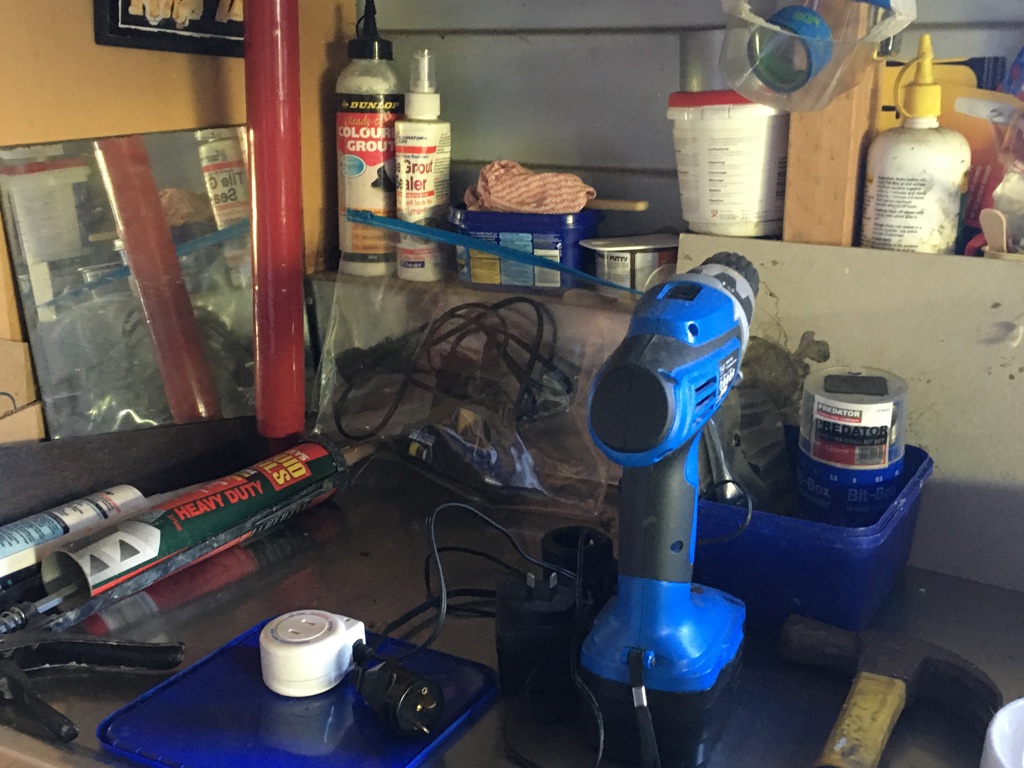
House maintenance tools make another bits-and-pieces corner (pun intended). The red pole used to be a roller towel holder. It now supports the corner of the shelf above.

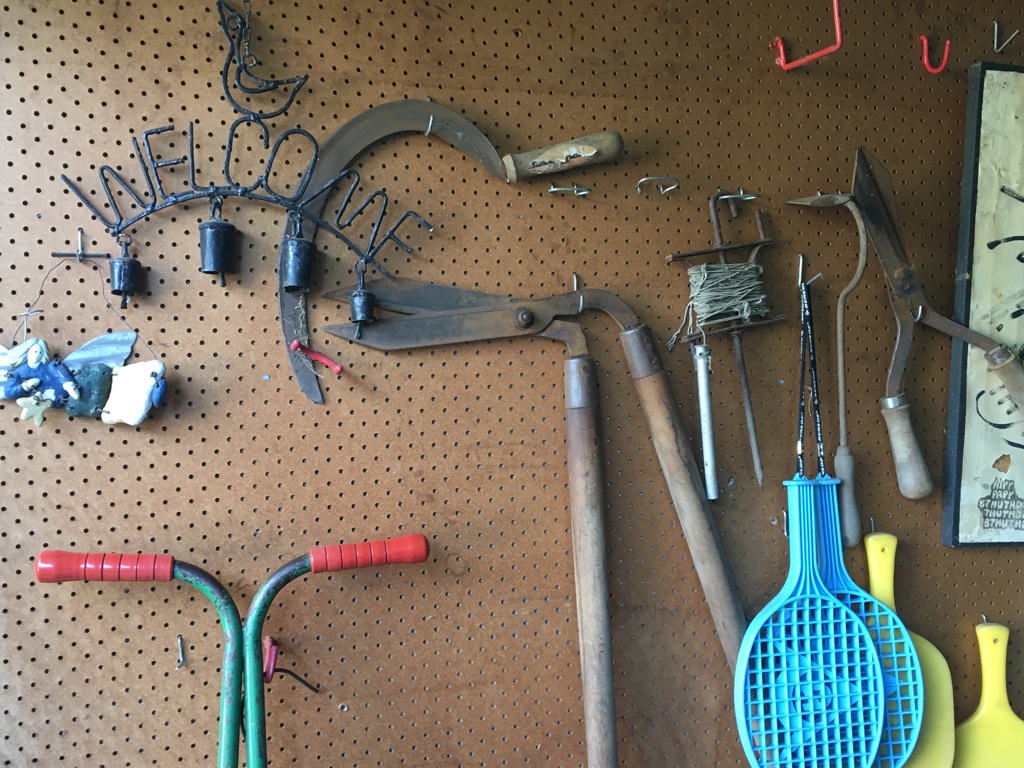
Then there’s the museum of Dad’s old tools on a peg board – alongside the anachronistic swing ball bats which have been idle since the pole broke.

From my childhood, there’s a wooden-framed tennis racket in a press. I remember putting protective tape along the top edge. Below it is my old canvas and leather external-frame tramping pack. I’ve walked many tracks with it, from Stewart Island to Abel Tasman National Park. The damp-damaged block-mounted prints have been kept simply because they are more interesting than the blank, unpainted garage wallboard!

There are people who make works of art out of bits and pieces. In November 2000, I bought this sculpture called Orville’s Dream. Can you identify the bits and pieces?

Orville’s Dream by Neil Ensor
Metal Assemblages from Found Material

Plus one!

The reason I went around the garden looking for flowers to photograph for my previous post, was this:

Cauliflower

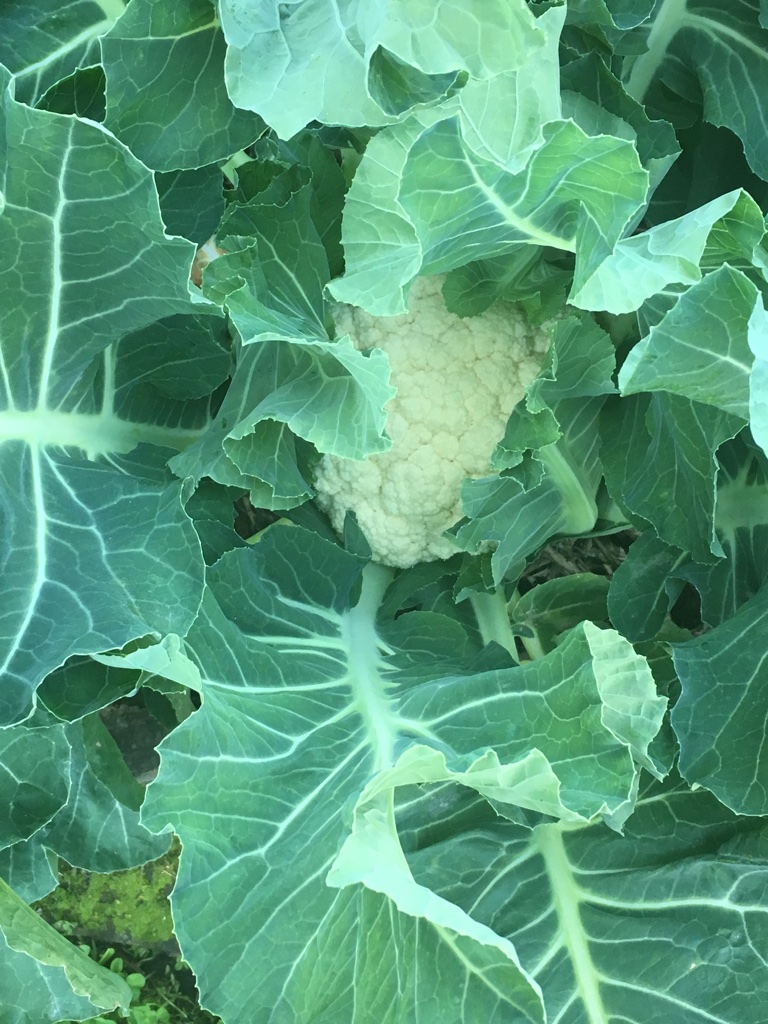
In April, my sister and my nephew helped me to dig up some lawn and extend the vegetable patch. I planted a lime tree and sweetpeas, and curly kale, rainbow chard and cauliflower. This is the first cauliflower in the new patch. I’ve been inspecting the plants regularly – while I hang washing out – and there it was, suddenly, already rather large. Magic!